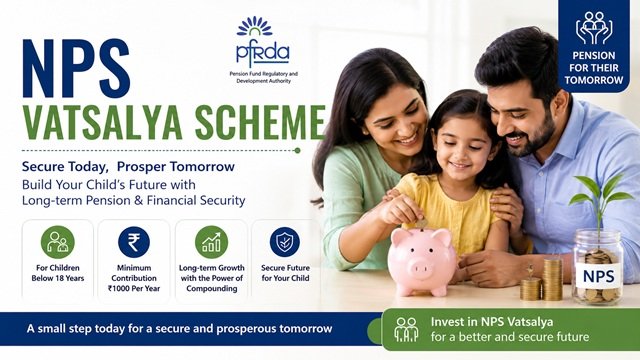
NPS Vatsalya is a government-backed pension and long-term financial security scheme launched for children below 18 years of age under the National Pension System framework. Through this scheme, parents or legal guardians can start retirement-focused investments for children from an early age with a minimum contribution of ₹1000 per year. The scheme also allows seamless transition into a regular NPS account after the child turns 18 years old.
NPS Vatsalya Scheme Highlights | |
|---|---|
| Scheme Name | NPS Vatsalya Scheme (National Pension System Vatsalya) |
| Scheme Type | Child Pension and Long-Term Financial Security Scheme |
| Announced In | Union Budget 2024-25 on 23 July 2024 |
| Launched By | Union Finance Minister Smt. Nirmala Sitharaman |
| Launch Date | 18 September 2024, New Delhi |
| Regulated By | Pension Fund Regulatory and Development Authority (PFRDA) |
| Legal Framework | PFRDA Act 2013, Section 12(1)(a) and Section 20 |
| Eligible Beneficiaries | All minors below 18 years, Resident Indians, NRIs, and OCIs |
| Who Can Open an Account | Parent or Legal Guardian |
| Minimum Contribution | Rs. 1,000 per year |
| Maximum Contribution | No upper limit |
| Partial Withdrawal | Up to 3 times, after 3 years, max 25% of own contributions |
| Exit at 18 | 80% annuity + 20% lump sum (if exiting) OR seamless transition to NPS Tier-I |
| Application Mode | Online (eNPS Portal) and Offline (PoP/Banks) |
| Online Portal | enps.nps-proteantech.in |
| NPS Toll-Free | 1800 110 708 |
Introduction of NPS Vatsalya Scheme: A Brief Insight
NPS Vatsalya is a long-term pension and financial security scheme launched by the Government of India for children below 18 years of age under the National Pension System (NPS) framework, regulated by the Pension Fund Regulatory and Development Authority (PFRDA). The scheme allows parents or legal guardians to start retirement-focused investments for children from an early age and build a long-term financial corpus through disciplined contributions and market-linked growth.
The word “Vatsalya” comes from Sanskrit and represents parental affection and care towards children. The Government introduced the scheme with the vision of encouraging financial literacy, disciplined savings habits, and long-term financial planning for minors under the broader vision of Viksit Bharat@2047. Finance Minister Smt. Nirmala Sitharaman announced the scheme during the Union Budget 2024-25 and officially launched it on 18 September 2024 in New Delhi.
Unlike traditional savings schemes that mainly focus on short-term goals, the NPS Vatsalya Scheme works as a retirement-oriented investment framework for children. The scheme uses the power of long-term compounding because investments started during childhood may continue growing for several decades under the NPS structure. Parents can choose pension fund managers and investment options according to their financial planning preferences.
One of the biggest advantages of NPS Vatsalya is its flexibility. Parents can start contributions with a minimum annual investment of ₹1000, while the scheme does not impose any upper contribution limit. The account can also seamlessly continue as a regular NPS Tier-I Account after the child attains 18 years of age, which allows long-term retirement planning continuity.
The scheme also includes several unique features rarely seen in child-focused financial schemes. Relatives and friends can contribute to the account as gift contributions, NRI and OCI minor subscribers are eligible, and partial withdrawals are allowed for specific situations such as education or medical emergencies after completion of the prescribed lock-in period.
NPS Vatsalya also becomes important for families already exploring long-term pension and social security schemes such as Atal Pension Yojana and the recently introduced NPS Sanchay Scheme. While Atal Pension Yojana focuses mainly on pension security for workers in the unorganised sector and NPS Sanchay simplifies retirement savings for informal sector subscribers, NPS Vatsalya specifically focuses on building financial discipline and retirement wealth for children from an early age.
Parents can open the account either online through the official eNPS portal or offline through authorised banks and registered Points of Presence (PoPs). The guardian manages the account until the child becomes an adult, after which fresh KYC formalities allow seamless transition into the regular NPS structure.
NPS Vatsalya has quickly gained attention because it combines child-focused financial planning, pension-based investing, tax benefits, and long-term wealth creation within a government-regulated framework. Families who want to explore more pension, savings, insurance, and welfare initiatives can also visit our All Welfare Schemes List of Central Government section for more scheme-related information and updates.
Benefits Provided to Eligible Beneficiaries
NPS Vatsalya Scheme helps parents create a long-term financial security corpus for their children through disciplined pension-based investments from an early age. The scheme combines the power of compounding, flexible contributions, and market-linked wealth creation under the regulated National Pension System (NPS) framework managed by PFRDA.
- Parents can start investing for children from an early age and build long-term retirement wealth
- The scheme promotes financial literacy and disciplined savings habits among children
- Minimum annual contribution starts from just ₹1000
- There is no maximum contribution limit under the scheme
- Parents can choose pension fund managers and investment options according to their financial goals
- The account invests across equity, corporate bonds, government securities, and other approved asset classes
- The account seamlessly transitions into a regular NPS Tier-I account after the child turns 18 years old
- Parents may claim tax benefits under applicable provisions of the Income Tax Act under the old tax regime
- Relatives and friends can also contribute to the child’s account as gift contributions
- NRI and OCI minor subscribers are also eligible under the scheme
- The scheme allows partial withdrawals for specific situations, such as education or medical emergencies, after completion of the prescribed lock-in period
The biggest advantage of NPS Vatsalya lies in the power of long-term compounding. If parents begin contributions from childhood and continue investments regularly for decades, the accumulated retirement corpus may grow significantly over time through disciplined long-term investing.
Eligibility Conditions Required to be Fulfilled
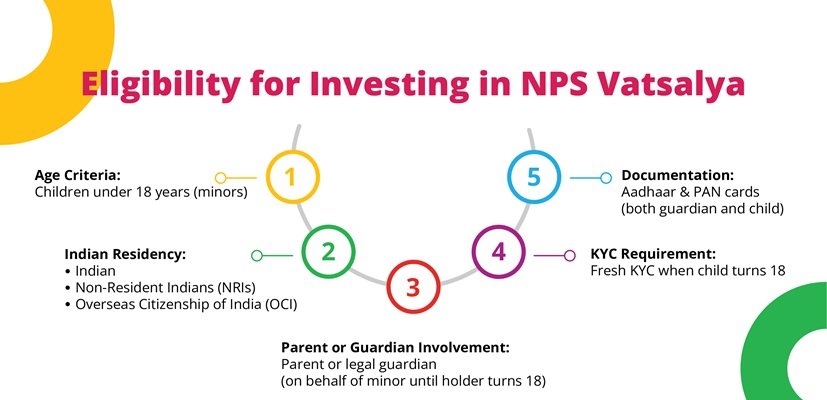
NPS Vatsalya is a special pension and long-term financial security scheme designed exclusively for minors. Parents or legal guardians can open and manage the account on behalf of the child until the child attains 18 years of age.
- The subscriber must be below 18 years of age at the time of account opening
- Resident Indian minors can apply under the scheme
- Non-Resident Indian (NRI) minors are also eligible
- Overseas Citizen of India (OCI) minors can also open an NPS Vatsalya account
- The parent or legal guardian must open and operate the account on behalf of the minor
- Only one NPS Vatsalya account can be opened for one child
- The account operates exclusively for the benefit of the minor subscriber
- Guardian must complete KYC verification during account opening
- Fresh KYC of the subscriber becomes mandatory after attaining 18 years of age
After the child turns 18 years old, the NPS Vatsalya account can seamlessly transition into a regular NPS Tier-I account under the All Citizen Model after completion of fresh KYC formalities.
Documents Required to be Attached
Parents or legal guardians need to submit KYC and identity-related documents of both the minor subscriber and the guardian while opening an NPS Vatsalya Scheme account. The Pension Fund Regulatory and Development Authority (PFRDA) allows account opening through online as well as offline modes.
Documents Required for the Minor Subscriber
- Birth Certificate
- School Leaving Certificate
- Matriculation Certificate
- PAN Card (if available)
- Passport
- Recent Passport Size Photograph
Documents Required for Parent or Legal Guardian
- Aadhaar Card
- PAN Card
- Voter ID Card
- Passport
- Driving Licence
- Address Proof
- Recent Passport Size Photograph
- Mobile Number and Email ID
Bank Account Related Requirement
- Minor’s bank account is optional for resident Indian subscribers during account opening
- A bank account becomes necessary at the time of partial withdrawal or exit before attaining 18 years of age
- NRI or OCI subscribers must provide NRE or NRO bank account details
Applicants should ensure that all KYC details remain updated because fresh KYC verification becomes mandatory once the subscriber attains 18 years of age and transitions into the regular NPS framework.
How Beneficiaries Can Apply to Avail the Benefit of this Scheme
Parents or legal guardians can open an NPS Vatsalya account either through online mode using the official eNPS Portal or by visiting authorised banks and Points of Presence (PoPs) registered under the National Pension System framework.
Online Process to Open NPS Vatsalya Account
Step 1: First, visit the official eNPS Portal from your mobile phone or computer.
Step 2: Select the option related to NPS Vatsalya registration for minor subscribers.
Step 3: Enter all required details of the child such as name, date of birth, address, and identity information carefully according to official documents.
Step 4: Fill in the parent or legal guardian details, including Aadhaar, PAN, mobile number, and address information.
Step 5: Upload required documents related to both the child and guardian, including birth certificate, identity proof, address proof, and photographs.
Step 6: Complete the Aadhaar-based or PAN-based KYC verification process through the portal.
Step 7: Choose the preferred pension fund manager and investment option available under the NPS framework.
Step 8: Deposit the minimum contribution amount. According to official guidelines, parents need to contribute at least ₹1000 per year under the scheme.
Step 9: Review all entered information carefully and submit the application form online.
Step 10: After successful verification and payment, the system generates a PRAN (Permanent Retirement Account Number) in the child’s name. This PRAN becomes the permanent pension account number of the subscriber.
Offline Process Through Bank or Point of Presence (PoP)
Step 1: Visit the nearest authorised bank, post office, or Point of Presence (PoP) registered under the NPS framework.
Step 2: Ask for the NPS Vatsalya registration form from the concerned official.
Step 3: Fill all required details related to the minor subscriber and guardian carefully.
Step 4: Attach all required KYC documents, photographs, and supporting papers along with the application form.
Step 5: Submit the minimum contribution amount and complete verification formalities at the centre.
Step 6: After successful processing of the application, the PRAN gets generated and the NPS Vatsalya account becomes active.
Important Points Parents Should Know
- The guardian operates the account until the child attains 18 years of age
- Fresh KYC of the subscriber becomes mandatory after attaining majority
- The account can seamlessly continue as a regular NPS Tier-I Account
- Relatives and friends can also contribute to the account as gift contributions
- Parents can contribute higher amounts because the scheme has no maximum investment limit
Applicants should always use official platforms such as PFRDA, authorised CRA portals, registered PoPs, and the official eNPS Portal while opening the account.
Partial Withdrawal Rules Under NPS Vatsalya Scheme
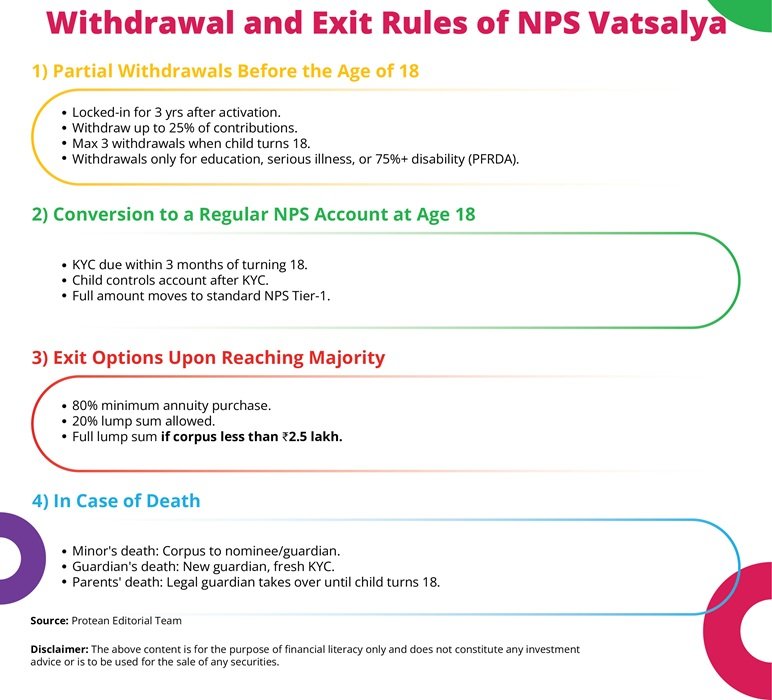
PFRDA allows a partial withdrawal facility under NPS Vatsalya for specific contingency situations after completion of the prescribed lock-in period. This feature gives families limited financial flexibility during serious situations such as education or medical emergencies.
- Partial withdrawal becomes available after completion of at least 3 years from the date of account opening
- Subscribers can withdraw up to 25% of their own contributions, excluding investment returns and appreciation
- The facility is available for specific purposes such as education, medical treatment, disability-related situations, and other approved contingency conditions
- Partial withdrawal can generally be availed up to 3 times before the subscriber attains 18 years of age, according to official guidelines
- Applicants need to submit a declaration and supporting documents while requesting withdrawal
The withdrawal rules ensure that most of the accumulated retirement corpus remains invested for long-term wealth creation while still providing limited support during genuine financial emergencies.
What Happens When the Child Turns 18 Years Old?
One of the most important features of NPS Vatsalya is that the account does not automatically close when the child attains 18 years of age. Instead, the subscriber gets the option to seamlessly continue the account under the regular National Pension System framework.
After turning 18 years old, the subscriber must complete fresh KYC verification within the prescribed timeline. Once the KYC process gets completed successfully, the NPS Vatsalya account can transition into a regular NPS Tier-I Account under the All Citizen Model.
The subscriber can then independently continue contributions, choose investment preferences, and manage the account like a standard NPS subscriber.
If the subscriber decides not to continue under the regular NPS structure, exit rules become applicable according to official guidelines. In such cases, at least 80% of the accumulated corpus must be utilised for annuity purchase, while a maximum of 20% can be withdrawn as a lump sum amount.
The seamless transition feature makes NPS Vatsalya different from many traditional child savings schemes because the account can continue supporting long-term retirement planning even after the subscriber becomes an adult.
Tax Benefits Available Under NPS Vatsalya
NPS Vatsalya also provides tax-related advantages for parents or guardians contributing towards the child’s pension account under the old tax regime. The scheme operates within the National Pension System framework, regulated by PFRDA.
- Parents or guardians may claim tax deduction benefits under applicable provisions of the Income Tax Act
- Additional deduction up to ₹50,000 may become available under Section 80CCD(1B) according to existing NPS tax provisions
- Partial withdrawals allowed under prescribed conditions may receive tax exemption benefits as per applicable rules
- Annuity purchase at the time of exit also receives tax treatment according to prevailing NPS regulations
Applicants should consult tax professionals or financial advisors for updated tax treatment and eligibility under the latest income tax rules before claiming deductions.
Can Relatives and Friends Contribute to NPS Vatsalya?
Yes. NPS Vatsalya includes a unique feature under which relatives and friends can also contribute money to the child’s pension account as gift contributions. This feature makes the scheme different from many traditional child savings and pension products available in India.
Grandparents, relatives, family members, and close friends can support the child’s long-term financial future by contributing towards the NPS Vatsalya account during birthdays, festivals, special occasions, or family events.
The gift contribution feature helps families gradually build a larger long-term retirement corpus for children through disciplined investing and the power of compounding over several decades.
NPS Vatsalya vs Sukanya Samriddhi Yojana – Which is Better for Your Child?
Many parents compare NPS Vatsalya with Sukanya Samriddhi Yojana (SSY) before deciding. Here is a clear comparison to help you understand the key differences :
| Feature | NPS Vatsalya | Sukanya Samriddhi Yojana |
| Eligible Beneficiary | All minors below 18 years (boys and girls) | Girl child only (below 10 years at account opening) |
| Scheme Purpose | Long-term retirement savings and pension | Education and marriage expenses of girl child |
| Minimum Contribution | Rs. 1,000 per year | Rs. 250 per year |
| Maximum Contribution | No upper limit | Rs. 1,50,000 per year |
| Returns | Market-linked (variable) | Fixed government interest rate (currently 8.2% per annum) |
| NRI/OCI Eligible | Yes | No |
| Partial Withdrawal | Yes (after 3 years, up to 25% own contributions) | Yes (50% after girl turns 18 for education) |
| Maturity | At 18 – transitions to NPS Tier-I or exit | 21 years from opening (or marriage after 18) |
| Regulator | PFRDA | Ministry of Finance / Post Offices and Banks |
NPS Vatsalya is better for parents who want to build long-term retirement wealth for their children using market-linked growth, while Sukanya Samriddhi Yojana is better for parents of girl children who want guaranteed fixed returns for education and marriage goals. Both schemes can be held simultaneously.
Important Links Available
- NPS Vatsalya Official Scheme Page.
- Apply Online for NPS Vatsalya Scheme Through eNPS Portal.
- NPS Vatsalya Official FAQs.
- NPS Vatsalya Scheme Guidelines.
- PFRDA Official Website.
Contact Details in Case of Help Needed
- NPS Toll-Free Number: 1800 110 708
- Phone Number: 011-26517501, 011-26517503
- SMS Service: Type NPS and send to 56677
- Address: 5th Floor, Tower E, World Trade Center, Nauroji Nagar, New Delhi – 110029
- PFRDA Official Contact Page.
Frequently Asked Questions (FAQs)
Q. What is the NPS Vatsalya Scheme?
Ans. NPS Vatsalya is a long-term pension and financial security scheme launched by the Government of India for minors below 18 years of age under the National Pension System framework, regulated by PFRDA.
Q. Who can open an NPS Vatsalya account?
Ans. Parents or legal guardians can open the account on behalf of children below 18 years of age.
Q. What is the minimum contribution required under NPS Vatsalya?
Ans. According to official guidelines, parents need to contribute a minimum of ₹1000 per year under the scheme.
Q. Is there any maximum investment limit under the scheme?
Ans. No. NPS Vatsalya does not impose any maximum contribution limit.
Q. Can NRI and OCI children open NPS Vatsalya accounts?
Ans. Yes. Resident Indian, NRI, and OCI minor subscribers are eligible under the scheme.
Q. What happens when the child turns 18 years old?
Ans. After attaining 18 years of age, the account can seamlessly transition into a regular NPS Tier-I Account after completion of fresh KYC formalities.
Q. Can relatives or grandparents contribute to the account?
Ans. Yes. Relatives and friends can also make gift contributions to the NPS Vatsalya account.
Q. Is partial withdrawal allowed under NPS Vatsalya?
Ans. Yes. Partial withdrawal is allowed after completion of the prescribed lock-in period for specific purposes such as education, medical emergencies, and other approved contingency situations.
Q. Is NPS Vatsalya a guaranteed return scheme?
Ans. No. NPS Vatsalya is a market-linked investment scheme and returns depend upon market performance and pension fund management.
Q. Which authority regulates NPS Vatsalya?
Ans. The Pension Fund Regulatory and Development Authority (PFRDA) regulates the NPS Vatsalya Scheme under the National Pension System framework.

Tabassum is a government schemes researcher and writer with 5 years of experience tracking Central and State welfare scheme programmes across India. She has covered 500+ schemes spanning agriculture, women welfare, education, and housing, helping lakhs of beneficiaries understand their entitlements in simple language.