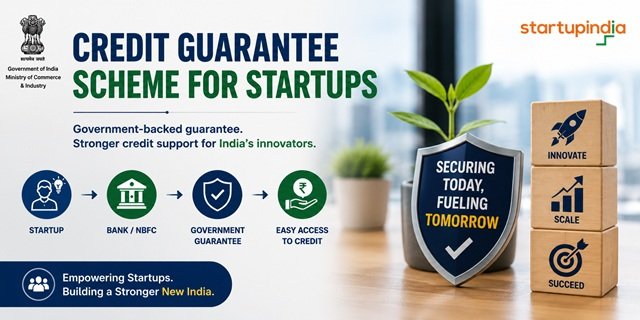
Credit Guarantee Scheme for Startups (CGSS) is a government-backed credit guarantee framework launched by DPIIT under which eligible banks, NBFCs, and venture debt funds receive guarantee cover to provide collateral-free loans up to Rs. 20 crore to DPIIT-recognised startups. The scheme is operated by the National Credit Guarantee Trustee Company Limited (NCGTC) and helps startups access institutional debt funding without pledging assets as security.
Credit Guarantee Scheme for Startups Highlights | |
|---|---|
| Scheme Name | Credit Guarantee Scheme for Startups (CGSS) |
| Notified By | Department for Promotion of Industry and Internal Trade (DPIIT), Ministry of Commerce and Industry |
| Original Notification Date | 6 October 2022 |
| Operationalised From | 1 April 2023 |
| Expansion Notified | 9 May 2025 |
| Operated By | National Credit Guarantee Trustee Company Limited (NCGTC) |
| Main Objective | Provide government-backed guarantee cover to enable collateral-free debt funding for DPIIT-recognised startups |
| Maximum Guarantee Cover | Up to Rs. 20 crore per eligible borrower |
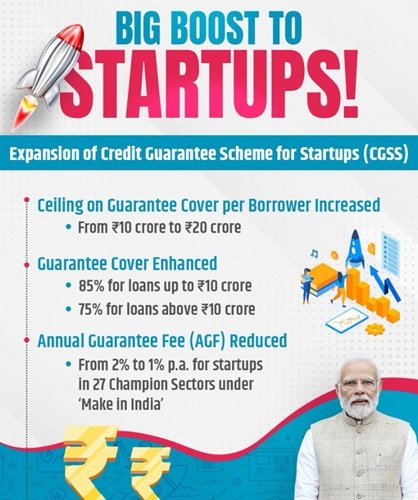
| Guarantee Coverage | 85% for loans up to Rs. 10 crore, 75% for loans above Rs. 10 crore |
| Annual Guarantee Fee | 2% per annum for general startups, 1% per annum for startups in 27 Champion Sectors |
| Eligible Member Institutions | Scheduled Commercial Banks, NBFCs, SEBI-registered Venture Debt Funds under AIFs |
| Types of Loans Covered | Venture debt, working capital, term loans, subordinated debt, mezzanine debt, debentures |
| Mandatory Prerequisite | DPIIT Recognition under Startup India |
| Loans Guaranteed So Far | 330 plus loans worth over Rs. 800 crore |
| Apply Through | Eligible Member Institution or Jan Samarth Portal |
| Official Scheme Page | startupindia.gov.in |
| NCGTC Page | ncgtc.in |
Introduction of Credit Guarantee Scheme for Startups: A Brief Insight
One of the biggest challenges young startups face in India is not the lack of ideas but the lack of access to debt funding. Banks and financial institutions are often reluctant to lend to early-stage businesses because startups typically have no physical collateral, no long credit history, and carry higher business risk. The Credit Guarantee Scheme for Startups (CGSS) was introduced by the Government of India specifically to address this problem.
CGSS was notified by the Department for Promotion of Industry and Internal Trade (DPIIT), Ministry of Commerce and Industry on 6 October 2022 and was operationalised from 1 April 2023. The scheme is operated by the National Credit Guarantee Trustee Company Limited (NCGTC) and provides government-backed guarantee cover to banks, NBFCs, and venture debt funds that lend to DPIIT-recognised startups. On 9 May 2025, DPIIT expanded the scheme and enhanced the maximum guarantee cover from Rs. 10 crore to Rs. 20 crore per eligible borrower.
It is important to understand that CGSS does not give money directly to startups. Instead, the government provides guarantee cover to eligible lending institutions called Member Institutions. When a Member Institution lends to a DPIIT-recognised startup, NCGTC backs that loan with a guarantee. This reduces the lender’s risk significantly and encourages banks and NBFCs to provide collateral-free loans to startups they would otherwise hesitate to fund. The guarantee cover stands at 85% for loans up to Rs. 10 crore and 75% for loans exceeding Rs. 10 crore.
CGSS covers a wide range of debt instruments, including venture debt, working capital loans, term loans, subordinated debt, mezzanine debt, debentures, and optionally convertible debt. This makes it one of the most comprehensive startup debt support frameworks operating in India today. Startups operating in 27 Champion Sectors identified under the Make in India initiative also benefit from a reduced Annual Guarantee Fee of 1% per annum compared to the standard 2% per annum.
The first step to accessing CGSS is obtaining DPIIT recognition. Without a valid DPIIT recognition certificate, no startup can access any benefit under this scheme. Startups that have not yet obtained recognition can apply through the Startup India Portal. Once recognised, startups can explore the complete range of benefits available under the Startup India Scheme, including tax exemptions, compliance relaxations, and IPR fast-tracking.
For startups at a very early stage that need seed-level funding before they are ready to approach banks, the Startup India Seed Fund Scheme provides financial support for proof of concept, prototyping, and market entry through a corpus of Rs. 945 crore distributed via incubators. Startups that have grown beyond the seed stage and need larger growth capital may also explore the Fund of Funds for Startups managed by SIDBI with a corpus of Rs. 10,000 crore. Women entrepreneurs and SC/ST founders looking for business loans can additionally explore the Stand Up India Scheme, which provides loans from Rs. 10 lakh to Rs. 1 crore for greenfield enterprises and PM Mudra Yojana.
As of the latest official data, over 330 loans worth more than Rs. 800 crore have already been guaranteed under CGSS since it was operationalised. This confirms the scheme is actively functioning and providing real credit access to startups across India.
Entrepreneurs and startup founders looking for more funding support, business loan schemes, government guarantee programmes, and Central Government entrepreneurship initiatives can also explore our complete Central Government Schemes List for detailed information according to their business stage and funding requirements.
How the Credit Guarantee Scheme for Startups Actually Works
Most people assume CGSS is a direct loan scheme where the government gives money to startups. That is not how it works. CGSS is a guarantee mechanism that sits between the startup and the lender. Here is the complete flow in simple terms.
A DPIIT-recognised startup approaches an eligible Member Institution, such as a bank or NBFC, for a loan. The Member Institution evaluates the startup based on its own credit assessment framework. If the loan is approved, NCGTC automatically issues a guarantee cover to the Member Institution against that loan. This guarantee cover means that if the startup defaults on the loan, the government will compensate the lender up to the guaranteed percentage of the outstanding amount. Because the lender knows the government backs the loan, it becomes far more willing to lend to startups that have no collateral or a long credit history.
The startup does not interact with NCGTC at any point. The entire guarantee process happens between NCGTC and the Member Institution in the background. From the startup’s perspective, the process feels like any regular loan application except that the chances of approval are significantly higher because of the government guarantee backing the lender’s risk.
Types of Startup Funding Covered Under CGSS
CGSS covers a wide range of debt instruments, which makes it useful for startups at different stages of their business cycle. The following types of funding are covered under the scheme.
- Venture Debt: Debt funding provided to startups alongside or after equity funding rounds, typically used for growth and expansion without further diluting equity
- Working Capital Loans: Short-term funding to manage day-to-day operational expenses such as salaries, inventory, and vendor payments
- Term Loans: Fixed-period loans for capital expenditure, equipment purchase, or business expansion purposes
- Subordinated Debt: Debt that ranks below senior debt in priority during repayment, often used for growth-stage startups
- Mezzanine Debt: A hybrid form of debt that carries higher risk for the lender and is typically used when startups need growth capital without full equity dilution
- Debentures: Fixed-income debt instruments issued by startups to raise capital from financial institutions
- Optionally Convertible Debt: Debt that gives the lender an option to convert the outstanding amount into equity at a later stage
- Other fund-based and non-fund-based facilities, as approved under the scheme guidelines
Startups should discuss their specific funding requirement with the Member Institution to determine which instrument best suits their business stage and capital needs.
Benefits Provided to Eligible Startups
The Credit Guarantee Scheme for Startups provides a government-backed guarantee framework that makes it significantly easier for DPIIT-recognised startups to access institutional debt funding without pledging collateral.
- Startups can access collateral-free loans up to Rs. 20 crore through eligible Member Institutions
- The government provides a guarantee cover of 85% of the amount in default for loans up to Rs. 10 crore
- The government provides a guarantee cover of 75% of the amount in default for loans exceeding Rs. 10 crore
- Startups in 27 Champion Sectors identified under Make in India pay a reduced Annual Guarantee Fee of 1% per annum instead of the standard 2% per annum
- Startups can access multiple types of debt funding, including venture debt, working capital loans, term loans, subordinated debt, mezzanine debt, and debentures
- Lenders face reduced risk due to government-backed guarantee coverage, making them more willing to fund early-stage startups
- Startups with no long credit history or hard collateral can still access institutional financing through the CGSS framework
- Over 330 loans worth more than Rs. 800 crore have already been guaranteed under the scheme since it was operationalised in April 2023
Eligibility Conditions Required to be Fulfilled
Startups must meet the following conditions to become eligible for credit guarantee support under the Credit Guarantee Scheme for Startups.
- A startup must hold a valid DPIIT recognition issued through the Startup India Portal
- A startup must meet the definition prescribed under the DPIIT Gazette Notification and its amendments
- A startup must not be a Non-Performing Asset (NPA) or a defaulting borrower at the time of application
- A startup must satisfy the eligibility and credit assessment criteria set by the Member Institution
- A startup must approach an eligible Member Institution, such as a Scheduled Commercial Bank, NBFC, or SEBI-registered Venture Debt Fund, for the loan
CGSS does not accept direct applications from startups. The guarantee cover is issued automatically through the Member Institution once the startup meets all required eligibility parameters.
Documents Required to be Attached
Startups applying for loans under the Credit Guarantee Scheme for Startups through eligible Member Institutions need to keep the following documents ready for submission.
- DPIIT Recognition Certificate issued through the Startup India Portal
- Certificate of Incorporation or Registration Certificate
- PAN Card of the entity
- Business plan or project report outlining the purpose and utilisation of the loan
- Audited financial statements wherever applicable
- Bank account statements of the entity
- KYC documents of directors or partners
- Details of existing loans or credit facilities, wherever applicable
- Any additional documents required by the Member Institution as per their internal lending protocols
Since CGSS operates through Member Institutions such as banks and NBFCs, the exact document list may vary depending on the lender. Startups should confirm the specific requirements directly with the lending institution before applying.
How Startups Can Apply Under the Credit Guarantee Scheme for Startups
Startups cannot apply directly to NCGTC or DPIIT for guarantee cover under CGSS. The entire process works through eligible Member Institutions. Here is how a startup can access CGSS benefits step by step.
Step 1: Obtain DPIIT recognition through the official Startup India Portal. DPIIT recognition is mandatory before a startup can access any benefit under CGSS.
Step 2: Identify your funding requirement and determine which type of debt support you need, whether working capital, term loan, venture debt, or any other eligible instrument covered under the scheme.
Step 3: Approach an eligible Member Institution such as a Scheduled Commercial Bank, a registered NBFC, or a SEBI-registered Venture Debt Fund operating under an Alternative Investment Fund. You can also apply through the Jan Samarth Portal which connects borrowers with government-backed loan schemes.
Step 4: Submit your loan application along with the DPIIT recognition certificate, business plan, financial documents, and any other documents required by the Member Institution as per their internal lending protocols.
Step 5: The Member Institution evaluates your application based on its credit assessment framework and scheme eligibility parameters.
Step 6: If the loan is approved, the guarantee cover under CGSS is issued automatically by NCGTC to the Member Institution. No separate application to NCGTC is required from the startup.
Step 7: Loan amount is disbursed into the startup’s bank account by the Member Institution after all documentation and verification is complete.
Important Links Available
- Credit Guarantee Scheme for Startups, Official Page on Startup India Portal.
- NCGTC, Credit Guarantee Scheme for Startups, Operational Guidelines and FAQs.
- Apply for DPIIT Recognition, Startup India Portal.
- Jan Samarth Portal, Apply for Government-Backed Startup Loans.
- Startup India Official Portal.
- Department for Promotion of Industry and Internal Trade, DPIIT.
Contact Details in Case of Help Needed
Startups facing issues related to CGSS eligibility, guarantee cover, loan application, or Member Institution queries can contact us through the following official channels.
- Startup India Toll Free Helpline: 1800 115 565 (Available 10:00 AM to 05:30 PM)
- Department for Promotion of Industry and Internal Trade (DPIIT)
Udyog Bhawan, Rafi Marg,
New Delhi 110011 - National Credit Guarantee Trustee Company Limited (NCGTC)
NCGTC Building, Plot No. C-11, G Block,
Bandra Kurla Complex, Bandra East,
Mumbai 400051 - NCGTC CGSS Page: ncgtc.in/en/product-details/CGSS/Credit-Guarantee-Scheme-for-Start-ups-(CGSS)
Frequently Asked Questions (FAQs)
Q. What is the Credit Guarantee Scheme for Startups?
Ans. The Credit Guarantee Scheme for Startups (CGSS) is a government-backed credit guarantee framework implemented by NCGTC under DPIIT that enables DPIIT-recognised startups to access collateral-free debt funding through eligible banks, NBFCs, and venture debt funds.
Q. Does CGSS directly give loans to startups?
Ans. No. CGSS does not directly provide loans to startups. It provides guarantee cover to Member Institutions such as banks and NBFCs, which in turn provide loans to eligible DPIIT-recognised startups.
Q. What is the maximum loan amount covered under CGSS?
Ans. The maximum guarantee cover under CGSS is up to Rs. 20 crore per eligible borrower. This limit was enhanced from Rs. 10 crore through an expansion notified by DPIIT on 9 May 2025.
Q. What is the guarantee coverage percentage under CGSS?
Ans. CGSS provides 85% guarantee cover on the amount in default for loans up to Rs. 10 crore and 75% guarantee cover for loans exceeding Rs. 10 crore.
Q. Is DPIIT recognition mandatory for CGSS?
Ans. Yes. A startup must hold valid DPIIT recognition to become eligible for credit guarantee support under CGSS. Startups can apply for recognition through the Startup India Portal.
Q. Which institutions provide loans under CGSS?
Ans. Eligible Member Institutions under CGSS include Scheduled Commercial Banks, All India Financial Institutions, RBI-registered NBFCs, and SEBI-registered Venture Debt Funds under Alternative Investment Funds.
Q. What types of loans are covered under CGSS?
Ans. CGSS covers venture debt, working capital loans, term loans, subordinated debt, mezzanine debt, debentures, optionally convertible debt, and other fund-based and non-fund-based facilities.
Q. Who operates the Credit Guarantee Scheme for Startups?
Ans. The scheme is operated by the National Credit Guarantee Trustee Company Limited (NCGTC), which acts as the Trustee and provides guarantee cover to Member Institutions.
Q. What is the Annual Guarantee Fee under CGSS?
Ans. The Annual Guarantee Fee is 2% per annum for general startups. For startups operating in 27 Champion Sectors identified under Make in India, the fee has been reduced to 1% per annum.
Q. How can a startup apply under CGSS?
Ans. A startup cannot apply directly to NCGTC. It must approach an eligible Member Institution such as a bank or NBFC or apply through the Jan Samarth Portal with its DPIIT recognition certificate and required documents.
Q. When was CGSS operationalised?
Ans. CGSS was notified on 6 October 2022 and operationalised from 1 April 2023.
Q. How many loans have been guaranteed under CGSS so far?
Ans. As per official government data, over 330 loans worth more than Rs. 800 crore have been guaranteed under CGSS since the scheme was operationalised.

Tabassum is a government schemes researcher and writer with 5 years of experience tracking Central and State welfare scheme programmes across India. She has covered 500+ schemes spanning agriculture, women welfare, education, and housing, helping lakhs of beneficiaries understand their entitlements in simple language.