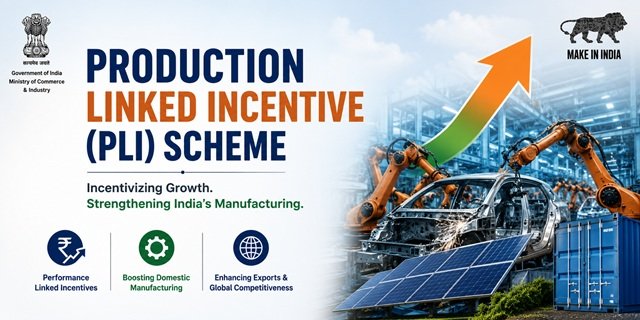
Production Linked Incentive (PLI) Scheme is a Government of India initiative launched in April 2020 to boost domestic manufacturing across 14 strategic sectors by providing performance-linked financial incentives of 4% to 18% on incremental sales above the base year. With a total outlay of Rs. 1.97 lakh crore, the scheme has already generated cumulative production exceeding Rs. 20.41 lakh crore and more than 14.39 lakh jobs as of December 2025.
Production Linked Incentive Scheme Highlights | |
|---|---|
| Scheme Name | Production Linked Incentive (PLI) Scheme |
| First Launched | April 2020 for 3 sectors (Mobile Manufacturing, Bulk Drugs, Medical Devices) |
| Expanded To | 14 sectors in total |
| Coordinating Body | Department for Promotion of Industry and Internal Trade (DPIIT), Ministry of Commerce and Industry |
| Total Outlay | Rs. 1.97 lakh crore across 14 sectors |
| Incentive Rate | 4% to 18% of incremental sales above base year (FY 2019-20) |
| Main Objective | Boost domestic manufacturing, reduce import dependence, attract investment, and generate employment |
| Scheme Type | Performance-linked incentive on incremental production and sales – not a subsidy or upfront payment |
| Primary Beneficiaries | Manufacturers, industrial companies, and exporters across approved sectors |
| Approved Applications | 836 applications across 14 sectors as of December 2025 |
| Cumulative Investment | Exceeding Rs. 2.16 lakh crore as of December 2025 |
| Cumulative Production and Sales | Exceeding Rs. 20.41 lakh crore as of December 2025 |
| Cumulative Exports | Exceeding Rs. 8.3 lakh crore as of December 2025 |
| Jobs Generated | More than 14.39 lakh direct and indirect jobs as of December 2025 |
| Incentive Disbursed | Rs. 28,748 crore as of 31 December 2025 |
| MSME Participation | 176 MSMEs among approved PLI beneficiaries |
| Official PIB Update | PIB Press Release dated 20 February 2026 |
| Coordinating Ministry Portal | dpiit.gov.in |
Introduction of Production Linked Incentive Scheme: A Brief Insight
For decades, India’s manufacturing sector played a secondary role in the economy while services dominated GDP growth. The country was heavily dependent on imports for critical products ranging from mobile phones and semiconductors to pharmaceutical ingredients and solar panels. The Production Linked Incentive Scheme was launched to reverse this trend and position India as a global manufacturing hub through a fundamentally different approach, rewarding companies not for setting up capacity but for actually increasing production.
The PLI Scheme was first launched in April 2020 for three sectors, including mobile manufacturing, bulk drugs, and medical devices. Following its early success, the Union Cabinet expanded it to 13 sectors in November 2020. The Union Budget 2021-22 announced a total outlay of Rs. 1.97 lakh crore across 14 strategic sectors. The scheme is coordinated by the Department for Promotion of Industry and Internal Trade (DPIIT) under the Ministry of Commerce and Industry, while each sector is implemented by its respective nodal ministry.
The core principle of PLI is simple but powerful. Approved companies receive financial incentives ranging from 4% to 18% of their incremental sales of manufactured goods in India above the base year (FY 2019-20). This means the government pays companies only when they actually increase production. No incremental production means no incentive. This performance-based mechanism is fundamentally different from traditional subsidies, where companies receive support regardless of output. It ensures accountability, efficiency, and measurable industrial outcomes.
The results have been significant. As of 31 December 2025, 836 applications have been approved across 14 sectors. Cumulative investment exceeds Rs. 2.16 lakh crore, cumulative production and sales exceed Rs. 20.41 lakh crore, cumulative exports exceed Rs. 8.3 lakh crore, and more than 14.39 lakh direct and indirect jobs have been generated. A total of Rs. 28,748 crore has been disbursed to approved manufacturers. Mobile phone imports have declined by nearly 77% since FY 2020-21 with over 99% of domestic demand now met through local production. India has turned from a net importer to a net exporter of bulk drugs. BSNL has deployed India’s first indigenous end-to-end 4G technology stack.
PLI Scheme primarily benefits manufacturers, industrial companies, and exporters rather than individual citizens. However, its impact reaches every Indian through job creation, affordable locally manufactured products, and a stronger national supply chain. Entrepreneurs who have already built innovative products and want to scale their manufacturing can explore the Startup India Scheme for DPIIT recognition and access to tax benefits and compliance relaxations that complement PLI incentives. Early-stage startups in manufacturing who need seed funding before reaching PLI scale can explore the Startup India Seed Fund Scheme, which provides grants up to Rs. 20 lakh and investment up to Rs. 50 lakh through approved incubators. Manufacturing startups that need institutional debt funding without collateral can additionally explore the Credit Guarantee Scheme for Startups, which provides government-backed guarantee cover for loans up to Rs. 20 crore.
PLI Scheme aligns directly with India’s Atmanirbhar Bharat mission and the Make in India initiative by strengthening domestic manufacturing capabilities, reducing import dependence, and integrating Indian companies into global value chains across 14 strategic sectors.
Manufacturers, entrepreneurs, and business owners looking for more industrial incentive schemes, government manufacturing support programmes, startup funding, and Central Government business initiatives can also explore our complete Central Government Schemes List for detailed information according to their sector and business stage.
How the Production Linked Incentive Scheme Actually Works
Most people assume PLI is a subsidy where the government gives money upfront to companies for setting up factories. That is not how it works. PLI is a performance-based incentive mechanism where companies earn financial rewards only after they actually increase their production and sales.
Here is the complete flow in simple terms. A company applies under the relevant sector and gets approved by the nodal ministry. The company then invests in expanding its manufacturing capacity and increases production above its base year (FY 2019-20) performance. At the end of each financial year, the company submits its verified incremental sales data to the ministry. Based on the verified incremental sales, the ministry calculates the incentive at the prescribed rate for that sector, ranging from 4% to 18%. The incentive is then disbursed to the company in the subsequent financial year. If the company fails to achieve incremental production above the base year, it receives no incentive for that year.
This outcome-based model ensures that government money goes only to companies that are actually producing more in India, creating real jobs and real exports. It is a complete departure from traditional input-based subsidies, where companies could receive support without delivering measurable results.
Benefits Provided to Eligible Manufacturers
The Production Linked Incentive Scheme provides performance-linked financial incentives to eligible manufacturers across 14 strategic sectors. The incentives are not upfront payments but are earned based on actual incremental production and sales achieved above the base year.
Financial Benefits
- Financial incentives ranging from 4% to 18% of incremental sales of manufactured goods above the base year (FY 2019-20), depending on the sector
- Total incentive outlay of Rs. 1.97 lakh crore across 14 strategic sectors
- Incentives are disbursed annually based on verified incremental production and sales performance
- As of 31 December 2025, Rs. 28,748 crore has already been disbursed to approved manufacturers across sectors
Manufacturing and Business Benefits
- Encourages companies to expand domestic manufacturing capacity and production scale
- Supports technology adoption and integration with global value chains
- Helps manufacturers achieve economies of scale, leading to improved global cost competitiveness
- Reduces import dependence by incentivising local production of critical products
- Strengthens domestic supply chains across strategic sectors
- Enables deeper localisation of components and raw materials
Economic and Employment Benefits
- Cumulative investment exceeding Rs. 2.16 lakh crore has been attracted across 14 sectors as of December 2025
- Cumulative production and sales exceeding Rs. 20.41 lakh crore generated
- Cumulative exports exceeding Rs. 8.3 lakh crore achieved
- More than 14.39 lakh direct and indirect jobs generated across approved sectors
- Mobile phone imports declined by nearly 77% since FY 2020-21 and over 99% of domestic demand is now met through local production
- India turned from a net importer to a net exporter of bulk drugs and domestic value addition reached 83.7%
- Telecom product sales increased more than six-fold over the base year and exports reached Rs. 21,033 crore
14 Sectors Covered Under PLI Scheme
PLI Scheme covers 14 strategic sectors identified by the Government of India as priority areas for domestic manufacturing growth. Each sector has its own nodal ministry, application portal, incentive rate, and performance framework.
| Sector | Nodal Ministry | Incentive Period |
|---|---|---|
| Large Scale Electronics Manufacturing (Mobile phones and components) | Ministry of Electronics and IT (MeitY) | 5 years |
| IT Hardware (Laptops, tablets, servers) | Ministry of Electronics and IT (MeitY) | 4 years |
| Bulk Drugs and Active Pharmaceutical Ingredients (APIs) | Department of Pharmaceuticals | 6 years |
| Medical Devices | Department of Pharmaceuticals | 5 years |
| Pharmaceuticals | Department of Pharmaceuticals | 6 years |
| Telecom and Networking Products | Department of Telecommunications | 5 years |
| White Goods (Air Conditioners and LED Lights) | DPIIT | 5 years |
| Specialty Steel | Ministry of Steel | 5 years |
| Food Processing | Ministry of Food Processing Industries | 6 years |
| Textiles (MMF and Technical Textiles) | Ministry of Textiles | 5 years |
| Automobiles and Auto Components | Ministry of Heavy Industries | 5 years |
| Advanced Chemistry Cell (ACC) Battery | Ministry of Heavy Industries | 5 years |
| High Efficiency Solar PV Modules | Ministry of New and Renewable Energy | 6 years |
| Drones and Drone Components | Ministry of Civil Aviation | 3 years |
Companies must apply through the sector-specific portal operated by the respective nodal ministry. Application windows are announced through gazette notifications and are open for a limited period. Some sectors have reopened applications in subsequent rounds based on industry participation.
Eligibility Conditions Required to be Fulfilled
The PLI Scheme eligibility conditions vary across sectors. However, the following broad eligibility criteria apply across most sectors under the scheme.
- Applicant must be a company registered in India under the Companies Act
- The company must have existing or planned manufacturing operations within India
- The company must meet the minimum investment threshold prescribed for the respective sector
- The company must commit to production and sales targets above the defined base year performance
- Applicant must manufacture eligible products falling within the approved product categories of the respective sector
- The company must not be defaulting on any statutory obligations at the time of application
- Applications must be submitted during the officially announced application window for the respective sector
- For sectors with domestic value addition requirements, companies must meet the prescribed minimum domestic value addition percentage
MSME Participation Under PLI
PLI Scheme is not limited to large companies. As confirmed from official government data, 176 MSMEs are among the approved PLI beneficiaries across sectors such as bulk drugs, medical devices, pharmaceuticals, telecom, white goods, food processing, textiles, and drones. MSMEs interested in participating should check eligibility conditions with the relevant nodal ministry for their sector.
Documents Required to be Attached
Companies applying under the Production Linked Incentive Scheme through their respective sector-specific ministry portal need to keep the following documents ready before submitting their application.
- Certificate of Incorporation or Registration Certificate of the company
- PAN Card of the entity
- Board resolution authorising the application and the authorised signatory
- Audited financial statements for the base year and preceding years
- Details of existing manufacturing facilities, including plant and machinery
- Investment plan with timeline and committed investment amounts
- Production capacity details and target product categories
- Manufacturing facility details, including location, area, and infrastructure
- GST registration certificate
- Details of existing loans and credit facilities, wherever applicable
- Any sector-specific documents as prescribed by the respective nodal ministry
Since each sector has its own nodal ministry and application portal, the exact document requirements vary across sectors. Companies should refer to the sector-specific guidelines published by the respective ministry before submitting their application.
How to Apply Under the Production-Linked Incentive Scheme
PLI Scheme does not have a single centralised application portal. Each sector operates through its own nodal ministry and sector-specific application portal. Companies interested in applying must follow the process outlined below.
Step 1: Identify the relevant sector and nodal ministry for your manufacturing activity. Each of the 14 sectors under PLI has a separate nodal ministry responsible for implementation, application review, and incentive disbursement.
Step 2: Monitor the official application window for your sector. Application windows are announced through gazette notifications and official ministry websites. Windows are open for a limited period and may be reopened in subsequent rounds as decided by the respective ministry.
Step 3: Visit the sector-specific PLI portal operated by the nodal ministry and register your company with the required credentials. These credentials will be used for all future application submissions and incentive claims.
Step 4: Fill in the application form with complete company details, including investment plan, production capacity, target product categories, manufacturing facility details, and committed production targets above the base year.
Step 5: Upload all required documents, including Certificate of Incorporation, PAN Card, board resolution, audited financial statements, investment plan, and any sector-specific documents prescribed by the nodal ministry.
Step 6: The Project Management Agency (PMA) appointed for the respective sector reviews all submitted applications. The review process includes verification of financial documents, assessment of the investment plan, and in some sectors a physical site inspection. The review period typically takes 30 to 60 working days.
Step 7: Approved applicants receive a formal approval letter from the nodal ministry specifying the incentive rate, production commitments, timeline, and compliance requirements applicable to the company.
Step 8: After receiving approval, the company must meet the committed production and sales targets every year. Incentives are calculated annually based on actual verified incremental sales above the base year and disbursed in the subsequent financial year.
PLI Scheme Achievements So Far
As per official government data confirmed through PIB Press Release dated 20 February 2026, the cumulative performance of PLI Scheme as of 31 December 2025 is as follows.
| Parameter | Achievement as of December 2025 |
|---|---|
| Approved Applications | 836 applications across 14 sectors |
| Cumulative Investment | Exceeding Rs. 2.16 lakh crore |
| Cumulative Production and Sales | Exceeding Rs. 20.41 lakh crore |
| Cumulative Exports | Exceeding Rs. 8.3 lakh crore |
| Direct and Indirect Jobs Generated | More than 14.39 lakh |
| Incentive Disbursed | Rs. 28,748 crore |
| Mobile Phone Import Reduction | Declined by nearly 77% since FY 2020-21 |
| Domestic Demand Met Locally (Mobile) | Over 99% of domestic demand is met through local production |
| Pharma Domestic Value Addition | 83.7% as of March 2025 |
| Telecom Sales Growth | More than six-fold increase over the base year FY 2019-20 |
| Telecom Exports | Rs. 21,033 crore |
| Solar PV Manufacturing Target | 48 GW fully integrated capacity under Tranche I and II |
Important Links Available
- Department for Promotion of Industry and Internal Trade, DPIIT.
- PIB, PLI Scheme Latest Update dated 20 February 2026.
- PIB, PLI Scheme Powering India’s Industrial Renaissance.
- PLI Scheme for Automobile and Auto Components, Ministry of Heavy Industries.
- PLI Scheme for Telecom and Networking Products, Department of Telecommunications.
- PLI Scheme for Bulk Drugs and APIs, Department of Pharmaceuticals.
- Ministry of Commerce and Industry.
Contact Details in Case of Help Needed
Companies facing issues related to PLI Scheme eligibility, application process, sector-specific guidelines, or incentive disbursement can contact us through the following official channels.
- Department for Promotion of Industry and Internal Trade (DPIIT)
Udyog Bhawan, Rafi Marg,
New Delhi 110011 - Ministry of Commerce and Industry
Udyog Bhawan, Rafi Marg,
New Delhi 110011 - For sector-specific queries: Contact the nodal ministry responsible for the respective PLI sector
Frequently Asked Questions (FAQs)
Q. What is the Production Linked Incentive Scheme?
Ans. Production Linked Incentive (PLI) Scheme is a Government of India initiative launched in 2020 to boost domestic manufacturing by providing performance-linked financial incentives to eligible companies based on their incremental production and sales above a defined base year.
Q. When was the PLI Scheme launched?
Ans. The PLI Scheme was first launched in April 2020 for three sectors, including mobile manufacturing, bulk drugs, and medical devices. It was expanded in November 2020 to cover 13 sectors and later extended to 14 sectors in total.
Q. What is the total outlay under PLI Scheme?
Ans. The Government of India has approved a total outlay of Rs. 1.97 lakh crore across 14 strategic sectors under the Production Linked Incentive Scheme.
Q. How does the PLI Scheme work?
Ans. PLI Scheme provides financial incentives to approved manufacturers based on their incremental sales of manufactured goods in India above the base year (FY 2019-20). Companies earn incentives ranging from 4% to 18% of incremental sales, depending on their sector. The higher the incremental production and sales, the higher the incentive earned.
Q. How many sectors are covered under the PLI Scheme?
Ans. PLI Scheme currently covers 14 strategic sectors, including mobile phones, IT hardware, pharmaceuticals, medical devices, telecom products, food processing, textiles, automobiles, advanced chemistry cell batteries, solar PV modules, white goods, speciality steel, drones, and bulk drugs.
Q. Is the PLI Scheme only for large companies?
Ans. No. While PLI primarily targets large-scale manufacturers, 176 MSMEs are among the approved PLI beneficiaries across sectors such as bulk drugs, medical devices, pharmaceuticals, telecom, white goods, food processing, textiles, and drones.
Q. What is the difference between PLI and a subsidy?
Ans. A subsidy is an upfront financial support given regardless of performance. PLI incentives are earned only when a company actually increases its production and sales above the base year. No incremental production means no incentive. This performance-based model ensures accountability and measurable industrial outcomes.
Q. Is there a single application portal for all PLI sectors?
Ans. No. Each sector has its own nodal ministry and sector-specific application portal. Companies must apply through the portal operated by the respective ministry for their sector.
Q. How much has been disbursed under the PLI Scheme so far?
Ans. As per official government data, Rs. 28,748 crore has been disbursed to approved manufacturers as of 31 December 2025 across 14 sectors.
Q. How many applications have been approved under the PLI Scheme?
Ans. As of 31 December 2025, 836 applications have been approved across 14 sectors under the Production Linked Incentive Scheme.
Q. What employment has the PLI Scheme generated?
Ans. As of 31 December 2025, the PLI Scheme has generated more than 14.39 lakh direct and indirect jobs across approved sectors.
Q. Which ministry coordinates the PLI Scheme?
Ans. The Department for Promotion of Industry and Internal Trade (DPIIT) under the Ministry of Commerce and Industry acts as the nodal coordinating body for the overall PLI programme. Each sector is implemented by its respective nodal ministry.
Q. Can a company apply for PLI in multiple sectors?
Ans. A company with manufacturing operations in different eligible sectors may apply separately under each sector through the respective ministry portal, subject to meeting the eligibility conditions prescribed for each sector.
Q. What is the base year for PLI incentive calculation?
Ans. The base year for calculating incremental sales under the PLI Scheme is FY 2019-20 for most sectors. Incentives are calculated on sales above this base year performance.

Tabassum is a government schemes researcher and writer with 5 years of experience tracking Central and State welfare scheme programmes across India. She has covered 500+ schemes spanning agriculture, women welfare, education, and housing, helping lakhs of beneficiaries understand their entitlements in simple language.