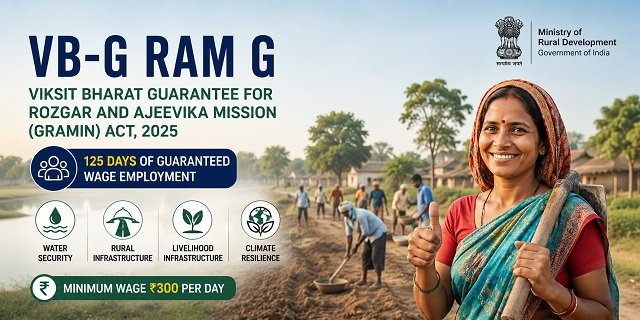
Viksit Bharat – Guarantee for Rozgar and Ajeevika Mission (Gramin) [VB-G RAM G] Act, 2025 is a Central Government law implemented by the Ministry of Rural Development. It replaced the Mahatma Gandhi National Rural Employment Guarantee Act (MGNREGA) from 1 July 2026. Under this Act, every eligible rural household can get up to 125 days of guaranteed wage employment in a financial year. The Central Government has also fixed a minimum daily wage of Rs. 300. Eligible workers can register through their Gram Panchayat and can visit the official VB-G RAM G Portal for the latest information, guidelines, and updates.
Viksit Bharat G RAM G Yojana 2025 Highlights | |
|---|---|
| Scheme Name | Viksit Bharat Guarantee for Rozgar and Ajeevika Mission (Gramin) Act, 2025 |
| Short Name | VB G RAM G (विकसित भारत जी राम जी) |
| Implementing Ministry | Ministry of Rural Development, Government of India |
| Act Passed | December 2025 |
| Effective From | 1 July 2026 |
| Coverage | All rural areas across India |
| Replaces | Mahatma Gandhi National Rural Employment Guarantee Act (MGNREGA), 2005 |
| Employment Guarantee | 125 days of wage employment for every eligible rural household in a financial year |
| Minimum Daily Wage | Rs. 300 per day |
| National Average Wage | Rs. 327.40 per day |
| Wage Payment | Paid through Direct Benefit Transfer (DBT) to an Aadhaar linked bank or post office account |
| Payment Timeline | Within 15 days after the muster roll is closed |
| Delay Compensation | 0.05% of unpaid wages for each day of delay from the 16th day onwards |
| Unemployment Allowance | One fourth of the wage rate for the first 30 days and one half of the wage rate for the remaining period |
| Agricultural Break | Up to 60 days, if notified by the State Government |
| Priority Work Areas | Water Security, Core Rural Infrastructure, Livelihood Infrastructure, and Climate Resilience |
| Attendance System | NMMS enabled face authentication with geo tagged attendance |
| Funding Pattern | 60:40 between the Central Government and State Governments. 90:10 for North Eastern and Himalayan States |
| Central Allocation (FY 2026-27) | Rs. 95,692.31 crore |
| Total Estimated Annual Outlay | More than Rs. 1.51 lakh crore including the State share |
| Identity Card | Gramin Rozgar Guarantee Card |
| Registration | Available free of cost through the Gram Panchayat |
| Official Portal | vbgramg.dord.gov.in |
Introduction of Viksit Bharat G RAM G Yojana 2025: A Brief Insight
For nearly twenty years, the Mahatma Gandhi National Rural Employment Guarantee Act (MGNREGA) provided guaranteed wage employment to millions of rural households across India. The programme helped families earn an income during difficult times, created useful village assets, and supported rural development. As rural India continued to change, the Government decided to introduce a new law with better technology, improved transparency, stronger livelihood support, and a higher employment guarantee.
To achieve these goals, Parliament passed the Viksit Bharat Guarantee for Rozgar and Ajeevika Mission (Gramin) Act, 2025. The Ministry of Rural Development implemented the Act across rural India from 1 July 2026. From the same date, the Mahatma Gandhi National Rural Employment Guarantee Act (MGNREGA) was repealed.
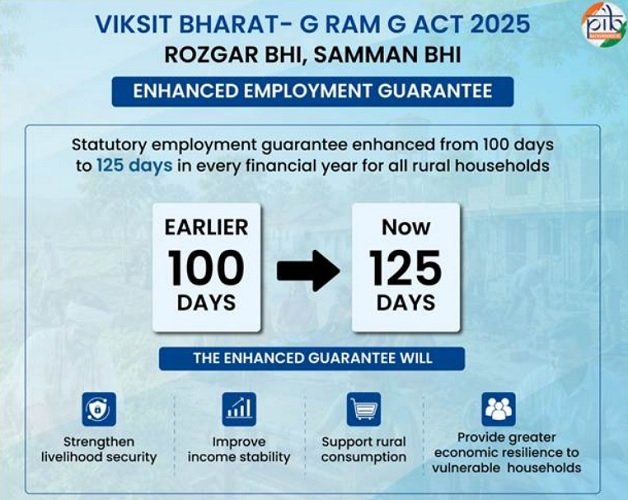
The VB G RAM G Act provides up to 125 days of guaranteed wage employment for every eligible rural household in a financial year, replacing the earlier limit of 100 days. It also introduces a minimum daily wage of Rs. 300. Wages are paid through Direct Benefit Transfer (DBT) into the worker’s Aadhaar linked bank or post office account. If wages are delayed beyond the prescribed time, eligible workers receive delay compensation as provided under the Act.
The Act focuses on creating long lasting community assets while providing employment. The priority work areas include water security, core rural infrastructure, livelihood infrastructure, and climate resilience. It also introduces modern technology such as NMMS based face authentication, geo tagged attendance, GIS planning, AI based monitoring, and digital dashboards to improve transparency and monitor works more effectively.
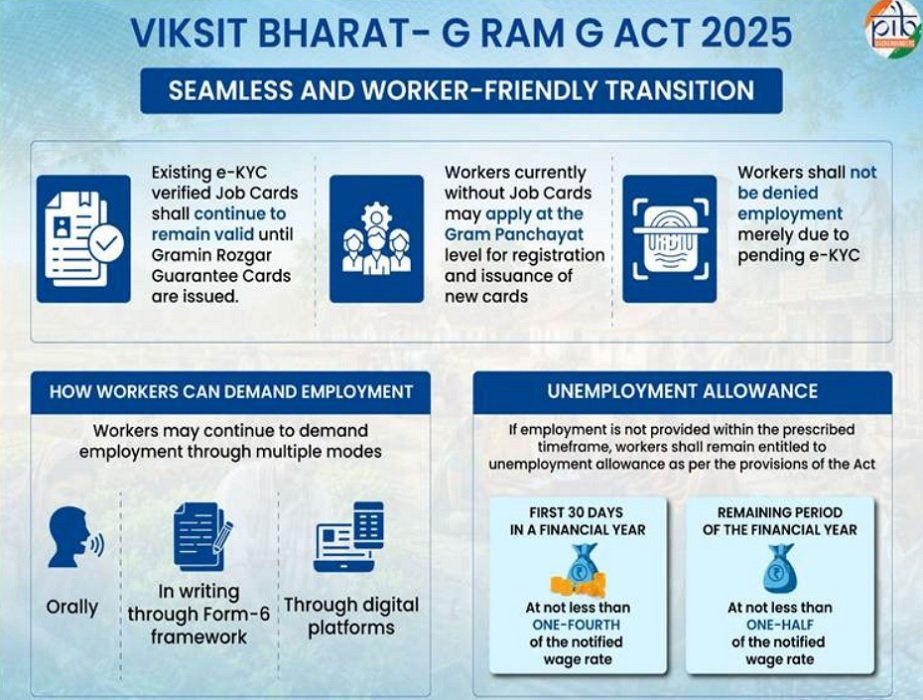
Eligible workers can register free of cost through their Gram Panchayat and receive a Gramin Rozgar Guarantee Card. Existing e KYC verified MGNREGA Job Cards remain valid during the transition period until new cards are issued. Workers can request employment by visiting the Gram Panchayat, submitting the prescribed application form, or using the official digital platform wherever available. If eligible employment is not provided within the prescribed time, workers can receive an unemployment allowance according to the provisions of the Act.
People who also want financial assistance to build a permanent house in rural areas and urban areas can explore the Pradhan Mantri Awas Yojana Gramin and Pradhan Mantri Awas Yojana Urban respectively.
Readers looking for more employment, livelihood, and rural development programmes can explore our Central Government Welfare Schemes section, where we regularly publish verified information about welfare schemes launched by the Government of India.
Benefits Provided to Eligible Beneficiaries
Eligible rural households registered under the VB G RAM G Act, 2025 can receive the following benefits from the Ministry of Rural Development, Government of India.
Employment Guarantee
- Up to 125 days of guaranteed wage employment for every eligible rural household in a financial year
- Employment is provided within the time limit prescribed under the Act after a worker requests work
- Workers can request employment by visiting the Gram Panchayat, submitting Form 6, or using the official digital platform wherever available
Wage Benefits
- Minimum daily wage of Rs. 300. No notified wage rate can be lower than this amount
- National average wage increased to Rs. 327.40 per day, which is more than the average wage under MGNREGA
- Wages are paid through Direct Benefit Transfer (DBT) into the worker’s Aadhaar linked bank or post office account
- Payments are made every week or within 15 days after the muster roll is closed, as provided under the Act
Unemployment Allowance
- If eligible employment is not provided within the prescribed time, workers can receive an unemployment allowance
- At least one fourth of the notified wage rate for the first 30 days of the financial year
- At least one half of the notified wage rate for the remaining period of the financial year
Delay Compensation
- If wages are not paid within the prescribed time, workers receive delay compensation of 0.05% of the unpaid wages for each day of delay from the 16th day onwards
Worksite Facilities
- Safe drinking water at every worksite
- Shaded place for workers to take rest
- First aid kit available at the worksite
- A childcare worker is provided when five or more children below five years of age are present at the worksite
- Ex gratia assistance in case of death or permanent disability as per the provisions of Pradhan Mantri Suraksha Bima Yojana
Gramin Rozgar Guarantee Card
- Every registered household receives a Gramin Rozgar Guarantee Card
- Existing e KYC verified MGNREGA Job Cards remain valid until new Gramin Rozgar Guarantee Cards are issued
Eligibility Conditions Required to be Fulfilled
To get employment under the VB G RAM G Act, 2025, applicants must meet the following eligibility conditions:
- Applicant must live in a rural area.
- Applicant must be an adult member of a rural household.
- Applicant must be willing to do unskilled manual work.
- The household must be registered with the Gram Panchayat and have a valid Gramin Rozgar Guarantee Card.
- The applicant should have an Aadhaar Card. Workers cannot be denied employment only because their e KYC is pending.
- The applicant must have an Aadhaar linked bank or post office account to receive wages through Direct Benefit Transfer (DBT).
Who Is Not Eligible
- People living in urban areas, as the Act applies only to rural areas.
- People looking for skilled or semi skilled jobs, as the Act provides only unskilled manual work.
Important Points
- Women are fully eligible to work under the Act.
- A childcare worker is provided at the worksite when five or more children below five years of age are present.
- Workers who do not have a Job Card can apply for a new Gramin Rozgar Guarantee Card through their Gram Panchayat.
- Existing MGNREGA Job Card holders with completed e KYC can continue to receive benefits during the transition period until new cards are issued.
Documents Required to be Attached
Applicants should keep the following documents ready while registering under the VB G RAM G Act, 2025 and applying for a Gramin Rozgar Guarantee Card:
- Aadhaar Card of all adult members of the household
- Proof of residence, such as a Ration Card, Voter ID, or any other government issued address proof
- Aadhaar linked bank or post office account details
- Recent passport size photographs of the applicant or eligible family members
- Mobile number for OTP verification and future communication
Registration through the Gram Panchayat is provided free of cost. Existing MGNREGA Job Card holders with completed e KYC can continue to use their current Job Card during the transition period until the new Gramin Rozgar Guarantee Card is issued.
How Beneficiaries Can Apply to Avail the Benefit of this Scheme
Eligible rural households can register under the VB G RAM G Act, 2025 through their Gram Panchayat. Registration is free of cost. After registration, workers can request employment whenever they need work. The complete process is explained below.
Step 1: Register at the Gram Panchayat
Visit your nearest Gram Panchayat office and submit your application for registration under the VB G RAM G Act. Carry your Aadhaar Card, residence proof, Aadhaar linked bank or post office account details, passport size photograph, and mobile number. The Gram Panchayat will verify your details and start the process of issuing a Gramin Rozgar Guarantee Card.
Step 2: Receive Your Gramin Rozgar Guarantee Card
After your application is verified, the Gram Panchayat will issue a Gramin Rozgar Guarantee Card. This card confirms your household’s eligibility to receive up to 125 days of guaranteed wage employment in a financial year. Existing MGNREGA Job Card holders with completed e KYC can continue to use their current Job Card during the transition period until the new card is issued.
Step 3: Request Employment
When you need work, submit your request to the Gram Panchayat. You can request employment orally, by submitting Form 6, or through the official digital platform wherever available. Keep a record of the date on which you requested work.
Step 4: Get Work Allotted
The Gram Panchayat or Programme Officer will allot work based on the approved projects available in your area. If eligible employment is not provided within the time limit prescribed under the Act, you may become eligible for an unemployment allowance.
Step 5: Attend the Worksite
Report to the worksite on the scheduled date. Your attendance will be recorded through the NMMS face authentication system, which uses geo tagged photographs to confirm your presence. The Gram Rozgar Sevak or Mate records the attendance in the official system.
Step 6: Work Measurement
After the work is completed, the concerned officials measure and verify the work done. Once the muster roll is closed, the wage payment process begins.
Step 7: Receive Wage Payment
Your wages are transferred directly to your Aadhaar linked bank or post office account through Direct Benefit Transfer (DBT). As per the Act, wages should be paid within the prescribed time after the muster roll is closed. If there is a delay beyond the permitted period, eligible workers receive delay compensation according to the provisions of the Act.
Need Help?
If you do not receive work, your wages are delayed, or you face any other problem, contact your Gram Panchayat, Programme Officer, or the District Programme Coordinator. You can also visit the official VB G RAM G Portal for the latest information, notifications, and updates.
What Type of Works Can Be Done Under VB G RAM G
The VB G RAM G Act allows different types of public works that create employment and improve rural infrastructure. These works are grouped into the following four priority areas:
- Water Security: Construction and repair of irrigation channels, groundwater recharge structures, watershed development works, restoration of ponds and other water bodies, tree plantation, and rainwater harvesting structures.
- Core Rural Infrastructure: Construction and improvement of rural roads, public buildings, school infrastructure, Anganwadi Centres, sanitation facilities, renewable energy projects, and housing related works under Central Government schemes.
- Livelihood Infrastructure: Development of agriculture assets, animal husbandry facilities, fisheries infrastructure, storage facilities, rural markets, skill development centres, and other works that help improve rural livelihoods.
- Climate Resilience: Flood control works, disaster preparedness projects, protection against extreme weather, and other public works that help villages deal with climate related challenges.
All these works are planned by the Gram Panchayat through the Viksit Gram Panchayat Plan. The Government monitors every approved work using modern digital tools to improve transparency and ensure proper implementation.
Difference Between VB G RAM G and MGNREGA
| Particulars | VB G RAM G Act, 2025 | MGNREGA, 2005 |
|---|---|---|
| Status | Implemented from 1 July 2026 | Repealed from 1 July 2026 |
| Employment Guarantee | 125 days for every eligible rural household in a financial year | 100 days for every eligible rural household in a financial year |
| Minimum Daily Wage | Rs. 300 per day as the minimum floor wage | No minimum national floor wage |
| Wage Payment | Paid every week or within 15 days after the muster roll is closed | Normally paid within 15 days |
| Attendance System | NMMS face authentication with geo tagged attendance | Attendance recorded under the MGNREGA system |
| Agricultural Break | State Governments can notify a break of up to 60 days during the agricultural season | No such provision |
| Work Categories | Four priority areas including water security, rural infrastructure, livelihood infrastructure, and climate resilience | General list of permissible works |
| Identity Card | Gramin Rozgar Guarantee Card | MGNREGA Job Card |
| Funding Pattern | Implemented as a Centrally Sponsored Scheme with the prescribed Centre and State funding pattern | Implemented as a Centrally Sponsored Scheme |
| Worksite Facilities | Drinking water, shade, first aid, childcare, and other facilities as provided under the Act | Basic worksite facilities provided under MGNREGA guidelines |
Important Links Available
- VB G RAM G Official Portal
- PIB Official Backgrounder on VB G RAM G Act, 2025
- India.gov.in Official Overview
- Download the Official VB G RAM G Act, 2025 (PDF)
- Ministry of Rural Development
Contact Details in Case of Help Needed
- Ministry of Rural Development: Government of India, Krishi Bhawan, New Delhi 110001
- Gram Panchayat: Contact your Gram Rozgar Sevak (GRS) or visit your Gram Panchayat for registration, work requests, and other scheme related assistance.
- Programme Officer: Contact the Programme Officer of your Block for issues related to work allocation, wage payment, or complaints.
- District Programme Coordinator: Contact the District Programme Coordinator of your district if your issue is not resolved at the Gram Panchayat or Block level.
Frequently Asked Questions (FAQs)
Q. What is VB G RAM G?
Ans. VB G RAM G stands for Viksit Bharat Guarantee for Rozgar and Ajeevika Mission (Gramin). It is a Central Government law passed by Parliament in December 2025 and implemented from 1 July 2026. The Act replaced the Mahatma Gandhi National Rural Employment Guarantee Act (MGNREGA) and provides up to 125 days of guaranteed wage employment to every eligible rural household in a financial year.
Q. What is the difference between VB G RAM G and MGNREGA?
Ans. VB G RAM G replaced MGNREGA from 1 July 2026. The new Act increases the employment guarantee from 100 days to 125 days, introduces a minimum daily wage of Rs. 300, strengthens digital monitoring, improves worksite facilities, and focuses on creating better rural infrastructure and livelihood assets.
Q. Who can apply for VB G RAM G?
Ans. Any adult member of a rural household who is willing to perform unskilled manual work can apply. The household must be registered with the Gram Panchayat and have a valid Gramin Rozgar Guarantee Card.
Q. Can women apply under VB G RAM G?
Ans. Yes. Women are fully eligible to work under the Act. A childcare worker is also provided at the worksite when five or more children below five years of age are present, making it easier for women with young children to participate.
Q. How many days of employment are available under VB G RAM G?
Ans. Every eligible rural household can receive up to 125 days of guaranteed wage employment in a financial year. State Governments may notify a temporary break of up to 60 days during the peak agricultural season, but the overall employment entitlement remains 125 days.
Q. What is the daily wage under VB G RAM G?
Ans. The Central Government has fixed a minimum daily wage of Rs. 300 under the VB G RAM G Act. The national average wage is Rs. 327.40 per day. No notified wage can be lower than the prescribed minimum.
Q. How are wages paid?
Ans. Wages are transferred directly to the worker’s Aadhaar linked bank or post office account through Direct Benefit Transfer (DBT). Payments are made every week or within the prescribed time after the muster roll is closed. If there is a delay beyond the permitted period, eligible workers receive delay compensation according to the Act.
Q. What is the Gramin Rozgar Guarantee Card?
Ans. The Gramin Rozgar Guarantee Card is the official identity card issued to registered rural households under the VB G RAM G Act. It replaces the earlier MGNREGA Job Card. Existing e KYC verified MGNREGA Job Cards remain valid during the transition period until new cards are issued.
Q. How can I register under VB G RAM G?
Ans. Visit your nearest Gram Panchayat with the required documents, including your Aadhaar Card, residence proof, bank or post office account details, photographs, and mobile number. Registration is provided free of cost.
Q. How can I request work under VB G RAM G?
Ans. You can request employment by visiting your Gram Panchayat, submitting Form 6, or using the official digital platform wherever available. Keep a record of the date on which you requested work.
Q. What happens if I do not get work?
Ans. If eligible employment is not provided within the prescribed time, you may receive an unemployment allowance. The allowance is at least one fourth of the notified wage rate for the first 30 days and at least one half of the notified wage rate for the remaining period, as provided under the Act.
Q. Is Aadhaar mandatory?
Ans. Aadhaar is required for registration and wage payments. However, workers cannot be denied employment only because their e KYC is pending. An Aadhaar linked bank or post office account is required to receive wages through DBT.
Q. What facilities are available at the worksite?
Ans. Workers are provided with safe drinking water, a shaded place for rest, first aid facilities, and childcare support where required. Ex gratia assistance is also available in case of death or permanent disability according to the applicable Government provisions.
Q. How is attendance recorded?
Ans. Attendance is recorded through the NMMS face authentication system. Workers mark their attendance using a mobile device, and the system records their photograph and location. The Gram Rozgar Sevak or Mate manages the attendance process.
Q. What types of works are allowed under VB G RAM G?
Ans. The Act covers works related to water security, rural infrastructure, livelihood infrastructure, and climate resilience. These include irrigation projects, village roads, ponds, public buildings, flood control works, plantations, fisheries infrastructure, and other approved public works.
Q. What is the 60 day agricultural break?
Ans. State Governments may declare a temporary break of up to 60 days during the peak sowing and harvesting season. This helps ensure that agricultural activities are not affected while workers continue to receive their overall employment entitlement under the Act.
Q. What is the funding pattern under VB G RAM G?
Ans. The scheme follows a Centrally Sponsored funding pattern. For most States, the expenditure is shared between the Central Government and the State Government in a 60:40 ratio. For North Eastern and Himalayan States, the ratio is 90:10. The Central Government provides full financial support to eligible Union Territories.
Q. What is the role of the Gram Rozgar Sevak?
Ans. The Gram Rozgar Sevak helps workers with registration, work requests, attendance, maintenance of records, and coordination with the Programme Officer. The Gram Rozgar Sevak is the first point of contact for most scheme related issues.
Q. What is a social audit?
Ans. A social audit is a public review of works and expenditure under the Act. It allows villagers to examine records, ask questions, and help ensure that the scheme is implemented in a transparent and accountable manner.
Q. How can I check my job card and payment details?
Ans. Visit the official VB G RAM G Portal for the latest information, notifications, and online services made available by the Ministry of Rural Development. You can also contact your Gram Panchayat or Programme Officer for assistance.
Q. How can I file a complaint?
Ans. If you face any problem related to registration, work allocation, wage payment, or any other scheme matter, first contact your Gram Panchayat or Programme Officer. If your issue is not resolved, you can approach the District Programme Coordinator or the concerned State authority.
Q. What is the role of the Gram Panchayat under VB G RAM G?
Ans. The Gram Panchayat registers eligible households, issues the Gramin Rozgar Guarantee Card, plans and implements approved works, accepts work requests, and helps ensure that eligible workers receive employment according to the provisions of the Act.
Q. What is the Viksit Bharat National Rural Infrastructure Stack?
Ans. The Viksit Bharat National Rural Infrastructure Stack (VB NRIS) is a digital platform developed by the Government to help plan, monitor, and manage rural development projects. It supports better planning, transparency, and monitoring of public works carried out under the Act.
Q. What is the official website for VB G RAM G?
Ans. The official website of the VB G RAM G Act is vbgramg.dord.gov.in. You can visit the portal for official notifications, guidelines, reports, and other scheme related information. You can also visit the Ministry of Rural Development at rural.gov.in for the latest updates.

Tabassum is a government schemes researcher and writer with 5 years of experience tracking Central and State welfare scheme programmes across India. She has covered 500+ schemes spanning agriculture, women welfare, education, and housing, helping lakhs of beneficiaries understand their entitlements in simple language.