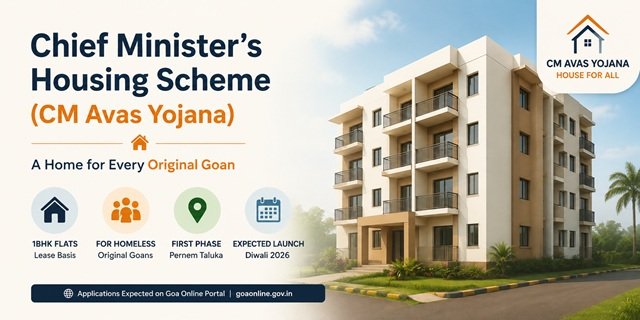
Chief Minister’s Housing Scheme (CM Avas Yojana) is a proposed housing initiative announced by Chief Minister Dr. Pramod Sawant to help homeless original Goans (Niz Goemkar) secure a dignified place to live. The scheme is expected to be implemented through the Goa Housing Board (GHB) and will likely provide 1BHK flats on a lease basis, with the first phase planned in Pernem Taluka. The official launch is expected around Diwali 2026, while detailed guidelines and the application process are awaited.
Goa Chief Minister’s Housing Scheme (CM Avas Yojana) Highlights | |
|---|---|
| Scheme Name | Chief Minister’s Housing Scheme (CM Avas Yojana) |
| Announced By | Chief Minister Dr Pramod Sawant |
| Implementing Agency (Expected) | Goa Housing Board (GHB) |
| Objective | Provide housing support to homeless original Goans under the state’s “House for All” vision |
| Target Beneficiaries | Original Goans (Niz Goemkar) who do not own a house |
| Housing Unit Proposed | 1BHK Flats |
| Housing Model | Lease-based allotment (not immediate permanent ownership) |
| Implementation Approach | Allotment of vacant Housing Board/Rehabilitation Board flats and construction of new housing units |
| First Phase Location | Pernem Taluka |
| Future Expansion | Planned rollout across all talukas of Goa |
| Residence Requirement (Reported) | Approximately 30 years of residence in Goa |
| House Ownership Condition | Applicant should not own a house |
| Selection Basis | Need-based assessment of eligible applicants |
| Special Condition (Reported) | Beneficiary may be required to vacate the unit after acquiring their own house |
| Expected Launch | Around Diwali 2026 |
| Application Mode | Yet to be officially announced |
| Application Portal (Expected) | Goa Online Portal |
| Current Status | Announced; detailed notification and operational guidelines awaited |
| Official Housing Portal | Goa Housing Board (GHB) |
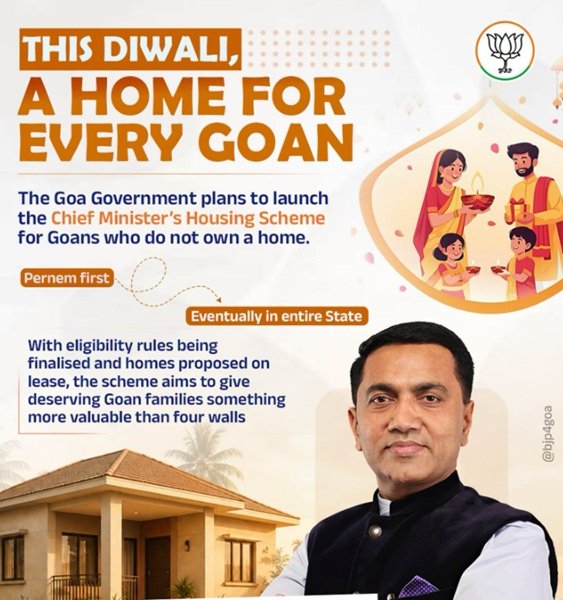
Introduction of Goa Chief Minister’s Housing Scheme: A Brief Insight
For many families in Goa, owning a house remains a distant dream despite living in the state for generations. Rising property prices, limited land availability, and modest household incomes have left numerous original Goan families dependent on rented accommodation or shared family homes for decades. Recognising this challenge, Chief Minister Dr. Pramod Sawant announced the Chief Minister’s Housing Scheme (CM Avas Yojana), a new housing initiative expected to be launched around Diwali 2026.
The scheme is proposed to be implemented through the Goa Housing Board (GHB) with the larger objective of advancing Goa’s vision of “House for All”. Unlike conventional housing projects that focus only on new construction, this initiative specifically targets original Goans (Niz Goemkar) who do not own a house and have spent a significant part of their lives in the state. The government intends to ensure that genuine long-term residents receive priority while addressing the housing needs of families that have remained without a permanent home despite years of residence in Goa.
To make the scheme practical and scalable, the government is exploring a two-pronged implementation model. The first approach involves identifying and allotting vacant flats already available with the Goa Housing Board and the Rehabilitation Board. The second approach focuses on constructing new residential units on government-owned land. As part of this plan, two parcels of land in Pernem Taluka have reportedly been identified for the scheme’s first housing project, which will serve as the pilot phase before expansion to other parts of the state.
Under the proposed framework, eligible beneficiaries are expected to receive 1BHK flats through a lease-based housing model. This means beneficiaries will receive the right to occupy and live in the allotted dwelling, but the unit may not be transferred, sold, or treated as an immediately owned asset. The government has also indicated that if a beneficiary later becomes financially capable of purchasing a house independently, the allotted unit may be returned and reassigned to another deserving family. This approach is intended to create a sustainable housing pool that continues to support families facing genuine housing deprivation.
The scheme is still in the pre-launch stage, and detailed operational guidelines are awaited. Based on announcements made so far, applicants are expected to demonstrate approximately 30 years of residence in Goa and establish that they do not currently own a house. The final eligibility criteria, income limits, priority categories, lease conditions, and allotment procedures will be confirmed through the official notification issued by the Goa Housing Board.
Once applications open, the process is expected to be conducted through the Goa Online Portal following a formal advertisement from the Goa Housing Board. Prospective applicants should begin gathering documents that establish long-term residence in Goa, as these are likely to play a central role during verification. For official updates, beneficiaries should regularly visit ghb.goa.gov.in and the Goa Online Portal, while residence-related documentation can be obtained through the local Mamlatdar office or the concerned Revenue Authority.
Families who already have legal complications relating to their existing homes can also explore the Mhaje Ghar Yojana, which helps regularise houses constructed on government or community land and grants ownership rights to eligible long-term occupants. Flat owners who have completed full payment but are still awaiting legal ownership documents may benefit from the Mhajo Flat Scheme, which focuses on resolving ownership and conveyance-related issues. Rural households seeking assistance for new house construction can additionally check the Pradhan Mantri Awas Yojana Gramin (PMAY-G), while urban families may explore the Pradhan Mantri Awas Yojana Urban (PMAY-U) for affordable housing support and housing-linked financial assistance.
Homeless families, low-income households, and residents looking for more housing, welfare, and social assistance programmes available under the Government of Goa can explore all available initiatives on our Goa Government Welfare Schemes page.
Benefits Provided to Eligible Beneficiaries
The Chief Minister’s Housing Scheme (CM Avas Yojana) has been announced by the Government of Goa with the objective of providing secure housing to homeless original Goan families who have been residing in the state for decades but do not own a home. While the detailed scheme guidelines are still awaited, the government has already outlined the broad benefits that eligible beneficiaries can expect under the programme.
Housing Support Under the Scheme
- Eligible beneficiaries are proposed to receive a 1BHK residential flat under the scheme
- The housing unit is expected to provide safe, secure, and dignified accommodation for families without a house of their own
- The scheme aims to support genuine homeless original Goans and improve their long-term living conditions
- The housing support is intended to contribute towards Goa’s broader “House for All” vision
Lease-Based Housing Model
- The proposed housing units are expected to be allotted on a lease basis rather than through immediate permanent ownership
- Beneficiaries will receive the right to occupy and use the allotted dwelling subject to the terms and conditions prescribed by the government
- The model is designed to ensure that housing assistance continues to reach families that genuinely require support
- Detailed conditions regarding occupancy rights, lease duration, maintenance responsibilities, and other obligations will be specified in the final allotment agreement
Multiple Sources of Housing Supply
- Existing Vacant Housing Stock: Vacant flats available with the Goa Housing Board and Rehabilitation Board may be identified and allotted to eligible beneficiaries
- New Housing Projects: Additional 1BHK flats may be constructed on government-owned land to expand housing availability under the scheme
- This dual approach is expected to accelerate implementation by utilising existing housing inventory while creating new residential units where required
Phased Statewide Expansion
- The initial phase of the scheme is focused on Pernem Taluka, where government land has reportedly been identified for housing development
- After the pilot phase, the scheme is intended to be expanded gradually to other talukas across Goa
- The phased rollout is expected to help the government identify eligible beneficiaries and scale the programme efficiently across the state
Important: The Chief Minister’s Housing Scheme is currently understood to be a lease-based housing assistance programme, not a scheme for unconditional free ownership of houses. Applicants should not assume that the allotted flat can be sold, transferred, mortgaged, or permanently retained without complying with the conditions that will be prescribed by the government.
Note: Key details such as the carpet area of the flats, number of housing units, lease tenure, maintenance charges, beneficiary contribution (if any), and project-wise implementation timelines have not yet been officially notified. These details will be clarified once the Goa Housing Board releases the formal scheme guidelines and allotment framework.
Eligibility Conditions Required to be Fulfilled
The Government of Goa has announced the Chief Minister’s Housing Scheme (CM Avas Yojana) with the objective of providing housing support to genuine Goan families who do not own a house. While the detailed scheme guidelines are still awaited, the government has already indicated several key eligibility principles that applicants should be aware of.
Confirmed Eligibility Framework
- Applicant must be an original Goan (Niz Goemkar)
- Applicant must not own a residential house in his or her name
- Applicant must be able to establish approximately 30 years of residence in Goa
- The scheme is intended for families facing genuine housing difficulties and will follow a need-based selection process
- Preference is expected to be given to applicants who can clearly demonstrate long-term roots in Goa through official records and supporting documents
Eligibility Details Awaiting Official Notification
- The exact annual family income limit
- Whether the 30-year residence requirement must be continuous or cumulative
- The specific documents that will be accepted as proof of long-term residence
- Whether residence can be established through family records if the applicant does not possess older documents personally
- Eligibility of Goan families who migrated outside the state and later returned
- Whether tenants, occupants of ancestral homes, or families living with relatives will qualify
- Whether ownership of agricultural land without a residential house affects eligibility
- Whether separate criteria will apply to urban and rural applicants
- Whether widows, senior citizens, persons with disabilities, women-headed households, or economically weaker families will receive priority during selection
- Whether the initial phase will be limited to specific areas such as Pernem Taluka or implemented across Goa simultaneously
Who May Not Be Eligible
- Persons who already own a residential house
- Applicants unable to establish the prescribed period of residence in Goa
- Applicants providing incorrect or unverifiable information during scrutiny
- Families found ineligible under the final income or ownership criteria notified by the government
Documents Required to be Attached
The Government of Goa has announced the Chief Minister’s Housing Scheme (CM Avas Yojana), but a detailed application form and official document checklist are yet to be notified. However, since the scheme is expected to prioritise families with long-term roots in Goa, applicants should start keeping the following documents ready in advance:
- Goa Birth Certificate of the applicant, where available
- Goa Domicile Certificate or Residence Certificate issued by the competent authority
- Electoral Roll (Voter List) records showing long-term residence in Goa
- Old Ration Cards issued in Goa
- School or educational records proving education in Goa
- Electricity, water, telephone, or other utility bills showing continuous residence
- Property tax receipts, municipal records, or house-related documents, where applicable
- Aadhaar Card
- Income Certificate
- Self-declaration stating that the applicant or family does not own a pucca house, if prescribed
- Family details and relationship proof documents
- Bank account passbook or bank account details
- Active mobile number
- Disability Certificate, Widow Certificate, Senior Citizen proof, or any other priority-category document, where applicable
Important: Since eligibility is expected to focus on approximately 30 years of continuous residence in Goa, applicants should preserve as many historical records as possible from different periods of their life. Documents such as old voter lists, ration cards, school certificates, and utility bills may play an important role in establishing long-term residency when the verification process begins.
How Beneficiaries Can Apply to Avail the Benefit of this Scheme
The Chief Minister’s Housing Scheme (CM Avas Yojana) is expected to be launched around Diwali 2026, and the Goa Housing Board has not yet released the official application form or detailed operational guidelines. However, based on the housing allotment procedures generally followed by the Board, eligible applicants can expect the following process once applications officially open:
Step 1: Keep a close watch on the official scheme advertisement, which is expected to be published on the Goa Online Portal and the Goa Housing Board Website. This notification will contain the most important details, including eligibility conditions, income limits, priority categories, application dates, and the complete list of required documents.
Step 2: Start collecting documents that can prove your long-term residence in Goa and your current housing status. Since the scheme is expected to prioritise original Goans who have lived in the state for nearly 30 years and do not own a house, older records such as ration cards, electoral roll entries, school certificates, domicile records, and utility bills may play a crucial role during verification.
Step 3: Once the application window opens, create or access your account on the official Goa Online Portal and carefully fill out the application form. You will likely be required to provide personal information, family details, address history, income information, and declarations regarding house ownership.
Step 4: Upload clear scanned copies of all supporting documents specified in the notification, including residence proof, income certificate, Aadhaar Card, bank account details, domicile records, and the self-declaration confirming that neither you nor your household owns a house, wherever applicable.
Step 5: After submitting the application, the Goa Housing Board and concerned government authorities are expected to verify the information provided. This verification may include checking residence records, income status, property ownership details, and the authenticity of supporting documents submitted by the applicant.
Step 6: Based on the verification process, a beneficiary list or priority list is likely to be prepared. Since the scheme is designed for genuinely homeless and economically vulnerable households, factors such as housing need, income level, and long-term residence in Goa may be given significant importance during the selection process.
Step 7: If your application is approved, the Goa Housing Board will inform you about the type of allotment available. Depending on availability, you may either receive an existing vacant flat under the Goa Housing Board or Rehabilitation Board, or be included in a newly constructed housing project such as the proposed development in Pernem Taluka.
Step 8: Before receiving possession of the allotted dwelling, you will likely be required to complete the allotment formalities and sign a lease or occupancy agreement. This document is expected to specify important conditions such as occupancy rights, lease duration, maintenance responsibilities, restrictions on transfer or sale, and the circumstances under which the dwelling may need to be surrendered.
Important: The official notification and application process are still awaited. Applicants should avoid sharing documents with unauthorised persons, paying money to agents, or registering on unofficial websites claiming to offer early enrolment. Always rely only on the Goa Online Portal and the Goa Housing Board Website for authentic updates, notifications, and application-related announcements before the scheme’s expected launch around Diwali 2026.
CM Housing Scheme vs Other Goa Housing Schemes – Don’t Get Confused
Goa currently has multiple housing-related schemes, and many applicants often assume they all offer the same benefit. In reality, each scheme serves a completely different purpose. Understanding the difference can help you apply for the right scheme and avoid unnecessary confusion.
| Feature | CM Housing Scheme | Mhaje Ghar Yojana | Mhajo Flat Scheme |
|---|---|---|---|
| Purpose | Provide housing to homeless original Goans | Regularise houses built on government/community land | Provide legal ownership to flat owners who have already paid in full |
| Who It Helps | Families that do not own any house | Families already living in a house but lacking ownership rights | Apartment owners waiting for ownership or deemed-conveyance documents |
| What You Get | A 1BHK flat on a lease basis | Ownership rights (Sanad) for an existing house | Legal ownership title for an already-purchased flat |
| Property Ownership Status | Lease-based occupancy | Ownership regularisation | Transfer of legal ownership rights |
| Ideal For | Homeless original Goans | Residents facing land-title or regularisation issues | Flat owners awaiting final ownership documentation |
| Current Status | Announced – expected launch around Diwali 2026 | Operational | Announced as a follow-up housing reform initiative |
In simple terms: If your family does not own any house and you are looking for a place to live, the CM Housing Scheme is likely the scheme meant for you. If you already live in a house but do not have proper ownership documents, you should explore Mhaje Ghar Yojana. If you have purchased a flat, completed all payments, but are still waiting for legal ownership papers, then Mhajo Flat Scheme is the more relevant option.
Important: These schemes are not interchangeable. Eligibility, benefits, and objectives are different under each programme, so applicants should carefully verify which scheme matches their housing situation before applying.
Important Links Available of the Scheme
Contact Details in Case of Help Needed
- Implementing Agency: Goa Housing Board (GHB), Government of Goa
- Announcing Authority: Office of the Chief Minister, Government of Goa
- Official Portal: ghb.goa.gov.in
- Local Level: Contact your local Mamlatdar office for residence certificate and domicile-related documentation
Note: No dedicated helpline number for this specific scheme has been officially announced yet. Applicants should watch for updates from the Goa Housing Board and the Chief Minister’s Office.
Frequently Asked Questions (FAQs)
Q. What is the Chief Minister’s Housing Scheme (CM Avas Yojana)?
Ans. The Chief Minister’s Housing Scheme (CM Avas Yojana) is a housing initiative announced by Chief Minister Dr. Pramod Sawant and proposed to be implemented through the Goa Housing Board. The scheme aims to provide affordable housing support to original Goans (Niz Goemkar) who do not own a house, helping the state move closer to its vision of “House for All”.
Q. Will beneficiaries receive the house free of cost with permanent ownership rights?
Ans. As per the information available so far, the proposed housing units are expected to be allotted on a lease basis. Beneficiaries may receive occupancy rights subject to prescribed conditions, rather than immediate permanent ownership. The exact terms will be clarified in the official scheme guidelines and allotment agreement.
Q. Who is eligible for the Chief Minister’s Housing Scheme?
Ans. The scheme is expected to target original Goans who do not own a house and can demonstrate approximately 30 years of residence in Goa. Detailed eligibility conditions, including income limits and priority categories, are yet to be officially notified.
Q. What type of houses are proposed under the scheme?
Ans. The initial phase of the scheme is expected to provide 1BHK flats. In addition to newly constructed units, vacant flats available with the Goa Housing Board and Rehabilitation Board may also be utilised for allotment to eligible beneficiaries.
Q. Where will the scheme be implemented first?
Ans. The first phase is expected to begin in Pernem Taluka, where government land has reportedly been identified for housing development. The scheme is intended to be expanded gradually to other talukas across Goa in subsequent phases.
Q. Can beneficiaries sell, transfer, or rent out the allotted house?
Ans. Since the proposed model is lease-based, beneficiaries should not assume they will have unrestricted ownership rights. The final allotment agreement is expected to specify whether transfer, sale, subletting, or other forms of disposal are permitted.
Q. What happens if a beneficiary later purchases or acquires another house?
Ans. According to statements made during the scheme announcement, beneficiaries who later become financially capable of owning a house may be required to vacate the allotted unit so that it can be reassigned to another deserving homeless family. The exact conditions will be specified in the official guidelines.
Q. How can I apply for the Chief Minister’s Housing Scheme?
Ans. The official application process has not yet been released. Once the scheme is formally launched, applications are expected to be invited through the Goa Online Portal following a notification issued by the Goa Housing Board.
Q. When is the scheme expected to be launched?
Ans. The Government of Goa has indicated that the scheme is expected to be launched around Diwali 2026. However, the exact launch date, application schedule, and implementation guidelines are still awaited.
Q. What documents should applicants keep ready in advance?
Ans. Applicants should begin collecting documents that establish long-term residence in Goa, such as domicile certificates, old ration cards, electoral roll records, school records, and utility bills, along with an Aadhaar Card, income certificate, bank account details, and a declaration regarding house ownership.
Q. Is there an income limit under the scheme?
Ans. The Government of Goa has not yet announced the official income ceiling for eligibility. The income criteria will be confirmed once the Goa Housing Board publishes the detailed scheme guidelines.
Q. Is this scheme the same as Mhaje Ghar Yojana or Mhajo Flat Scheme?
Ans. No. The Chief Minister’s Housing Scheme (CM Avas Yojana) is a separate housing initiative focused on providing homes to eligible homeless original Goans. Mhaje Ghar Yojana deals with structure certification and house-number regularisation, while the Mhajo Flat Scheme focuses on ownership-related issues faced by existing flat owners.
Q. Where can I check the latest updates regarding the scheme?
Ans. Applicants should regularly visit the Goa Housing Board Website and the Goa Online Portal for official notifications, application announcements, eligibility updates, and scheme guidelines.
Q. Whom should I contact for assistance regarding residence-related documents?
Ans. For domicile certificates, residence records, and other supporting documents that may be required under the scheme, applicants can contact their local Mamlatdar Office or the concerned Revenue Authority in their area.

Tabassum is a government schemes researcher and writer with 5 years of experience tracking Central and State welfare scheme programmes across India. She has covered 500+ schemes spanning agriculture, women welfare, education, and housing, helping lakhs of beneficiaries understand their entitlements in simple language.