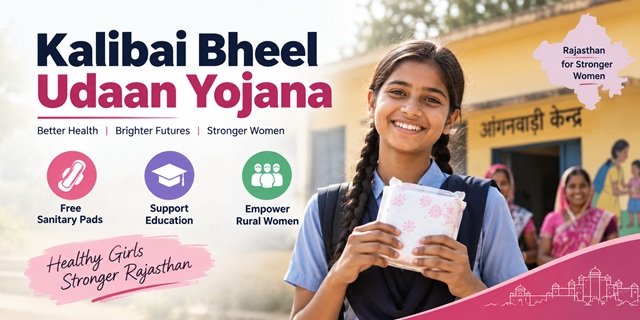
Kalibai Bheel Udaan Yojana, implemented by the Directorate of Women Empowerment, Government of Rajasthan, aims to improve menstrual hygiene among women and adolescent girls by providing free sanitary pads through schools, colleges, and Anganwadi centres. The scheme also supports women’s livelihoods by encouraging sanitary pad production through Self-Help Groups (SHGs).
Rajasthan Kalibai Bheel Udaan Yojana Highlights | |
|---|---|
| Scheme Name | Kalibai Bheel Udaan Yojana |
| Launch Date | 19 November 2021 |
| Earlier Name | I Am Shakti Udaan Yojana |
| Nodal Department | Directorate of Women Empowerment, Government of Rajasthan |
| Supporting Agency | Rajeevika (RGAVP) |
| Main Objective | Promote menstrual hygiene and support women-led livelihood opportunities |
| Primary Benefit | Free sanitary napkins for eligible beneficiaries |
| Coverage | Women and adolescent girls across Rajasthan |
| Distribution Network | Government schools, colleges, Anganwadi centres, and community channels |
| Average Supply | Approximately 12 sanitary pads per month |
| SHG Manufacturing Component | About 20% of pads produced by women’s Self-Help Groups |
| District Production Units | 33 semi-automatic manufacturing units |
| Approved Procurement Rate | Rs. 3.30 per sanitary pad |
| Budget Provision (2025-26) | Rs. 508.25 crore |
| Application Process | No statewide online application; benefit delivered through institutional distribution |
| Helpline Number | 181 (Rajasthan Women Helpline) |
Introduction of Rajasthan Kalibai Bheel Udaan Yojana: A Brief Insight
For many girls and women, something as basic as access to sanitary pads can influence health, confidence, and even school attendance. Recognising this challenge, the Government of Rajasthan launched Kalibai Bheel Udaan Yojana on 19 November 2021, originally under the name “I Am Shakti Udaan Yojana”.
The scheme is implemented by the Directorate of Women Empowerment, Government of Rajasthan in partnership with Rajeevika (RGAVP). Rather than focusing only on product distribution, the initiative aims to improve menstrual hygiene awareness, support the education of adolescent girls, and encourage greater participation of women in everyday social and economic activities.
Another important aspect of the scheme is its livelihood component. Alongside improving access to menstrual hygiene products, Rajasthan has also encouraged women’s Self-Help Groups (SHGs) to participate in sanitary pad manufacturing, creating local employment opportunities across the state.
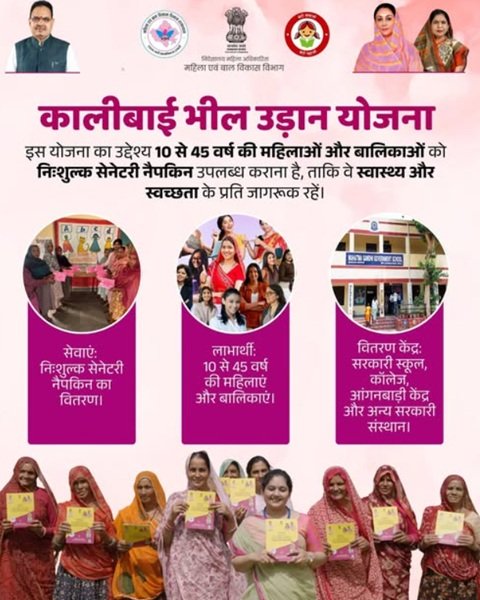
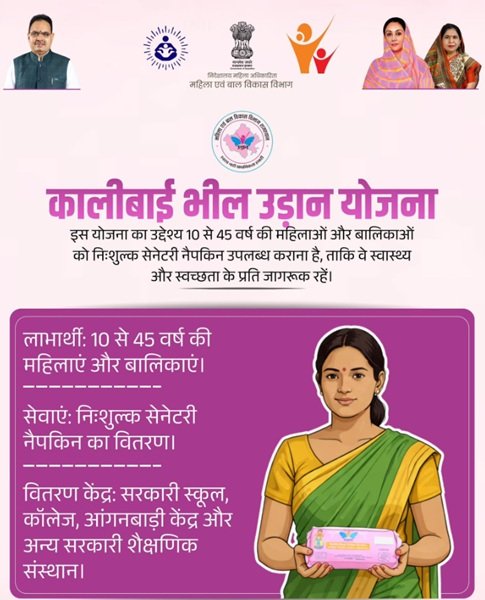
Under the scheme, eligible women and adolescent girls, generally in the 10/11 to 45-year age group, receive 12 free sanitary pads every month. Distribution takes place through schools, colleges, and Anganwadi centres, making the benefit accessible even in remote areas.
Approximately 20% of the sanitary pads supplied under the programme are produced by women’s Self-Help Groups through Rajeevika. To support this model, the state has established 33 production units across Rajasthan. The scheme also receives significant budgetary support, with a provision of Rs. 508.25 crore in Rajasthan’s 2025-26 budget documents.
Unlike many welfare schemes, Kalibai Bheel Udaan Yojana does not require beneficiaries to complete a statewide online application. Instead, sanitary pads are distributed directly through educational institutions, Anganwadi centres, and other approved community-level channels. If you need assistance regarding availability in your area, you can contact your local Women Empowerment Office or call the Rajasthan Women Helpline at 181.
Students should not confuse this programme with the separate Kali Bai Bheel Medhavi Chhatra Scooty Yojana, which rewards academically meritorious girls with scooties or financial assistance. Similarly, the Devnarayan Chatra Scooty Vitran Yojana serves a different purpose for eligible MBC students. Those planning higher education may also explore the PM Vidyalaxmi Yojana, which helps students access collateral-free education loans.
Women, adolescent girls, parents, and readers looking for more welfare initiatives can explore additional programmes on our Rajasthan Government Schemes page.
Benefits Provided to Eligible Beneficiaries
Kalibai Bheel Udaan Yojana goes beyond simple product distribution. Implemented by the Directorate of Women Empowerment of the Government of Rajasthan, the programme combines menstrual hygiene support with awareness initiatives and livelihood opportunities for rural women.
Free Sanitary Napkins
- Free sanitary napkins are provided to eligible women and adolescent girls without any charge
- Distribution is generally carried out in packets containing 6 sanitary pads, with beneficiaries commonly receiving the equivalent of 12 pads every month
- Supplies reach beneficiaries through government schools, colleges, hostels, and Anganwadi centres operating under the scheme
Menstrual Hygiene Awareness
- The scheme also promotes menstrual health awareness and behavioural change activities to improve hygiene practices among girls and women
- Awareness sessions help address myths, misconceptions, and social stigma associated with menstruation
- The initiative encourages informed health choices and greater confidence among adolescent girls
A Women’s Livelihood Angle, Not Just a Health Scheme
One of the most distinctive features of Kalibai Bheel Udaan Yojana is that it supports both beneficiaries and women producers. The programme creates livelihood opportunities for rural women’s groups while simultaneously ensuring access to menstrual hygiene products.
- Approximately 20% of the sanitary napkins supplied under the scheme are intended to be produced by women-led Self-Help Groups (SHGs) associated with Rajeevika/RGAVP
- The Rajasthan Government has approved a uniform procurement rate of Rs. 3.30 per sanitary pad for SHG-manufactured supplies
- 33 semi-automatic sanitary napkin production units have been established across Rajasthan, with one unit located in each district
- According to recent implementation reports, 29,23,986 sanitary pads were distributed through Cluster Level Federations (CLFs), benefiting students in 1,557 schools across 12 districts
Budget Backing the Scheme
- The Rajasthan Government’s 2025-26 Output-Outcome Budget includes a financial provision of approximately Rs. 508.25 crore for the scheme, referenced as Kalibai Bheel Mahila Sambal Yojana/Udaan Scheme
- The dedicated budget allocation reflects the state’s continued focus on menstrual health, women’s welfare, and community-based implementation mechanisms
Eligibility Conditions Required to be Fulfilled
Kalibai Bheel Udaan Yojana is designed to improve menstrual hygiene and health awareness among women and adolescent girls across Rajasthan. Since the scheme functions through institutional distribution rather than individual applications, the eligibility framework published by the government remains relatively broad.
- Beneficiary should be a woman or adolescent girl, generally falling within the 10/11 to 45 years age group covered under the programme
- Must be a resident of Rajasthan
- Benefits are distributed through approved channels such as government schools, colleges, hostels, and Anganwadi centres
- The scheme is intended for girls and women who are part of the institutions and communities covered under the state’s distribution network
What’s Genuinely Not Confirmed
Official materials reviewed so far, including Rajasthan Government budget documents and Rajasthan Grameen Aajeevika Vikas Parishad (RGAVP) progress reports, do not prescribe any officially notified income ceiling, caste-based eligibility condition, BPL requirement, or universally applicable age cut-off for beneficiaries.
Because of this, readers should be careful when relying on websites that claim to provide exact income limits, reservation criteria, or detailed beneficiary categories unless those conditions are supported by an official government notification.
Important Distinction to Remember
Kalibai Bheel Udaan Yojana is often confused with the Kali Bai Bheel Medhavi Chhatra Scooty Yojana. However, both programmes serve completely different purposes. The Scooty Yojana rewards meritorious girl students with scooters, whereas Kalibai Bheel Udaan Yojana focuses on the distribution of sanitary napkins and menstrual hygiene support for women and adolescent girls.
Documents Required to be Attached
Kalibai Bheel Udaan Yojana is not structured like a conventional welfare scheme where beneficiaries submit an application form and upload documents. Since sanitary napkins are distributed directly through educational institutions and Anganwadi centres, the Rajasthan Government has not issued any standard statewide document checklist for individual beneficiaries.
- In certain colleges and educational institutions, beneficiaries have been asked to provide their Jan Aadhaar number during local registration or distribution drives
- Schools, colleges, hostels, or Anganwadi centres may maintain a basic beneficiary record and could request simple identity verification for administrative purposes
- Any document requirement generally depends on the institution conducting the distribution activity rather than a uniform state-level rule
How Beneficiaries Can Apply to Avail the Benefit of the Scheme
Kalibai Bheel Udaan Yojana follows a different model from most government welfare schemes. You don’t need to fill out an online application form or wait for approval. Instead, sanitary pads are distributed directly through schools, colleges, Anganwadi centres, and other local channels. Here’s how you can access the benefit.
Step 1: If you’re studying in a government school or college, start by speaking with your school principal, teacher, or college administration. Many institutions distribute sanitary pads regularly under the scheme.
Step 2: Some colleges may ask students to complete a simple registration using their Jan Aadhaar details before distribution. If your institution follows this process, make sure your registration is completed correctly.
Step 3: If you’re not a student, visit the nearest Anganwadi Centre in your area. Anganwadi centres serve as one of the primary distribution points for beneficiaries covered under the scheme.
Step 4: You can also contact your local ASHA worker or Auxiliary Nurse Midwife (ANM). These frontline health workers often help spread awareness about menstrual hygiene and may guide you regarding pad distribution in your locality.
Step 5: In many rural areas, distribution activities are supported by Rajeevika Self-Help Groups (SHGs) and Cluster Level Federations (CLFs). If SHG-produced sanitary pads are being supplied in your district, these groups may help beneficiaries access them.
Step 6: If you’re unable to get information through any of the above channels, contact your nearest District Women Empowerment Office or the local RGAVP/Rajeevika district office. They can provide the latest details regarding distribution centres and availability in your district.
Important: Remember that Kalibai Bheel Udaan Yojana currently does not have a statewide online application portal for individual beneficiaries. If any website, social media page, or agent asks you to pay money or submit documents online for registration, verify the information carefully before proceeding. Since pad distribution depends on local availability and procurement, the easiest and most reliable way to access the benefit is by checking directly with your school, college, Anganwadi centre, or local health worker.
Important Links Available of the Scheme
- Rajeevika (RGAVP) Official Portal
- Kalibai Bheel Udaan Yojana Reference Page – Jaipur District Administration
Contact Details in Case of Help Needed
- Implementing Authority: Directorate of Women Empowerment, Government of Rajasthan
- Email Support: udaan.we@rajasthan.gov.in
- Women’s Helpline: 181
- District Assistance: Visit or contact your nearest District Women Empowerment Office for scheme-related guidance and local updates.
- Community Support Points: Information regarding pad distribution can also be obtained from your nearest Anganwadi Centre, ASHA Worker, ANM, or the administration of your school or college.
Tip: Since sanitary pads are distributed through local institutions rather than a central application system, the fastest way to get accurate information is usually through your school, college, Anganwadi centre, or district-level women empowerment officials.
Frequently Asked Questions (FAQs)
Q. What is Kalibai Bheel Udaan Yojana?
Ans. Kalibai Bheel Udaan Yojana is a menstrual hygiene initiative implemented by the Directorate of Women Empowerment, Government of Rajasthan. Under the scheme, eligible women and adolescent girls receive free sanitary napkins through government-supported distribution channels across the state.
Q. Is Kalibai Bheel Udaan Yojana the same as Kali Bai Bheel Medhavi Chhatra Scooty Yojana?
Ans. No. These are two different schemes. The Scooty Yojana supports meritorious female students, while Kalibai Bheel Udaan Yojana focuses on menstrual hygiene by providing free sanitary pads.
Q. Who can receive benefits under this scheme?
Ans. The scheme primarily covers women and adolescent girls residing in Rajasthan. Benefits are generally provided through schools, colleges, Anganwadi centres, and other approved distribution networks.
Q. Do I need to fill out an online application form?
Ans. No verified statewide online application portal currently exists for individual beneficiaries. Distribution is carried out directly through institutions and local implementation channels.
Q. How are sanitary pads distributed under the scheme?
Ans. Free sanitary napkins are supplied through government schools, colleges, Anganwadi centres, and selected community-level distribution points across Rajasthan.
Q. How many sanitary pads are generally provided?
Ans. Beneficiaries commonly receive the equivalent of around 12 sanitary pads per month, although actual distribution may vary depending on local supply and implementation arrangements.
Q. Is there any fixed income limit or caste condition for beneficiaries?
Ans. Official documents reviewed for the scheme do not specify any statewide income ceiling, caste-based eligibility condition, or BPL requirement for receiving sanitary pads.
Q. What documents are required to receive benefits?
Ans. There is no officially prescribed statewide document checklist. Some institutions may ask for basic identification details or Jan Aadhaar information for local record-keeping purposes.
Q. Can non-students also receive sanitary pads under the scheme?
Ans. Yes. Apart from educational institutions, beneficiaries may also access distribution through Anganwadi centres and other community-based channels operating in their area.
Q. Why is Rajeevika/RGAVP associated with this scheme?
Ans. A portion of the sanitary pads distributed under the scheme is produced by women’s Self-Help Groups (SHGs) supported through Rajeevika (RGAVP), creating livelihood opportunities alongside menstrual hygiene support.
Q. Where can I get assistance or the latest distribution information?
Ans. You can contact your nearest District Women Empowerment Office, speak with your school or college administration, visit an Anganwadi Centre, call the Rajasthan Women Helpline at 181, or write to udaan.we@rajasthan.gov.in.
Tabassum is a government schemes researcher and writer with 5 years of experience tracking Central and State welfare scheme programmes across India. She has covered 500+ schemes spanning agriculture, women welfare, education, and housing, helping lakhs of beneficiaries understand their entitlements in simple language.