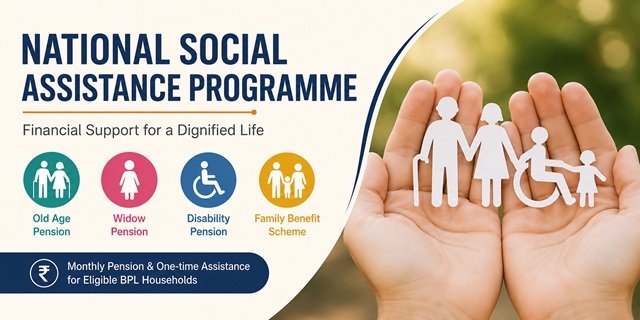
The National Social Assistance Programme (NSAP) is a social security programme of the Government of India that provides financial assistance to eligible Below Poverty Line (BPL) households through four welfare schemes. Implemented by the Department of Rural Development under the Ministry of Rural Development, the programme offers monthly pension support to eligible senior citizens, widows, and persons with severe disabilities, while also providing a one-time financial assistance of ₹20,000 to eligible families after the death of their primary breadwinner.
National Social Assistance Programme (NSAP): Key Highlights | |
|---|---|
| Programme Name | National Social Assistance Programme (NSAP) |
| Implemented By | Department of Rural Development, Ministry of Rural Development, Government of India |
| Introduced In | 1995 |
| Programme Components | Four (IGNOAPS, IGNWPS, IGNDPS, and NFBS) |
| Common Eligibility | Eligible below-the-poverty-line (BPL) households, subject to the conditions prescribed for the respective component |
| Monthly Pension (Central Assistance) | ₹200 to ₹500, depending on the applicable NSAP pension scheme and the beneficiary’s age |
| One-Time Financial Assistance | ₹20,000 under the National Family Benefit Scheme (NFBS) |
| Application Mode | UMANG Portal, UMANG Mobile App, or the authority designated by the concerned State Government or Union Territory |
| Payment Mode | Bank Account or Post Office Savings Account |
| Official Website | nsap.dord.gov.in |
Introduction of National Social Assistance Programme (NSAP): A Brief Overview
The National Social Assistance Programme (NSAP) is one of the Government of India’s major social security initiatives for economically vulnerable households. Introduced in 1995, the programme brings together multiple welfare schemes that provide financial assistance to eligible Below Poverty Line (BPL) families facing different life situations, including old age, widowhood, severe disability, and the loss of a family’s primary breadwinner. The programme is implemented by the Department of Rural Development under the Ministry of Rural Development, Government of India.
The programme reflects the objective of Article 41 of the Constitution of India, which encourages the State to make effective provision for securing public assistance in cases such as old age, sickness, disablement, and other circumstances of need. Instead of providing a single uniform benefit, NSAP operates through separate schemes so that financial assistance can be extended according to the beneficiary’s specific circumstances.
At present, the National Social Assistance Programme (NSAP) comprises four major welfare schemes. These include the Indira Gandhi National Old Age Pension Scheme (IGNOAPS) for eligible senior citizens, the Indira Gandhi National Widow Pension Scheme (IGNWPS) for eligible widows, the Indira Gandhi National Disability Pension Scheme (IGNDPS) for eligible persons with severe or multiple disabilities, and the National Family Benefit Scheme (NFBS), which supports eligible households after the death of their primary breadwinner.
The three pension schemes provide monthly Central financial assistance to eligible beneficiaries, while the National Family Benefit Scheme extends a one-time Central financial assistance of ₹20,000. In addition to the Central assistance, many State Governments and Union Territories provide their own contribution under the pension schemes, resulting in a higher overall benefit for eligible beneficiaries in several parts of the country.
Although each NSAP component has its own eligibility conditions, the programme is primarily intended for eligible Below Poverty Line (BPL) households. Applicants must satisfy the specific requirements prescribed for the respective scheme before their claim can be considered by the competent authority.
Depending on the facilities made available by the concerned State Government or Union Territory, eligible applicants may submit their applications through the UMANG Portal, the UMANG App (Android) or the UMANG App (iOS) mobile application, or by following the offline procedure prescribed by the designated authority. Applicants can also track the progress of their application through the official NSAP Application Status portal.
Those looking for detailed guidance on a particular component of the programme can also explore our dedicated articles on the Indira Gandhi National Old Age Pension Scheme (IGNOAPS), the Indira Gandhi National Widow Pension Scheme (IGNWPS), the Indira Gandhi National Disability Pension Scheme (IGNDPS), and the National Family Benefit Scheme (NFBS) for scheme-specific eligibility, benefits, documents, and application procedures.
Benefits Provided to Eligible Beneficiaries
The National Social Assistance Programme (NSAP) brings together four welfare schemes designed to support different categories of vulnerable households. Depending on the component for which a person qualifies, the programme provides either monthly financial assistance or a one-time family benefit to help meet essential needs during old age, widowhood, severe disability, or the loss of a family’s primary breadwinner.
- Under the Indira Gandhi National Old Age Pension Scheme (IGNOAPS), eligible senior citizens receive ₹200 per month between 60 and 79 years of age, which increases to ₹500 per month after attaining the age of 80 years.
- Under the Indira Gandhi National Widow Pension Scheme (IGNWPS), eligible widows receive ₹300 per month between 40 and 79 years of age, which increases to ₹500 per month after reaching 80 years of age.
- Under the Indira Gandhi National Disability Pension Scheme (IGNDPS), eligible persons with severe or multiple disabilities (80% or more) receive ₹300 per month between 18 and 79 years of age, which increases to ₹500 per month after attaining 80 years of age.
- Under the National Family Benefit Scheme (NFBS), an eligible Below Poverty Line (BPL) household receives a one-time Central financial assistance of ₹20,000 after the death of its primary breadwinner.
- Many State Governments and Union Territories provide an additional contribution over and above the Central assistance under the three pension schemes. As a result, beneficiaries in several States receive a higher monthly amount than the Central share alone.
- After approval of the claim, the sanctioned financial assistance is released to the beneficiary’s bank account or Post Office savings account in accordance with the applicable implementation process.
Eligibility Conditions Required to be Fulfilled
The National Social Assistance Programme (NSAP) consists of multiple welfare schemes, each designed to support a specific category of vulnerable beneficiaries. While the eligibility requirements differ from one component to another, all schemes are intended to assist eligible households belonging to the Below Poverty Line (BPL) category in accordance with the prescribed guidelines.
- The applicant or the applicant’s household should satisfy the Below Poverty Line (BPL) criteria applicable to the respective scheme.
- Each NSAP component has its own additional eligibility conditions based on factors such as age, widowhood, severe disability, or the death of the family’s primary breadwinner.
- Applicants should fulfill all the conditions prescribed for the specific NSAP component under which they are seeking assistance.
- The concerned authority verifies the applicant’s eligibility and supporting documents before approving benefits under the respective scheme.
- Since the detailed eligibility conditions vary across individual NSAP schemes, applicants should also refer to the dedicated guidelines of the respective component before submitting their application.
Documents Required to be Attached
The National Social Assistance Programme (NSAP) includes multiple welfare schemes, and the documents required for each application depend on the specific component under which the benefit is being claimed. However, every application generally requires documents that help the competent authority verify the applicant’s identity, eligibility, and the conditions prescribed for the respective scheme.
- Identity proof of the applicant, such as an Aadhaar Card, Voter ID Card, or any other government-recognised identity document.
- Below Poverty Line (BPL) card or any other document accepted for establishing the household’s BPL status, wherever applicable.
- Scheme-specific supporting document, such as age proof for old age pension, the husband’s death certificate for widow pension, a valid disability certificate for disability pension, or the death certificate of the primary breadwinner for the National Family Benefit Scheme.
- Bank account or Post Office savings account passbook for receiving the sanctioned financial assistance.
- Recent passport-size photographs of the applicant, wherever required during the application process.
- Any additional document prescribed by the concerned State Government or Union Territory for processing the claim.
How Beneficiaries Can Apply to Avail the Benefit of this Scheme
The National Social Assistance Programme (NSAP) covers multiple welfare schemes, and the procedure for submitting an application depends on the component selected by the applicant and the implementation mechanism followed by the concerned State Government or Union Territory. In many cases, eligible beneficiaries can access NSAP services through the UMANG Portal or the UMANG mobile application, while offline applications are accepted through the authority designated by the respective State or Union Territory.
Applying Through the UMANG Portal
Step 1: Visit the official UMANG Portal and sign in using your registered mobile number. New users should complete the registration process before proceeding.
Step 2: Open the National Social Assistance Programme (NSAP) service and select the scheme that corresponds to your eligibility, such as old age pension, widow pension, disability pension, or the National Family Benefit Scheme.
Step 3: Enter the applicant’s details carefully and upload the supporting documents required for the selected NSAP component.
Step 4: Review all the information entered in the application form and submit it after confirming that the details are accurate.
Step 5: Save the acknowledgement or reference number generated after submission, as it may be required to track the progress of your application.
Applying Through the UMANG Mobile App
Step 1: Download the UMANG App for Android or the UMANG App for iPhone (iOS) and log in with your registered mobile number.
Step 2: Search for the National Social Assistance Programme (NSAP) within the application and choose the relevant scheme.
Step 3: Complete the online application by providing the required information and uploading clear copies of the prescribed supporting documents.
Step 4: Verify the details entered in the application and submit the request through the mobile app.
Step 5: Keep the acknowledgement details safely until the application is processed by the competent authority.
Applying Through the Offline Mode
Step 1: Visit the office or authority designated by your State Government or Union Territory for accepting applications under the National Social Assistance Programme.
Step 2: Obtain the application form for the relevant NSAP component and complete it with the required personal and eligibility details.
Step 3: Attach the prescribed supporting documents and submit the completed application to the concerned office.
Step 4: The competent authority examines the application and verifies the eligibility conditions in accordance with the applicable scheme guidelines.
Step 5: After approval, the financial assistance is released through the payment mechanism prescribed for the respective NSAP component and the concerned State or Union Territory.
Applicants may also use the official NSAP Application Status portal to check the latest status of their application by entering the required details.
Important Links Available
The following official resources can help applicants understand the National Social Assistance Programme (NSAP), access online services, track applications, and explore the individual welfare schemes implemented under the programme.
- National Social Assistance Programme (NSAP) Official Portal
- UMANG Portal
- UMANG App for Android and UMANG App for iPhone (iOS)
- NSAP Application Status Portal
- Indira Gandhi National Old Age Pension Scheme (IGNOAPS)
- Indira Gandhi National Widow Pension Scheme (IGNWPS)
- Indira Gandhi National Disability Pension Scheme (IGNDPS)
- National Family Benefit Scheme (NFBS)
Contact Details in Case of Help Needed
If you require assistance regarding any component of the National Social Assistance Programme, you may contact the National Social Assistance Programme (NSAP) Division using the details below.
- Department: National Social Assistance Programme (NSAP) Division, Department of Rural Development, Ministry of Rural Development, Government of India
- Office Address: Kartavya Bhavan-3, New Delhi – 110114
- Email: mis-nsap@nic.in
Applicants may also contact the authority designated by their respective State Government or Union Territory for assistance with eligibility, document verification, application submission, or payment-related queries.
Frequently Asked Questions (FAQs)
Q. What is the National Social Assistance Programme (NSAP)?
Ans. The National Social Assistance Programme (NSAP) is a welfare programme of the Government of India introduced in 1995. It provides financial assistance to eligible Below Poverty Line (BPL) households through different social security schemes covering old age, widowhood, severe disability, and the death of a family’s primary breadwinner.
Q. Which schemes are implemented under NSAP?
Ans. NSAP currently comprises four major welfare schemes: the Indira Gandhi National Old Age Pension Scheme (IGNOAPS), the Indira Gandhi National Widow Pension Scheme (IGNWPS), the Indira Gandhi National Disability Pension Scheme (IGNDPS), and the National Family Benefit Scheme (NFBS).
Q. Which department implements the National Social Assistance Programme?
Ans. The programme is implemented by the Department of Rural Development under the Ministry of Rural Development, Government of India.
Q. Is Below Poverty Line (BPL) status necessary to receive benefits under NSAP?
Ans. Yes. The programme is intended for eligible Below Poverty Line (BPL) households, along with the additional eligibility conditions prescribed for the respective NSAP component.
Q. Do all NSAP schemes provide a monthly pension?
Ans. No. The three pension schemes provide monthly financial assistance, whereas the National Family Benefit Scheme (NFBS) provides a one-time financial assistance of ₹20,000 after the death of an eligible family’s primary breadwinner.
Q. Is the financial assistance the same in every State?
Ans. The Central Government provides a fixed amount under each NSAP component. However, many State Governments and Union Territories contribute an additional amount, so the total benefit received may vary from one State or Union Territory to another.
Q. How can beneficiaries apply under NSAP?
Ans. Eligible applicants may submit their application through the UMANG Portal, the UMANG mobile application, or the authority designated by their respective State Government or Union Territory, depending on the implementation mechanism followed in that area.
Q. How is the financial assistance released to beneficiaries?
Ans. After approval of the application, the sanctioned financial assistance is released to the beneficiary’s bank account or Post Office savings account in accordance with the applicable implementation process.
Q. How can applicants check the status of their application?
Ans. Applicants can track the progress of their application through the official NSAP Application Status portal using the required application details.
Q. Is there any application fee for NSAP?
Ans. No. The Central Government does not prescribe any application fee for submitting an application under the National Social Assistance Programme.
Q. Who supervises the implementation of NSAP?
Ans. The implementation of the National Social Assistance Programme is monitored by the Department of Rural Development in coordination with the concerned State Governments and Union Territories in accordance with the programme guidelines.

Tabassum is a government schemes researcher and writer with 5 years of experience tracking Central and State welfare scheme programmes across India. She has covered 500+ schemes spanning agriculture, women welfare, education, and housing, helping lakhs of beneficiaries understand their entitlements in simple language.