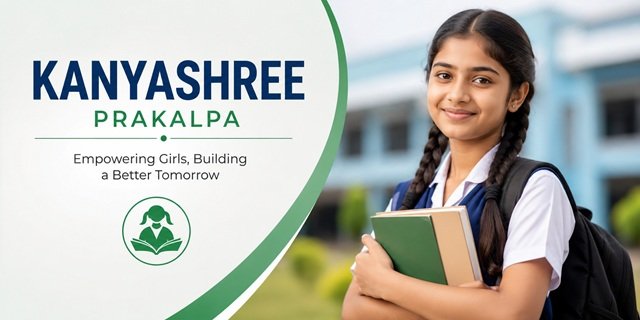
Kanyashree Scheme is a flagship social welfare scheme of the Government of West Bengal that encourages girls to continue their education and discourages child marriage through direct financial assistance. Implemented by the Department of Women Development and Social Welfare, the scheme provides an Annual Scholarship (K1) of ₹1,000 to eligible girls aged 13 to 18 years and a One-Time Grant (K2) of ₹25,000 after they attain 18 years of age, subject to fulfilling the prescribed eligibility conditions. Eligible former beneficiaries can also receive financial support for postgraduate studies under the K3 component of the Swami Vivekananda Merit-cum-Means Scholarship (SVMCM).
West Bengal Kanyashree Scheme Highlights | |
|---|---|
| Scheme Name | Kanyashree Scheme |
| Launch Date | 1 October 2013 |
| Implemented By | Department of Women Development and Social Welfare, Government of West Bengal |
| Eligible Beneficiaries | Eligible unmarried girls aged 13 to 19 years who are permanent residents of West Bengal |
| Annual Scholarship (K1) | ₹1,000 per year |
| One-Time Grant (K2) | ₹25,000 |
| K3 Scholarship | ₹2,000 per month (Arts/Commerce) or ₹2,500 per month (Science) for eligible former beneficiaries pursuing postgraduate studies |
| Family Income Limit | ₹1,20,000 per year (not applicable to certain exempt categories) |
| Application Mode | Offline through the applicant’s recognised educational institution |
| Payment Mode | Direct Benefit Transfer (DBT) to the beneficiary’s bank account |
| Official Website | wbkanyashree.gov.in |
Introduction of Kanyashree Scheme: A Brief Insight
Kanyashree Scheme is one of the flagship social welfare schemes of the Government of West Bengal, launched to encourage girls to continue their education and discourage child marriage. Introduced on 1 October 2013 by Chief Minister Mamata Banerjee, the scheme provides financial assistance to eligible unmarried girls studying in recognised educational institutions, helping them complete their education and build a secure future.
The Department of Women Development and Social Welfare, Government of West Bengal, implements the scheme in coordination with the School Education, Higher Education, Technical Education, and other concerned departments. The financial assistance is transferred directly into the beneficiary’s own bank account through the Direct Benefit Transfer (DBT) system, ensuring transparency and timely payments.
Under the Kanyashree Scheme, eligible girls aged between 13 and 18 years receive an Annual Scholarship (K1) of ₹1,000, provided they continue their education and remain unmarried. After attaining 18 years of age, eligible beneficiaries can receive a One-Time Grant (K2) of ₹25,000 if they are still unmarried and pursuing education or vocational training. In addition, former Kanyashree beneficiaries who complete graduation with at least 45% marks can apply for the K3 component under the Swami Vivekananda Merit-cum-Means Scholarship (SVMCM) to receive financial assistance for postgraduate studies.
To receive the scheme benefits, the applicant must be an unmarried resident of West Bengal, fulfil the prescribed age criteria, study in a recognised educational institution, and satisfy the applicable eligibility conditions. The annual family income should not exceed ₹1,20,000, although this condition is relaxed for eligible applicants with a disability of 40% or more, applicants who have lost both parents, and girls residing in homes registered under the Juvenile Justice Act.
The application process is simple and institution-based. Eligible applicants need to collect the prescribed application form from their school, college, or recognised educational institution, submit the required documents, and hand over the completed form to the Head of Institution. The institution verifies the application and uploads it to the official Kanyashree portal for further processing, after which the financial assistance is credited directly to the beneficiary’s bank account upon approval.
Applicants who require any assistance during the application, renewal, or payment process should first contact the Head of Institution. If the issue remains unresolved, they may approach the District Kanyashree Nodal Officer or use the official Kanyashree Help Desk for further support.
Kanyashree Scheme forms an important part of West Bengal’s efforts to improve girls’ education and reduce child marriage. While this scheme focuses on encouraging adolescent girls to remain in education through financial assistance, the state also runs several other welfare programmes that support students belonging to different age groups and social categories.
Depending on their eligibility, students may also benefit from the Sarathi Scheme, which provides bicycles to school students for easier access to education, the Shikshashree Scheme for eligible Scheduled Caste and Scheduled Tribe students, and the Medhashree Scheme, which supports eligible students from Other Backwards Classes pursuing school education.
Benefits Provided to Eligible Beneficiaries
Under Kanyashree Scheme, eligible girls receive financial assistance to continue their education and delay early marriage. Besides monetary support, the scheme also promotes financial inclusion, higher education, life skills, and women’s empowerment through various complementary initiatives.
- Annual Scholarship (K1): Eligible girls receive an annual scholarship of ₹1,000, credited directly to their own bank account, provided they continue their education and remain unmarried.
- One-Time Grant (K2): Eligible beneficiaries receive a one-time grant of ₹25,000 after attaining 18 years of age, subject to continuing their education or vocational training and remaining unmarried.
- Support for Higher Education (K3): Former Kanyashree beneficiaries securing at least 45% marks in graduation may apply for monthly financial assistance under the K3 component of the Swami Vivekananda Merit-cum-Means Scholarship (SVMCM).
- Direct Benefit Transfer (DBT): Scholarship and grant amounts are transferred directly to the beneficiary’s own bank account through the Direct Benefit Transfer (DBT) system.
- Kanyashree ID Card and Certificate: Every enrolled beneficiary receives a Kanyashree ID and Identity Card, while K2 beneficiaries are also issued a Kanyashree Certificate.
- Kanyashree Plus Activities: Beneficiaries can participate in Kanyashree Clubs, career guidance programmes, life skills education, financial literacy sessions, and awareness activities organised under the Kanyashree Plus initiative.
- Financial Independence: Since payments are made directly into the beneficiary’s own bank account, the scheme encourages financial inclusion and helps girls manage their own finances.
- Award-Winning Initiative: Kanyashree Scheme has received several prestigious honours, including the United Nations Public Service Award, recognising its contribution towards girls’ education and empowerment.
Eligibility Conditions Required to be Fulfilled
Applicants must fulfil the following eligibility conditions to receive benefits under the Kanyashree Scheme. The eligibility criteria vary slightly for the Annual Scholarship (K1) and the One-Time Grant (K2).
- Age Requirement: Girls aged between 13 and 18 years are eligible for the Annual Scholarship (K1), while girls aged between 18 and 19 years can apply for the One-Time Grant (K2).
- Unmarried Status: The applicant must be unmarried at the time of application and continue to remain unmarried to receive the scheme benefits.
- Permanent Resident of West Bengal: The applicant must be a permanent resident of West Bengal.
- Educational Enrolment: The applicant must be studying in Class VIII or above at a Government-recognised school, madrasa, college, open school, open university, or a recognised vocational, technical, or industrial training institution. Students enrolled in a Sports Training Institute are eligible only for the One-Time Grant (K2).
- Exemption from Class VIII Requirement: Girls with a disability of 40% or more are exempt from the minimum Class VIII enrolment condition.
- Bank Account: The applicant must have a bank account in her own name, with her mother or a female guardian registered as the nominee.
- Family Income Limit: The annual family income must not exceed ₹1,20,000.
- Exemption from Income Limit: The family income criterion does not apply to applicants with a disability of 40% or more, applicants who have lost both parents, or applicants residing in a home registered under the Juvenile Justice Act.
Documents Required to be Attached
Applicants should submit the following documents while applying for the Kanyashree Scheme. Some documents are required only for fresh applications or upgrades, while others may not be needed during the annual scholarship renewal process.
- Birth Certificate: Required for fresh applications under the Annual Scholarship (K1) or the One-Time Grant (K2). Girls residing in a home registered under the Juvenile Justice Act may submit age certification from the Head of Institution if a birth certificate is unavailable.
- Declaration of Marital Status: A declaration confirming that the applicant is unmarried. It must be signed by the parent or legal guardian if the applicant is below 18 years of age, or self-declared if she is 18 years or above. This declaration is required for fresh applications as well as annual renewals.
- Family Income Certificate: Required for fresh K1 or K2 applications and when upgrading from K1 to K2, showing that the annual family income does not exceed ₹1,20,000. It is not required during renewal and is waived for eligible applicants submitting a Disability Certificate.
- Bank Passbook: A photocopy of the first page of the applicant’s own bank passbook showing her name, account number, and other relevant details. Required for fresh applications and upgrades.
- Disability Certificate: Required only if the applicant has a disability of 40% or more. Eligible applicants receive exemption from the family income limit and the minimum Class VIII enrolment requirement.
- Death Certificates of Both Parents with Guardian’s Declaration: Required only if both parents are deceased. Eligible applicants are exempt from the family income condition.
- Certificate of Residence in a Juvenile Justice Home: Required only for applicants residing in a home registered under the Juvenile Justice Act. This also exempts the applicant from the family income condition.
- Recent Passport-Size Photograph: A recent passport-size photograph to be submitted with the application form.
- Parent’s or Legal Guardian’s Voter ID: A photocopy may be required as identity proof during enrolment or document verification.
How Beneficiaries Can Apply to Avail the Benefit of this Scheme
Eligible girls can apply for the Kanyashree Scheme through their school, college, or other recognised educational institution. The application process differs for fresh applicants, Annual Scholarship (K1) renewals, and upgradation to the One-Time Grant (K2). The step-by-step process for each category is explained below.
Fresh Application for the Annual Scholarship (K1) or the One-Time Grant (K2)
Step 1: Obtain the prescribed Kanyashree Scheme application form from the Head of Institution. The K1 (Annual Scholarship) form is printed on light green paper, while the K2 (One-Time Grant) form is printed on light blue paper.
Step 2: Open a bank account in your own name, if you do not already have one, and keep your bank passbook ready for the application process.
Step 3: Fill in the application form carefully and attach all the required documents, including your birth certificate, marital status declaration, family income certificate or disability certificate (where applicable), bank passbook copy, and other supporting documents.
Step 4: Submit the completed application form to the Head of Institution. After verifying your documents, the Head of Institution will sign and stamp the acknowledgement slip and return it to you for future reference.
Step 5: The Head of Institution uploads your application on the Kanyashree portal, after which a unique Kanyashree ID is generated. You will also receive your Kanyashree Identity Card through your educational institution.
Step 6: The application is verified by the concerned authorities. Once approved, the scholarship or grant amount is transferred directly to your registered bank account through Direct Benefit Transfer (DBT), and an SMS is sent to your registered mobile number.
Renewal of the Annual Scholarship (K1 to K1)
Step 1: Continue studying in a recognised educational institution and remain unmarried during the scholarship period.
Step 2: Submit a fresh declaration confirming your unmarried status to the Head of Institution. Other documents, such as the birth certificate, family income certificate, and bank passbook, are generally not required again during renewal.
Step 3: The Head of Institution verifies your eligibility and processes the renewal through the Kanyashree portal using the Bulk Renewal facility.
Step 4: After the renewal process is completed, the institution displays the list of renewed beneficiaries on its notice board or informs eligible students accordingly.
Step 5: Once the renewal is approved, the Annual Scholarship amount is credited directly to the bank account linked with your Kanyashree ID.
Upgradation from the Annual Scholarship to the One-Time Grant (K1 to K2)
Step 1: After attaining 18 years of age, while continuing your education and remaining unmarried, inform the Head of Institution that you wish to apply for the K2 One-Time Grant.
Step 2: The Head of Institution generates a pre-filled K2 application form using your existing Kanyashree ID.
Step 3: Verify the details in the application form, complete any remaining information, and attach the required documents, including your birth certificate, marital status declaration, updated family income certificate (where applicable), and bank passbook copy.
Step 4: Submit the completed application to the Head of Institution. Your application is then forwarded for the required verification, including a home visit wherever applicable under the scheme guidelines.
Step 5: After successful verification and approval by the competent authority, the ₹25,000 One-Time Grant (K2) is credited directly to your bank account, and you are also issued a Kanyashree Certificate.
How to Check Kanyashree Scheme Application Status?
Applicants can easily track the status of their Kanyashree Scheme application through the official Kanyashree portal. To check the latest status, they only need their Application Form Number or Kanyashree ID.
Step 1: Visit the official Kanyashree Scheme Application Status page at https://www.wbkanyashree.gov.in/kp_4.0/track_application.php.
Step 2: Enter your Application Form Number or Kanyashree ID in the required field.
Step 3: Complete the verification, if prompted, and click on the Submit or Track button.
Step 4: Your application status will appear on the screen, showing whether it is under verification, approved, rejected, or the scholarship amount has been released.
Step 5: If the application remains pending for a long time or shows any discrepancy, contact the Head of Institution or the District Kanyashree Nodal Officer for further assistance.
Important Links Available
The following official links provide authentic information related to the Kanyashree Scheme, including application services, application status, scheme guidelines, and higher education support for eligible beneficiaries.
- Kanyashree Scheme Official Portal
- Track Your Kanyashree Application
- Swami Vivekananda Merit-cum-Means Scholarship (SVMCM) Portal
Contact Details in Case of Help Needed
Applicants facing any difficulty during the application, renewal, or payment process should first contact their educational institution. If further assistance is required, they may use the following official contact details.
- First Point of Contact: Head of Institution or class teacher of the applicant’s school, college, or training institution.
- Nodal Department: Department of Women Development and Social Welfare, Government of West Bengal.
- Help Desk Number: +91 9007462088
- Email Address: support.kanyashree@nic.in
- District Kanyashree Nodal Officer: Applicants may also contact the designated District Kanyashree Nodal Officer for assistance.
- Online Grievance Portal: Submit complaints or grievances through the Kanyashree Scheme Portal using your application details.
Frequently Asked Questions (FAQs)
Q. What is Kanyashree Scheme?
Ans. Kanyashree Scheme is a flagship scheme of the Government of West Bengal that provides financial assistance to eligible girls to encourage them to continue their education and remain unmarried until at least 18 years of age.
Q. Which department implements Kanyashree Scheme?
Ans. The Department of Women Development and Social Welfare, Government of West Bengal implements the scheme in coordination with recognised educational institutions across the state.
Q. What are K1 and K2 under Kanyashree Scheme?
Ans. K1 is the Annual Scholarship of ₹1,000 provided to eligible girls aged 13 to 18 years, while K2 is a one-time grant of ₹25,000 given to eligible girls after they attain 18 years of age and continue their education or vocational training while remaining unmarried.
Q. Is there any scholarship after K1 and K2?
Ans. Yes. Eligible former Kanyashree beneficiaries who secure at least 45% marks in graduation can apply for the K3 component under the Swami Vivekananda Merit-cum-Means Scholarship (SVMCM) for postgraduate studies.
Q. Is there any family income limit to apply?
Ans. Yes. The applicant’s annual family income should not exceed ₹1,20,000. However, this condition does not apply to eligible applicants with a disability of 40% or more, applicants who have lost both parents, or applicants residing in a home registered under the Juvenile Justice Act.
Q. Which documents are required for a fresh application?
Ans. Applicants generally need a birth certificate, marital status declaration, family income certificate (where applicable), bank passbook, passport-size photograph, and other supporting documents prescribed under the scheme.
Q. Do I need to submit fresh documents every year?
Ans. No. During the Annual Scholarship (K1) renewal process, applicants generally need to submit only a fresh declaration confirming their unmarried status.
Q. How can I apply for Kanyashree Scheme?
Ans. Eligible applicants can collect the prescribed application form from their school, college, or recognised educational institution, attach the required documents, and submit it to the Head of Institution for processing through the Kanyashree portal.
Q. Whom should I contact if I face any problem with my application?
Ans. Applicants should first contact the Head of Institution of their school or college. If further assistance is required, they may contact the District Kanyashree Nodal Officer or the official Kanyashree Help Desk.

Tabassum is a government schemes researcher and writer with 5 years of experience tracking Central and State welfare scheme programmes across India. She has covered 500+ schemes spanning agriculture, women welfare, education, and housing, helping lakhs of beneficiaries understand their entitlements in simple language.