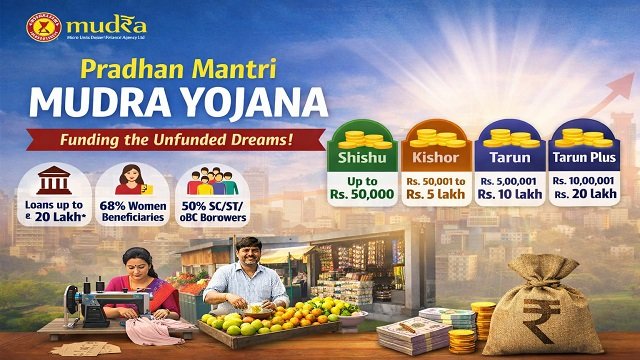
The Government of India launched the Pradhan Mantri Mudra Yojana (PMMY) on 8 April 2015 to provide easy and affordable collateral-free business loans to small entrepreneurs, street vendors, and micro business owners across the country. Under this scheme, eligible applicants can get loans of up to Rs. 20 lakh to start or expand their income-generating business activities. This scheme is especially beneficial for first-generation entrepreneurs and small business owners who do not have access to formal institutional credit.
Pradhan Mantri Mudra Yojana (PMMY) Highlights | |
|---|---|
| Scheme Name | Pradhan Mantri Mudra Yojana (PMMY). |
| Year of Launch | 8 April 2015. |
| Benefits Provided | Business Loans up to Rs. 20 Lakh. |
| Eligible Beneficiaries | Non-corporate, non-farm micro and small entrepreneurs. |
| Responsible Department | Ministry of Finance. |
| Official Website | www.mudra.org.in. |
| How to Apply | Online via the Jan Samarth Portal or offline at the nearest bank branch. |
| Free Scheme Updates | WhatsApp | Telegram |
Introduction of Pradhan Mantri Mudra Yojana: A Brief Insight
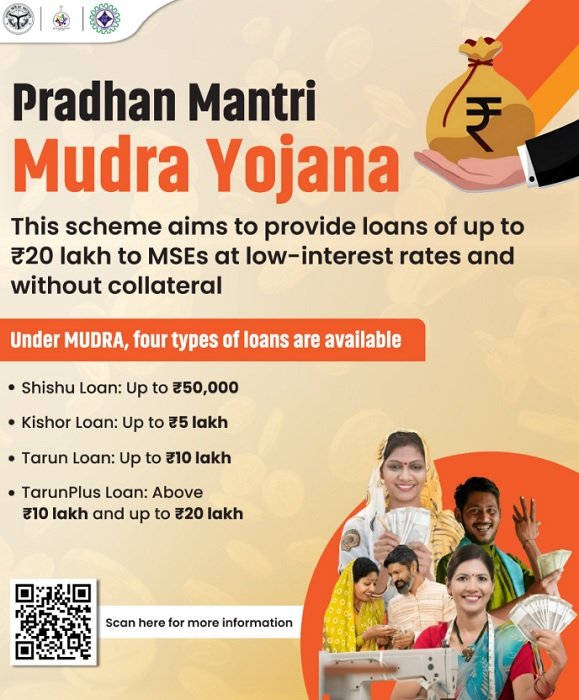
The Pradhan Mantri Mudra Yojana (PMMY) is one of India’s most impactful financial inclusion schemes, launched on 8 April 2015 by Prime Minister Shri Narendra Modi. The scheme runs on a simple but powerful mission – “Funding the Unfunded.” Before PMMY, millions of small business owners across the country had no access to affordable institutional credit. They were forced to borrow from local moneylenders at exploitative interest rates. PMMY changed this reality.
Under this scheme, collateral-free business loans of up to Rs. 20 lakh are available to non-corporate, non-farm micro and small entrepreneurs through Member Lending Institutions (MLIs) such as Scheduled Commercial Banks, Regional Rural Banks (RRBs), Small Finance Banks (SFBs), Non-Banking Financial Companies (NBFCs), and Microfinance Institutions (MFIs). The loan limit was originally Rs. 10 lakh, which was enhanced to Rs. 20 lakh in the Union Budget 2024-25. This new limit came into effect on 24 October 2024.
In its 10 years of operation, Pradhan Mantri Mudra Yojana has sanctioned over 52.37 crore loans worth Rs. 33.65 lakh crore, making it one of the largest micro-credit programmes in the world. Nearly 68% of all MUDRA loan accounts belong to women entrepreneurs, and over 50% of beneficiaries come from SC/ST/OBC communities. The scheme has not just provided credit – it has created jobs, built businesses, and given millions of Indians the confidence to become job creators instead of job seekers.
Applicants can apply for a Mudra Loan both online through the Jan Samarth Portal and offline at any bank branch or NBFC across India.
If you are a street vendor or small shopkeeper looking for quick financial support, you can also explore the PM SVANidhi Scheme, which provides working capital loans to help restart or grow small businesses.
The Complete List of Central Government Welfare Schemes can be checked here.
Mudra Loan Categories Explained: Shishu, Kishor, Tarun & Tarun Plus (Loan Limits & Eligibility)
Pradhan Mantri Mudra Yojana divides its loans into four categories based on the stage of business growth and the amount of funding required. This structure ensures that both first-time micro entrepreneurs and growing small businesses get the right level of support without over-borrowing.
| Category | Loan Amount | Who Should Apply |
|---|---|---|
| Shishu | Up to Rs. 50,000 | First-time borrowers, very small or new businesses just starting out |
| Kishor | Rs. 50,001 to Rs. 5 lakh | Existing businesses that need working capital or moderate expansion |
| Tarun | Rs. 5,00,001 to Rs. 10 lakh | Established small businesses planning significant expansion or asset purchase |
| Tarun Plus | Rs. 10,00,001 to Rs. 20 lakh | Only for borrowers who have already availed and successfully repaid a Tarun loan |
Important: The Tarun Plus category was introduced via the Union Budget 2024-25 and became effective from 24 October 2024. Loans under this category also get coverage from the Credit Guarantee Fund for Micro Units (CGFMU), so no separate collateral is needed even at this higher loan level.
Benefits Provided to Eligible Beneficiaries
The Pradhan Mantri Mudra Yojana (PMMY) offers multiple financial and practical benefits to small business owners, helping them start, sustain, and expand their income-generating activities. The scheme is designed to support micro-entrepreneurs at every stage of their business journey with easy access to credit and flexible repayment options.
Below are the key benefits provided under the Mudra Yojana:
- Collateral-free loans up to Rs. 20 lakh – No property or asset needs to be pledged as security, making it genuinely accessible for first-generation entrepreneurs.
- Four loan categories – Shishu (up to Rs. 50,000), Kishor (Rs. 50,001 to Rs. 5 lakh), Tarun (Rs. 5 lakh to Rs. 10 lakh), and Tarun Plus (Rs. 10 lakh to Rs. 20 lakh) – so applicants borrow only what they need at their stage of business.
- MUDRA Card – A RuPay debit card that gives working capital access in a flexible overdraft format. You can use it at ATMs, Point of Sale (POS) machines, or through Business Correspondents.
- Minimal documentation for Shishu category loans – most banks also waive processing charges for Shishu loans.
- Covers agriculture-allied activities too – poultry, dairy, beekeeping, and other agri-linked businesses qualify under PMMY.
- Interest subvention available – During the Aatma Nirbhar Bharat Abhiyan (2020-21), the government offered 2% interest subvention on all Shishu loans for prompt repayment.
- CGFMU guarantee cover – The Credit Guarantee Fund for Micro Units (established 2016) backs PMMY loans, giving lenders the confidence to lend and borrowers the protection they need.
- Broad sector coverage – Manufacturing, trading, services, transport, food processing, textile, and agri-allied activities all qualify.
- MUDRA MITRA app – Available on Google Play Store and Apple App Store, this app helps loan seekers find the right bank, access sample application forms, and understand the scheme better.
One of the biggest advantages of this scheme is that it focuses on empowering small entrepreneurs who usually struggle to get loans from traditional sources. By providing easy and affordable credit, Mudra Yojana plays an important role in boosting grassroots-level businesses across India.
To secure your future income, you may also consider the Pradhan Mantri Shram Yogi Maandhan Yojana, which provides a monthly pension of Rs. 3,000 after the age of 60 years to unorganised sector workers.
Eligibility Conditions Required to be Fulfilled
PM Mudra Yojana keeps its eligibility criteria simple and inclusive. The scheme is open to a wide range of business structures – from individual street vendors to small private companies. If you run or want to start any income-generating non-farm activity, you most likely qualify. Here are the key conditions to check before you apply:
The key eligibility requirements are as follows:
- Applicant must be an Indian citizen.
- Age of the applicant should generally be between 18 to 65 years.
- Applicant should be engaged in a non-corporate, non-farm income-generating activity.
- Individuals, proprietorship firms, partnership firms, and small business units are eligible to apply.
- Business activities such as manufacturing, trading, services, transport, and food-related work are covered under the scheme.
- The applicant should have a clear business plan or idea for starting or expanding the business.
- Applicant must not be a defaulter of any bank or financial institution.
- Business activity must be in manufacturing, trading, services, transport, or agriculture-allied sectors such as poultry, dairy, or beekeeping.
- Applicant must have the necessary skill, experience, or knowledge relevant to the proposed business activity.
- Private Limited Companies and Public Companies are also eligible (not just individuals).
Documents Required to be Attached
The documentation process under Prime Minister Mudra Yojana is deliberately kept light, especially for smaller loan amounts. Banks and NBFCs have the flexibility to ask for additional documents based on their internal policies, but the basic list remains standard across most lenders. First-time applicants should note that Shishu category loans (up to Rs. 50,000) often require the least paperwork and can be processed faster than higher categories.
The exact document requirements may slightly vary depending on the bank or financial institution, but generally, the following documents are required:
- Aadhaar Card or any valid Identity Proof (for verification of applicant).
- Address Proof such as Voter ID, Electricity Bill, or Rent Agreement.
- PAN Card (mandatory for higher loan amounts).
- Recent Passport Size Photographs.
- Business Proof, such as a Shop License, Registration Certificate, or any valid document showing business activity.
- Bank Account Details or last 6 months Bank Statement.
- Quotation of machinery or equipment (if applying for business expansion or purchase).
- Simple Business Plan or details of the activity for which a loan is required.
How Beneficiaries Can Apply to Avail the Benefit of this Scheme
Applying for the Pradhan Mantri Mudra Yojana (PMMY) is a simple and flexible process designed to help small business owners easily access credit. Applicants can choose between online and offline methods based on their convenience. To increase approval chances and avoid delays, it is important to follow the correct step-by-step process and submit complete information.
Online Application Process (Through Jan Samarth Portal)
The Government of India has introduced the Jan Samarth Portal to provide a single platform for applying to various credit-linked schemes, including Mudra Loan. Follow the steps below to apply online:
- Step 1: Visit the official Jan Samarth Portal using your browser.
- Step 2: On the homepage, select the “Business Activity Loan” category.
- Step 3: Choose the Mudra Loan option from the available schemes.
- Step 4: Register yourself using your mobile number and complete OTP verification.
- Step 5: Fill in the online application form with your personal details such as name, address, age, and Aadhaar information.
- Step 6: Enter your business details, including the type of activity, investment requirement, and purpose of loan (start or expansion).
- Step 7: Upload required documents such as identity proof, address proof, bank details, and business-related documents.
- Step 8: Review all the information carefully before final submission.
- Step 9: Submit the application form online.
- Step 10: After submission, your application will be forwarded to the concerned bank for verification.
- Step 11: The bank may contact you for additional details or clarification if required.
- Step 12: Once verified and approved, the loan amount will be directly credited to your bank account.
Applying through the online portal saves time and allows you to track your application status easily without visiting any office.
Offline Application Process (Through Bank Branch)
Applicants who prefer personal assistance or are not comfortable with online systems can apply offline by visiting their nearest bank branch, NBFC, or microfinance institution offering Mudra loans.
- Step 1: Visit your nearest public sector bank, private bank, or NBFC that provides Mudra loans.
- Step 2: Ask for the Mudra Loan application form from the bank official.
- Step 3: Carefully fill out the application form with correct personal and business details.
- Step 4: Attach all required documents such as Aadhaar Card, PAN Card, address proof, photographs, and business proof.
- Step 5: Submit the completed application form to the concerned bank officer.
- Step 6: The bank will verify your documents and assess your business proposal.
- Step 7: You may be called for a discussion or asked to provide additional details regarding your business plan.
- Step 8: After successful verification, the bank will approve your loan application.
- Step 9: The sanctioned loan amount will be disbursed directly into your bank account.
The offline method is especially useful for first-time applicants who need guidance during the application process. Bank officials can help you understand the scheme, check your eligibility, and ensure that your application is correctly submitted.
Whether applying online or offline, it is important to provide accurate information and complete documents to improve your chances of quick approval under the Mudra Yojana.
PM Mudra Yojana Achievements: Why This Scheme Has Changed the Game
Numbers tell the real story of PMMY’s impact across India. Since its launch in April 2015, the scheme has grown consistently every single year – except FY 2020-21 when COVID-19 disrupted economic activity across the country.
| Financial Year | Loans Sanctioned (in Crore) | Amount Sanctioned (Rs. in Lakh Crore) |
|---|---|---|
| 2015-16 | 3.49 | 1.37 |
| 2016-17 | 3.97 | 1.80 |
| 2017-18 | 4.81 | 2.54 |
| 2018-19 | 5.98 | 3.22 |
| 2019-20 | 6.23 | 3.37 |
| 2020-21 | 5.07 | 3.22 (COVID impact) |
| 2021-22 | 5.38 | 3.39 |
| 2022-23 | 6.24 | 4.56 |
| 2023-24 | 6.67 | 5.41 |
| 2024-25 (till March 2025) | 4.53 | 4.77 |
| Total | 52.37 | 33.65 |
A few standout facts from the data:
- Nearly 68% of total MUDRA loan accounts have been sanctioned to women entrepreneurs – making PMMY one of the most women-centric credit schemes in India.
- Over 50% of loans have gone to SC/ST/OBC borrowers, directly addressing financial inequality at the grassroots level.
- The average loan amount has grown from Rs. 24,746 in 2015-16 to Rs. 64,537 in 2024-25 – a 160% rise that reflects growing borrower confidence and business scale.
- Tamil Nadu leads state-wise disbursals with Rs. 3,23,647.76 crore, followed by Uttar Pradesh (Rs. 3,14,360.86 crore) and Karnataka (Rs. 3,02,146.41 crore).
- Among Union Territories, Jammu & Kashmir tops with Rs. 45,815.92 crore disbursed across 21.33 lakh accounts.
- MSME lending in India surged from Rs. 8.51 lakh crore in FY14 to Rs. 27.25 lakh crore in FY24 – a growth significantly driven by PMMY’s momentum.
Who Should Apply for Pradhan Mantri Mudra Yojana (PMMY)?
The Pradhan Mantri Mudra Yojana is built for India’s grassroots economy — the millions of small businesses that run our streets,
markets, and neighbourhoods but have always struggled to access formal credit. If you earn your livelihood through any small
business activity and need funds to start or grow it, PMMY is designed for you. The following categories of people are the
primary target beneficiaries of this scheme:
- Small shopkeepers, kirana store owners, and retail traders.
- Street vendors, hawkers, and small market sellers.
- Repair shop owners – mobile, electronics, vehicles, and more.
- Small manufacturers, weavers, potters, and artisans.
- Transport operators – auto-rickshaw, taxi, and small goods vehicle owners.
- Food processing units, dhabas, small restaurants, and catering services.
- Beauty parlours, salons, and personal care service providers.
- Women entrepreneurs and self-help group members starting or expanding any small business.
- First-generation entrepreneurs with a business idea but no access to formal capital.
One important thing to remember – you do not need to already have a running business to apply for a Mudra Loan. If you have a
clear business plan and meet the basic eligibility criteria, you can apply even as a first-time entrepreneur.
Individuals involved in traditional work or small-scale businesses can also benefit from the PM Vishwakarma Yojana, which offers skill training, toolkit support, and financial assistance to artisans and craftsmen.
Important Links Available
- Official Website of Pradhan Mantri Mudra Yojana.
- Apply Online for PM Mudra Yojana on
Jan Samarth Portal. - Official Guidelines of Pradhan Mantri Mudra Yojana.
Contact Details in Case of Help Needed
- Contact Email of Pradhan Mantri Mudra Yojana :- help@mudra.org.in.
- Pradhan Mantri Mudra Yojana Toll Free Numbers.
Frequently Asked Questions (FAQs) – Pradhan Mantri Mudra Yojana
Q1. What is the maximum loan amount under Mudra Yojana in 2025?
The maximum loan amount under PMMY is now Rs. 20 lakh. This limit was increased from Rs. 10 lakh in the Union Budget 2024-25, and it came into effect from 24 October 2024 under the new Tarun Plus category.
Q2. Is collateral required for Mudra Loan?
No. All MUDRA loans up to Rs. 10 lakh are collateral-free as per RBI guidelines. Loans under the Tarun Plus category (up to Rs. 20 lakh) are also covered under the CGFMU guarantee, so no collateral is needed there either.
Q3. Who can apply for a Mudra Loan?
Any Indian citizen between 18 and 65 years of age who runs or wants to start a non-corporate, non-farm income-generating business can apply. This includes individuals, proprietorship firms, partnership firms, private limited companies, and public companies.
Q4. What is the difference between Shishu, Kishor, Tarun and Tarun Plus?
These are four loan categories under PMMY based on business stage. Shishu covers loans up to Rs. 50,000 for new micro businesses. Kishor covers Rs. 50,001 to Rs. 5 lakh for growing businesses. Tarun covers Rs. 5 lakh to Rs. 10 lakh for more established units. Tarun Plus is a new category covering Rs. 10 lakh to Rs. 20 lakh, exclusively for borrowers who have already repaid a Tarun loan successfully.
Q5. What is the interest rate on Mudra Loan?
There is no fixed interest rate set by the government. Each bank or NBFC charges interest as per RBI guidelines and its internal policy. However, RBI mandates that the rate must be reasonable. Shishu loans typically attract the lowest rates, and most lenders also waive processing charges for the Shishu category.
Q6. Can women apply for a Mudra Loan separately?
Yes. Women entrepreneurs can and should apply. In fact, as of March 2025, nearly 68% of all MUDRA loan accounts belong to women. There is no separate women-only category, but women-led businesses may receive priority processing at many lenders and get access to additional state-level schemes along with PMMY.
Q7. Can I get a Mudra Loan without ITR?
For smaller loans, especially under the Shishu category (up to Rs. 50,000), most banks do not insist on ITR. For Kishor and Tarun categories, some lenders may ask for past financial records. Requirements vary by bank, so check with your nearest branch or NBFC before applying.
Q8. What is the MUDRA Card?
MUDRA Card is a RuPay-based debit card issued to PMMY borrowers for managing working capital. It works like an overdraft facility – you draw from it when needed and repay when cash is available, reducing overall interest cost. It can be used at ATMs, POS machines, and through Business Correspondents.
Q9. How long does it take to get a Mudra Loan approved?
If all documents are in order, approval typically takes around 7 to 10 working days at most bank branches. Online applications through the Jan Samarth Portal may be processed faster as the system directly routes your application to the concerned lender.
Q10. What activities are NOT covered under Mudra Loan?
MUDRA loans are strictly for income-generating business activities. Personal loans, consumption expenses, agricultural farming (crop cultivation), and corporate sector businesses do not qualify under PMMY.
Q11. Is the Mudra Loan available in rural areas?
Yes. PMMY is available at all bank branches, RRBs (Regional Rural Banks), MFIs, and NBFCs across the country — including rural and semi-urban areas. The scheme was specifically designed to reach underserved regions where formal credit was previously unavailable.
Q12. What is MUDRA MITRA?
MUDRA MITRA is an official mobile app available on both the Google Play Store and Apple App Store. It helps potential borrowers find nearby PMMY lenders, access sample loan application forms, and get information about loan products under the scheme.

Tabassum is a government schemes researcher and writer with 5 years of experience tracking Central and State welfare scheme programmes across India. She has covered 500+ schemes spanning agriculture, women welfare, education, and housing, helping lakhs of beneficiaries understand their entitlements in simple language.