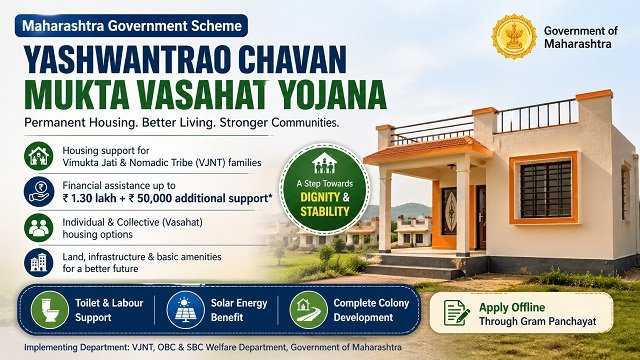
The Yashwantrao Chavhan Mukt Vasahat Awaas Yojana is a Maharashtra Government housing scheme designed to provide permanent housing and settlement support to families belonging to Vimukta Jati and Nomadic Tribes (VJNT). The scheme offers financial assistance for house construction along with land and basic infrastructure in selected areas. It focuses on improving the living conditions of economically weaker VJNT families through structured implementation at the Gram Panchayat and district level.
Maharashtra Yashwantrao Chavhan Mukt Vasahat Awaas Yojana Highlights | |
|---|---|
| Scheme Name | Maharashtra Yashwantrao Chavhan Mukt Vasahat Awaas Yojana. |
| Date of Launch | 2011 (Restructured in 2018). |
| Benefits Provided | Rs. 1.20 lakh – Rs. 1.30 lakh + Rs. 50,000 additional support. |
| Eligible Beneficiaries | Vimukta Jati and Nomadic Tribe (VJNT) families. |
| Responsible Agency | Other Backwards Class Bahujan Welfare Department. |
| How to Apply | Offline through the Gram Panchayat. |
Introduction of Maharashtra Yashwantrao Chavhan Mukt Vasahat Awaas Yojana: A Brief Insight
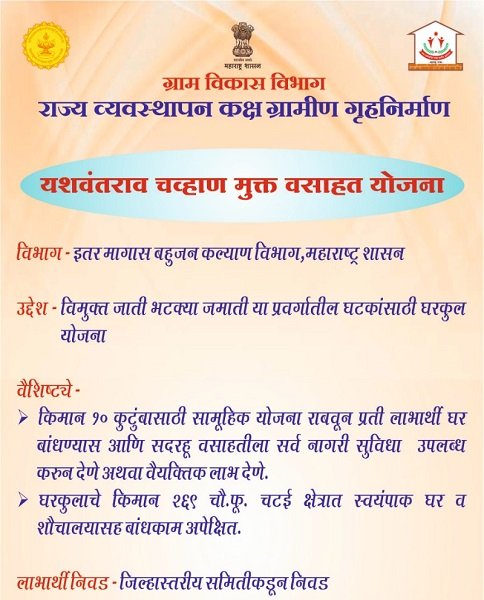
The Yashwantrao Chavhan Mukt Vasahat Awaas Yojana is a Maharashtra Government housing scheme launched in 2011 and later restructured in 2018 to provide permanent housing support to Vimukta Jati and Nomadic Tribe (VJNT) families. The scheme is implemented by the Other Backwards Class Bahujan Welfare Department with support from rural housing authorities. It focuses on bringing socially and economically backward families into the mainstream by offering safe housing along with basic living facilities.
Under this scheme, the government provides financial assistance of Rs. 1.20 lakh in general areas and up to Rs. 1.30 lakh in hilly regions for house construction. In addition, beneficiaries receive support for toilet construction, labour wages, and recently approved additional financial assistance including solar energy benefits. The scheme works in two formats, individual assistance for those who already have land and collective “Vasahat” development, where complete residential colonies are created with roads, water supply, electricity, and community infrastructure.
The scheme mainly targets homeless families or those living in kutcha, temporary, or tent-based structures. Eligible applicants must belong to the VJNT category, meet the income criteria, and should not have received benefits under any other housing scheme. The selection process is carried out at the Gram Panchayat level and finalised by district authorities to ensure that only genuine beneficiaries are included.
In Maharashtra, different housing schemes cover different sections of society. For example, tribal communities can benefit from the Adim Awas Yojana, while SC and Neo-Buddhist families are covered under the Ramai Awas Yojana. Similarly, specific communities like Pardhi are supported through targeted initiatives such as Pardhi Awas Yojana. In comparison, the Yashwantrao Chavhan Mukt Vasahat Awaas Yojana focuses specifically on VJNT families and also provides a unique colony-based housing model.
There is no online application system for this scheme. Interested beneficiaries need to apply through their Gram Panchayat, after which their application is verified and approved at the district level. In case of any assistance, applicants can contact the concerned department or local authorities for guidance.
Further, readers can also explore the Complete List of Maharashtra Government Welfare Schemes to understand other benefits available for different categories.
Benefits Provided to Eligible Beneficiaries
The Maharashtra Government provides financial and infrastructure support under the Yashwantrao Chavhan Mukt Vasahat Awaas Yojana to ensure that eligible VJNT families get permanent housing along with basic living facilities.
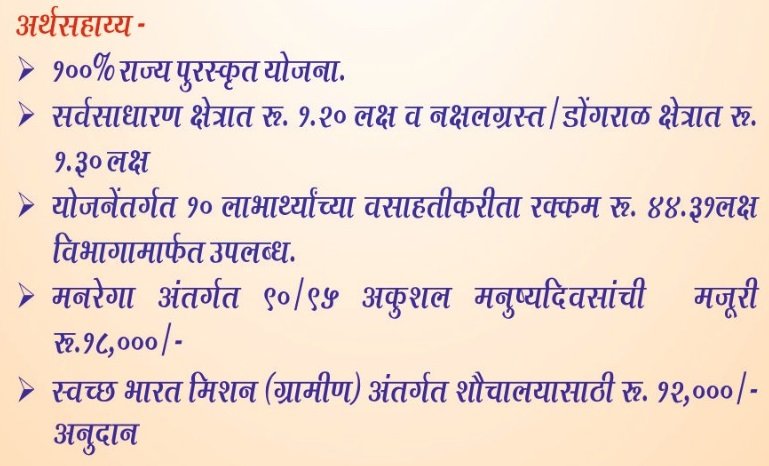
- Financial assistance of Rs. 1.20 lakh for house construction in general areas.
- Financial assistance of up to Rs. 1.30 lakh in hilly or difficult areas.
- Additional Rs. 50,000 support (latest update), including house construction and solar energy benefit.
- Rs. 12,000 provided for toilet construction under sanitation schemes.
- Labour wage support for around 90 days under rural employment programmes.
- Minimum house size of 25 sq. metres (approx. 269 sq. ft.) with kitchen and basic facilities.
- Financial assistance is transferred directly to the beneficiary’s bank account through DBT (PFMS).
- House construction is monitored through geo-tagging using government systems.
- Under the collective (Vasahat) mode, land of around 5 guntha is allotted per family.
- Development of a full residential colony with basic facilities like road, water, electricity, drainage, and a community hall.
- Up to Rs. 44 lakh+ is provided for the infrastructure development of each colony.
- Land is allotted jointly in the name of husband and wife (or in the name of women beneficiaries where applicable).
The scheme not only provides housing assistance but also focuses on creating proper residential settlements with essential amenities, ensuring long-term improvement in living conditions.
Types of Benefits Available Under the Scheme
1. Individual Housing Assistance
- For beneficiaries who already own land.
- Financial assistance was provided for house construction.
- Funds transferred directly via DBT.
2. Collective Vasahat (Group Settlement)
- The government provides land for settlement.
- 5 guntha of land allotted per family.
- Colony includes road, water, electricity & drainage.
- A community hall (Samaj Mandir) is also provided.
Eligibility Conditions Required to be Fulfilled
Applicants must meet the following eligibility conditions to avail benefits under the Yashwantrao Chavhan Mukt Vasahat Awaas Yojana of the Maharashtra Government.
- Applicant must belong to the VJNT category (Vimukta Jati and Nomadic Tribes).
- Dhangar community is not eligible under this scheme.
- Must be a permanent resident of Maharashtra for at least 15 years.
- Family must be homeless or living in a kutcha / temporary / tent house.
- Annual family income should not exceed Rs. 1.20 lakh.
- Benefit is provided to only one member per family.
- The applicant should not have availed the benefit under any other government housing scheme.
- For Individual Mode: Applicant must have their own land or government-allotted land.
- For Collective (Vasahat) Mode: Preference is given to landless families.
- Selection is done through the Gram Panchayat and approved by the district-level committee.
Priority is given to: widows, divorcees, persons with disabilities, families living in tents, and those affected by natural disasters like floods.
Documents Required to be Attached
Applicants need to submit the following documents to apply under the Yashwantrao Chavhan Mukt Vasahat Awaas Yojana. These documents help the authorities verify eligibility and approve the housing benefit.
- Caste Certificate confirming belonging to the VJNT category (issued by Sub-Divisional Officer).
- Income Certificate (annual income up to Rs. 1.20 lakh) issued by the competent authority.
- Residence/Domicile Certificate showing a minimum of 15 years’ stay in Maharashtra.
- Aadhaar Card of the applicant.
- Bank account details (Aadhaar-linked for DBT transfer).
- Ration Card.
- Voter ID Card.
- Passport-size photograph.
- Proof of being homeless or living in a kutcha/temporary structure.
- Gram Sabha Resolution confirming selection as beneficiary.
- Land ownership document or Government land allotment letter (required for individual beneficiary mode).
Applicants should ensure that all submitted documents are valid and updated. Any mismatch or incomplete information may lead to rejection during verification at the Gram Panchayat or district level.
How Beneficiaries Can Apply to Avail the Benefit of this Scheme
The application process for the Yashwantrao Chavhan Mukt Vasahat Awaas Yojana is offline and handled at the village and district level.
Step 1: Visit your Gram Panchayat office and collect or submit the application form.
Step 2: Attach all required documents and submit them to the Gram Panchayat.
Step 3: Your application is verified at the village level and forwarded to district authorities.
Step 4: The concerned department prepares the beneficiary list after verification.
Step 5: Final approval is given by the district-level committee headed by the District Collector.
Step 6: Selected beneficiaries are informed through official communication (SMS/letter).
Step 7: Benefits are provided, either house construction assistance (individual mode) or inclusion in a housing colony (collective mode).
Note: Applicants should stay in contact with the Gram Panchayat or district office for status updates.
Important Links Available
- Other Backwards Class Bahujan Welfare Department Official Website
- Yashwantrao Chavhan Mukt Vasahat Awaas Yojana Guidelines.
- Government Resolutions (GR) for the Scheme.
- Maharashtra Awaas Official Portal.
- Rural Housing Department – Maharashtra Government
Conclusion
The Yashwantrao Chavhan Mukt Vasahat Awaas Yojana provides both housing and settlement support to VJNT families in Maharashtra. With financial assistance, land allocation, and infrastructure development, the scheme ensures long-term improvement in living conditions. Eligible applicants should apply through their Gram Panchayat and stay connected with local authorities for updates.
Contact Details in Case of Help Needed
If you need any help regarding the Yashwantrao Chavhan Mukt Vasahat Awaas Yojana, you can contact the concerned department or local authorities.
- Other Backwards Class Bahujan Welfae Department (Nodal Department)
- Address: Annex Building-139, First Floor, Mantralaya, Madam Cama Road, Mumbai – 400032
- Toll Free: 18001208040.
- Phone: 022-22823821 / 022-22823820
- Email: jdvjnt@maharashtra.gov.in
- State Management Unit – Rural Housing (SMU-RH)
- Address: CBD Belapur – 400614
- Phone: 022-27561824
- District Level Assistance
- Assistant Commissioner, VJNT / Social Welfare Department. (Zilla Parishad)
- Concerned Gram Panchayat Office.
Frequently Asked Questions (FAQs)
Q. What is Yashwantrao Chavhan Mukt Vasahat Awaas Yojana?
Ans. It is a Maharashtra Government housing scheme for VJNT families to provide permanent houses and basic facilities.
Q. Who can apply under this scheme?
Ans. Only VJNT (Vimukta Jati & Nomadic Tribe) category families can apply.
Q. Is the Dhangar community eligible?
Ans. No, the Dhangar community is not covered under this scheme.
Q. How much financial assistance is provided?
Ans. Rs. 1.20 lakh in general areas and up to Rs. 1.30 lakh in hilly areas, with additional support as per the latest updates.
Q. Is there any additional benefit apart from house construction?
Ans. Yes, toilet support, labour wages, and infrastructure facilities are also provided.
Q. What is the collective (Vasahat) mode?
Ans. In this mode, the government develops a full residential colony with land, houses, and basic amenities.
Q. What is individual mode?
Ans. In this mode, beneficiaries with their own land receive financial assistance to construct a house.
Q. Is there any online application process?
Ans. No, the application process is completely offline.
Q. Where to apply for this scheme?
Ans. You need to apply through your Gram Panchayat.
Q. How are beneficiaries selected?
Ans. Selection is done by a district-level committee after verification.
Q. Can I apply if I already received a housing scheme benefit?
Ans. No, such applicants are not eligible.
Q. How is the payment given?
The amount is transferred directly to the bank account through DBT.
Q. Who to contact for help?
Ans. You can contact the VJNT Department or your Gram Panchayat / Zilla Parishad office.
Q. Is this scheme available in cities and towns?
Ans. No. This scheme is applicable only in rural areas. Families residing in Municipal Corporation, Municipality, or Nagar Panchayat areas are not covered under this scheme.
Q. Is the land allotted under the Vasahat mode transferable?
Ans. No. The land allotted under the collective Vasahat mode is non-transferable. It cannot be sold, rented, or transferred to any other person.

Tabassum is a government schemes researcher and writer with 5 years of experience tracking Central and State welfare scheme programmes across India. She has covered 500+ schemes spanning agriculture, women welfare, education, and housing, helping lakhs of beneficiaries understand their entitlements in simple language.