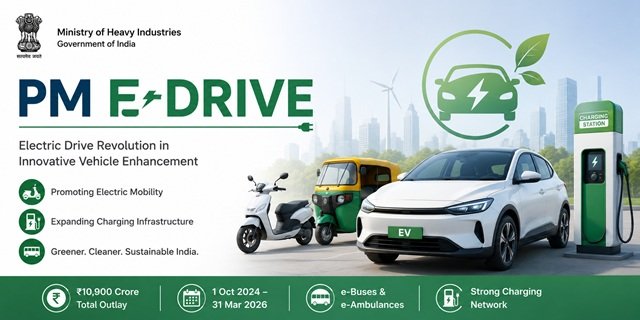
PM E-DRIVE Scheme (PM Electric Drive Revolution in Innovative Vehicle Enhancement) is a Government of India initiative approved on 11 September 2024 with a total outlay of Rs. 10,900 crore to accelerate electric vehicle adoption across India. The scheme provides upfront demand incentives for eligible e-2Ws and e-3Ws, funds procurement of 14,028 electric buses, establishes 72,300 EV chargers, and supports e-ambulances, e-trucks, and testing agency upgradation through the official PM E-DRIVE Portal.
PM E-DRIVE Scheme – Key Details at a Glance | |
|---|---|
| Scheme Name | PM Electric Drive Revolution in Innovative Vehicle Enhancement (PM E-DRIVE) Scheme |
| Cabinet Approval | 11 September 2024 |
| Gazette Notification | S.O. 4259 (E) dated 29 September 2024 |
| Scheme Launch | 1 October 2024 at Bharat Mandapam, New Delhi |
| Launched By | Union Minister for Heavy Industries and Steel, Shri H.D. Kumaraswamy |
| Nodal Ministry | Ministry of Heavy Industries (MHI) |
| Total Outlay | Rs. 10,900 crore |
| Predecessor Schemes | FAME India Scheme and EMPS 2024 (subsumed into PM E-DRIVE) |
| Main Objective | Accelerate EV adoption, establish charging infrastructure, and build a robust EV manufacturing ecosystem in India |
| Vehicle Categories Covered | e-2W, e-3W (e-rickshaws, e-carts, L5), e-Buses, e-Ambulances, e-Trucks |
| Demand Incentive Rate FY 2024-25 | Rs. 5,000 per kWh, capped at 15% of ex-factory price |
| Demand Incentive Rate FY 2025-26 | Rs. 2,500 per kWh, capped at 15% of ex-factory price |
| e-2W Target | 24.79 lakh electric two-wheelers |
| e-3W Target | 3.2 lakh electric three-wheelers |
| e-Bus Allocation | Rs. 4,391 crore for 14,028 electric buses |
| e-Ambulance Allocation | Rs. 500 crore |
| e-Truck Allocation | Rs. 500 crore |
| Charging Infrastructure | Rs. 2,000 crore for 72,300 EV chargers across key cities and highways |
| Testing Agency Upgradation | Rs. 780 crore |
| Incentive Mechanism | Upfront reduced purchase price via Aadhaar authenticated e-Voucher system |
| Terminal Date for e-2W | 31 July 2026 |
| Terminal Date for e-3W (e-rickshaws and e-carts) | 31 March 2028 |
| e-3W L5 Category Status | Closed on 26 December 2025 |
| Terminal Date for e-Trucks, e-Buses, Testing Agencies | 31 March 2028 |
| Scheme Extension | Extended from 2 years to 4 years on 8 August 2025, within the same outlay |
| FY 2024-25 Achievement | 11,49,334 e-2Ws sold (21% growth) and 1,59,235 e-3W L5 sold (57% growth) |
| Official Portal | pmedrive.heavyindustries.gov.in |
| Support Phone | +91 9319019073 (09:45 AM to 05:45 PM on working days) |
Introduction of PM E-DRIVE Scheme: A Brief Insight
India has one of the largest vehicle fleets in the world and also one of the highest levels of urban air pollution. Two-wheelers and three-wheelers account for the majority of vehicles on Indian roads, and most of them run on petrol or diesel. Every litre of fossil fuel burned adds to the pollution load in cities, increases India’s import bill, and deepens the country’s energy dependence. PM E-DRIVE Scheme is the Government of India’s most comprehensive response to this challenge.
The Union Cabinet under Prime Minister Narendra Modi approved the PM Electric Drive Revolution in Innovative Vehicle Enhancement (PM E-DRIVE) Scheme on 11 September 2024. The Ministry of Heavy Industries notified the scheme through Gazette Notification S.O. 4259 (E) on 29 September 2024 and launched it officially at Bharat Mandapam, New Delhi, on 1 October 2024. The scheme carries a total financial outlay of Rs. 10,900 crore and succeeds the earlier FAME India Scheme and the Electric Mobility Promotion Scheme (EMPS) 2024, which has been subsumed into PM E-DRIVE.
PM E-DRIVE is not just a subsidy scheme for individual EV buyers. It is a comprehensive electric mobility ecosystem initiative that works at multiple levels simultaneously. At the buyer level, it provides upfront demand incentives as a reduced purchase price for eligible e-2Ws and e-3Ws through a digital Aadhaar-authenticated e-Voucher system. At the public transport level, it allocates Rs. 4,391 crore for the procurement of 14,028 electric buses across nine major cities. At the infrastructure level, it allocates Rs. 2,000 crore to install 72,300 EV chargers across key cities and highways. At the manufacturing level, it allocates Rs. 780 crore for upgrading testing agencies to maintain quality standards. It also separately allocates Rs. 500 crore for e-ambulances and Rs. 500 crore for e-trucks.
The demand incentive for individual buyers works as a direct price reduction at the showroom. A buyer purchasing an eligible e-2W or e-3W pays a lower price upfront. The dealer generates an Aadhaar FACE authenticated e-Voucher through the PM E-DRIVE Portal, the buyer signs and returns it, and the OEM later claims reimbursement from MHI. The incentive rate was Rs. 5,000 per kWh for vehicles registered in FY 2024-25 and Rs. 2,500 per kWh for FY 2025-26, capped at 15% of the ex-factory price. The scheme targets incentivising approximately 24.79 lakh e-2Ws and 3.2 lakh e-3Ws.
In August 2025, the Ministry of Heavy Industries extended the scheme from two years to four years. The terminal date for e-2Ws has been extended to 31 July 2026 and for e-3Ws (e-rickshaws and e-carts) to 31 March 2028. e-Trucks, e-buses, and testing agency upgradation have also been extended to 31 March 2028. The e-3W L5 category was closed on 26 December 2025. The total outlay remains Rs. 10,900 crore and the scheme will close if funds are exhausted before the terminal date.
PM E-DRIVE works in coordination with other key Government of India initiatives. Manufacturers in the EV sector who want to scale up production can benefit from the Production Linked Incentive (PLI) Scheme for Automobile and Auto Components which provides performance-linked incentives on incremental sales for domestic EV manufacturers. Startups building EV technology solutions can access DPIIT recognition and tax benefits through the Startup India Scheme and scale their operations with collateral-free institutional debt through the Credit Guarantee Scheme for Startups. Small business owners and entrepreneurs who want to purchase an EV for commercial use can also explore the PM Mudra Yojana for working capital support alongside PM E-DRIVE incentives.
EV buyers, two-wheeler and three-wheeler owners, logistics operators, state transport undertakings, and EV manufacturers looking for more green mobility schemes, manufacturing incentives, infrastructure support programmes, and Central Government business initiatives can also explore our complete Central Government Welfare Schemes List for detailed information according to their vehicle category and business requirements.
Benefits Provided to Eligible Beneficiaries
PM E-DRIVE Scheme provides demand incentives to eligible EV buyers in the form of an upfront reduced purchase price at the time of buying the vehicle. The incentive is directly reflected in the lower price paid at the dealership and is subsequently reimbursed by the Ministry of Heavy Industries to the OEM.
Demand Incentives for Electric Two-Wheelers and Three-Wheelers
- Demand incentive of Rs. 5,000 per kWh for e-2Ws and e-3Ws registered in FY 2024-25
- Demand incentive of Rs. 2,500 per kWh for e-2Ws and e-3Ws registered in FY 2025-26
- Incentive capped per vehicle or at 15% of ex-factory price, whichever is lower
- Approximately 24.79 lakh e-2Ws to be incentivised under the scheme
- Approximately 3.2 lakh e-3Ws, including e-rickshaws, e-carts, and L5 category vehicles, to be incentivised
Electric Bus Support
- Total allocation of Rs. 4,391 crore for the procurement of 14,028 electric buses by State Transport Undertakings and public transport agencies
- Demand aggregation managed by CESL across nine major cities with a population above 40 lakh, including Delhi, Mumbai, Kolkata, Chennai, Ahmedabad, Surat, Bengaluru, Pune, and Hyderabad
- Preference given to cities that scrap old STU buses before procuring new e-buses
- Special provisions for unique geographies, including hilly areas, north-eastern states, island territories, and coastal regions
Electric Ambulance Support
- A budget of Rs. 500 crore has been allocated for deploying e-ambulances across India
- New government initiative to promote comfortable and clean patient transport through electric ambulances
- Performance and safety standards are being established in coordination with the Ministry of Health and Family Welfare and the MoRTH
Electric Truck Support
- Budget of Rs. 500 crore set aside to incentivise the adoption of electric trucks
- Supports the reduction of CO2 emissions in the logistics sector
- Only buyers holding a valid scrapping certificate from a MoRTH-approved Registered Vehicle Scrapping Facility are eligible
EV Charging Infrastructure
- Total outlay of Rs. 2,000 crore for the establishment of a public EV charging network
- 22,100 fast chargers for electric four-wheelers to be installed at key cities and select highways
- 1,800 chargers for electric buses to be deployed at bus depots and terminals
- 48,400 chargers for electric two-wheelers and three-wheelers to be installed in high EV penetration cities
- Charging infrastructure to be set up in coordination with the Ministry of Road Transport and Highways
Testing Agency Upgradation
- Outlay of Rs. 780 crore for upgrading and modernising testing agencies under the Ministry of Heavy Industries
- Equips testing facilities with new and emerging EV technologies to maintain quality and safety standards
- Promotes research and development in the EV segment across India
Vehicle Categories and Incentives Under PM E-DRIVE
PM E-DRIVE Scheme covers multiple electric vehicle categories with different incentive structures, allocations, and terminal dates. The following table gives a complete picture of all categories covered under the scheme.
| Vehicle Category | Target Units | Incentive Rate | Allocation | Terminal Date |
|---|---|---|---|---|
| Electric Two-Wheelers (e-2W) | 24.79 lakh units | Rs. 5,000 per kWh (FY 2024-25), Rs. 2,500 per kWh (FY 2025-26), capped at 15% of ex-factory price | A major portion of the scheme outlay | 31 July 2026 |
| Electric Three-Wheelers (e-rickshaws and e-carts) | Part of 3.2 lakh e-3W target | Rs. 5,000 per kWh (FY 2024-25), Rs. 2,500 per kWh (FY 2025-26), capped at 15% of ex-factory price | Part of the scheme outlay | 31 March 2028 |
| Electric Three-Wheelers L5 Category | Part of the 3.2 lakh e-3W target | As per the scheme guidelines | Part of the scheme outlay | Closed on 26 December 2025 |
| Electric Buses (e-Buses) | 14,028 buses | Grant based on procurement | Rs. 4,391 crore | 31 March 2028 |
| Electric Ambulances (e-Ambulances) | To be notified | To be notified | Rs. 500 crore | 31 March 2028 |
| Electric Trucks (e-Trucks) | To be notified | As per the scheme guidelines | Rs. 500 crore | 31 March 2028 |
| EV Charging Infrastructure | 72,300 chargers | Grant based | Rs. 2,000 crore | 31 March 2028 |
| Testing Agency Upgradation | MHI testing agencies | Grant based | Rs. 780 crore | 31 March 2028 |
Eligibility Conditions Required to be Fulfilled
The following eligibility conditions apply to buyers and vehicles seeking demand incentives under PM E-DRIVE Scheme as per the official Gazette Notification S.O. 4259 (E) dated 29 September 2024 and operational guidelines issued by the Ministry of Heavy Industries.
Eligibility for Buyers
- Any individual buyer purchasing an eligible electric vehicle from a registered OEM or authorised dealer is eligible for a demand incentive
- Both commercially registered and privately owned e-2Ws are eligible
- e-3Ws, including e-rickshaws and e-carts, are eligible only for commercial use
- Each buyer can avail an incentive for only one EV per category
- Aadhaar-based e-KYC authentication is mandatory at the time of purchase
- Vehicles purchased by government departments are not eligible for demand incentives
Eligibility for Vehicles
- EV must be registered with the Ministry of Heavy Industries on the official PM E-DRIVE Portal
- EV must comply with PM E-DRIVE eligibility parameters and technical standards
- EVs must be equipped with advanced batteries to qualify for demand incentives
- EV must be registered under the Central Motor Vehicles Rules (CMVR) 1989
- e-2Ws and e-3Ws must be manufactured and registered within the scheme validity period
- The ex-factory price of EV must be below the threshold value prescribed under the PM E-DRIVE Scheme guidelines
- OEM must provide a comprehensive warranty, including a battery warranty for the life of the vehicle
- OEM must have adequate after-sales service facilities for the vehicle
Category-wise Terminal Dates
- Electric Two-Wheelers (e-2W): Terminal date 31 March 2026
- e-Rickshaws and e-Carts: Terminal date 31 March 2026
- e-3W L5 Category: Closed on 26 December 2025, last date for claim submission 25 April 2026
- e-Trucks, e-Buses, e-Ambulances, and Testing Agencies: Extended till 31 March 2028
Important: PM E-DRIVE is a fund-limited scheme. Total payout is restricted to the sanctioned outlay of Rs. 10,900 crore. If funds for the scheme or any sub-component are exhausted before the terminal date, that component will be closed, and no further claims will be entertained.
Documents Required to be Attached
PM E-DRIVE Scheme provides demand incentives as an upfront reduction in purchase price at the time of buying an eligible EV. Buyers do not need to submit a separate application or documents to any government office. However, the following details and documents are required at the time of purchase to generate the e-Voucher and avail the incentive.
- Aadhaar Card for e-KYC FACE authentication at the time of e-Voucher generation
- Valid mobile number registered with Aadhaar for receiving the e-Voucher link via SMS
- Vehicle registration documents as per the Central Motor Vehicles Rules (CMVR) 1989
- For e-Truck buyers: a scrapping certificate from a MoRTH-approved Registered Vehicle Scrapping Facility (RVSF)
- Bank account details for any reimbursement or claim processing, wherever applicable
Important: Government department vehicles are not eligible for demand incentives under the PM E-DRIVE Scheme. Each individual buyer can avail an incentive for only one EV per category. All eligible EV models must be registered with the Ministry of Heavy Industries on the official PM E-DRIVE Portal before the incentive can be applied.
How Buyers Can Avail the Benefit of this Scheme
PM E-DRIVE Scheme provides demand incentives as an upfront reduction in the purchase price of eligible EVs at the time of buying from an authorised dealer. Buyers do not need to visit any government office or submit a separate application. The entire process is digital and handled through the official PM E-DRIVE Portal using the e-Voucher system.
Step 1: Visit an authorised dealer of a registered OEM whose EV model is approved on the official PM E-DRIVE Portal. Confirm that the EV model you want to purchase is listed and eligible for the demand incentive under the scheme.
Step 2: At the time of purchase, the dealer initiates the e-Voucher generation process on the PM E-DRIVE scheme portal. The portal generates an e-KYC Aadhaar FACE authenticated e-Voucher for the buyer.
Step 3: A link to download the e-Voucher is sent to the buyer’s registered mobile number via SMS. The buyer downloads and signs the e-Voucher.
Step 4: The signed e-Voucher is submitted by the buyer to the dealer. The dealer also signs the e-Voucher and uploads it on the PM E-DRIVE Portal.
Step 5: After both signatures are complete, the signed e-Voucher is sent to both the buyer and the dealer via SMS as confirmation.
Step 6: The demand incentive is applied as an upfront reduction in the purchase price of the EV. The buyer pays the reduced price at the dealership itself.
Step 7: The OEM uses the signed e-Voucher to claim reimbursement of the demand incentive from the Ministry of Heavy Industries. MHI reimburses the OEM for the incentive amount already passed on to the buyer.
Step 8: For e-Truck buyers, a valid scrapping certificate from a MoRTH-approved Registered Vehicle Scrapping Facility (RVSF) must be submitted to the dealer before the incentive can be applied.
Step 9: Ensure the purchased EV is registered under the Central Motor Vehicles Rules (CMVR) 1989 within the scheme validity period. No PM E-DRIVE certificate for e-2W or e-3W will be valid after the terminal date of the respective category.
Important: Each buyer can avail the incentive for only one EV per category. Government department vehicles are not eligible for demand incentives. Always verify that the EV model is listed on the official PM E-DRIVE Portal before finalising the purchase to ensure you receive the incentive.
PM E-DRIVE vs FAME India Scheme
PM E-DRIVE Scheme replaced the earlier FAME India Scheme and the Electric Mobility Promotion Scheme (EMPS) 2024. Buyers who were familiar with FAME benefits should understand the key differences before purchasing an EV under PM E-DRIVE.
| Feature | FAME India Scheme | PM E-DRIVE Scheme |
|---|---|---|
| Launch Year | 2015 (FAME I), 2019 (FAME II) | 2024 |
| Total Outlay | Rs. 11,500 crore (FAME II) | Rs. 10,900 crore |
| Incentive Mechanism | Direct subsidy to OEM based on sales | Upfront price reduction via Aadhaar authenticated e-Voucher system |
| e-2W Coverage | Limited to registered commercial vehicles | Both commercially registered and privately owned e-2Ws eligible |
| e-Ambulance Coverage | Not covered | Rs. 500 crore allocated |
| e-Truck Coverage | Not covered separately | Rs. 500 crore allocated |
| Charging Infrastructure | Limited focus | Rs. 2,000 crore for 72,300 EV chargers |
| Testing Agency Support | Not included | Rs. 780 crore for upgradation |
| Digital Verification | Manual process | Aadhaar FACE authenticated e-Voucher system |
| EVs Under FAME-II Eligible | Yes under FAME-II | No, EVs under FAME-II are not eligible under PM E-DRIVE |
| Current Status | Closed, subsumed into PM E-DRIVE | Active until 31 March 2028 |
Important: EVs manufactured under the FAME-II Scheme are not eligible for incentives under the PM E-DRIVE Scheme. Buyers must ensure their vehicle model is registered and approved on the official PM E-DRIVE Portal before purchase to avail the demand incentive.
Important Links Available
- PM E-DRIVE Scheme Official Portal.
- PM E-DRIVE Scheme Guidelines and Notifications.
- Ministry of Heavy Industries Official Portal.
Contact Details in Case of Help Needed
Buyers, dealers, and OEMs facing issues related to PM E-DRIVE Scheme eligibility, e-Voucher generation, incentive claims, or scheme-related queries can contact through the following official channels.
- Phone: +91 9319019073 (Available during office hours only)
- Office Timings: 09:45 AM to 05:45 PM on working days
- Technical Support Email: advisory.support@ifciltd.com
- IFCI Limited
IFCI Tower, 61 Nehru Place,
New Delhi 110019 - Ministry of Heavy Industries
Udyog Bhawan, Rafi Marg,
New Delhi 110011
Frequently Asked Questions (FAQs)
Q. What is the PM E-DRIVE Scheme?
Ans. PM E-DRIVE stands for PM Electric Drive Revolution in Innovative Vehicle Enhancement. It is a Government of India scheme approved by the Union Cabinet on 11 September 2024 and notified on 29 September 2024 by the Ministry of Heavy Industries to accelerate EV adoption, establish charging infrastructure, and build a robust EV manufacturing ecosystem across India.
Q. When did the PM E-DRIVE Scheme come into effect?
Ans. The PM E-DRIVE Scheme came into effect from 1 October 2024. The Electric Mobility Promotion Scheme (EMPS) 2024 implemented from 1 April 2024 to 30 September 2024, has been subsumed into PM E-DRIVE, making the effective period of the scheme two years from 1 April 2024.
Q. What is the total financial outlay of the PM E-DRIVE Scheme?
Ans. The total financial outlay of the PM E-DRIVE Scheme is Rs. 10,900 crore. This is a fund-limited scheme and if funds are exhausted before the terminal date, the scheme or its relevant sub-components will be closed.
Q. Has the scheme been extended?
Ans. Yes. The Ministry of Heavy Industries announced on 8 August 2025 that the scheme has been extended from two years to four years within the same outlay of Rs. 10,900 crore. The terminal date for e-2Ws has been extended to 31 July 2026. The terminal date for e-3Ws (e-rickshaws and e-carts) has been extended to 31 March 2028. e-Trucks, e-Buses, and Testing Agencies have also been extended to 31 March 2028. The e-3W L5 category was closed on 26 December 2025.
Q. Which vehicle categories are covered under the PM E-DRIVE Scheme?
Ans. PM E-DRIVE Scheme covers electric two-wheelers (e-2W), electric three-wheelers (e-3W), including e-rickshaws, e-carts, and L5 category, electric buses (e-buses), electric ambulances (e-ambulances), and electric trucks (e-trucks).
Q. How does the demand incentive work under PM E-DRIVE?
Ans. The demand incentive is provided as an upfront reduction in the purchase price of the eligible EV at the time of buying from an authorised dealer. The buyer pays the reduced price directly at the dealership. The OEM then claims reimbursement of the incentive amount from the Ministry of Heavy Industries using the signed e-Voucher.
Q. What is the e-Voucher system under PM E-DRIVE?
Ans. The e-Voucher is an Aadhaar FACE authenticated digital document generated by the PM E-DRIVE Portal at the time of EV purchase. A link to download the e-Voucher is sent to the buyer’s registered mobile number. The buyer signs and submits it to the dealer, who uploads it to the portal. The signed e-Voucher is then used by the OEM to claim reimbursement of the demand incentive from MHI.
Q. What is the demand incentive rate for e-2Ws and e-3Ws?
Ans. The demand incentive is Rs. 5,000 per kWh for e-2Ws and e-3Ws registered in FY 2024-25 and Rs. 2,500 per kWh for those registered in FY 2025-26. The incentive is capped per vehicle or at 15% of the ex-factory price, whichever is lower.
Q. Are government department vehicles eligible for incentives?
Ans. No. EVs purchased by any Central or State Government department or government agency are not eligible for demand incentives under the PM E-DRIVE Scheme.
Q. Can one person buy multiple EVs and claim an incentive on all?
Ans. No. Each buyer can avail the incentive for only one EV per category. Each mobile number can also be used only once for incentive purposes to prevent multiple claims by the same individual.
Q. Are EVs made under FAME-II eligible under PM E-DRIVE?
Ans. No. EVs manufactured under the FAME-II Scheme are not eligible for incentives under the PM E-DRIVE Scheme.
Q. What is the charging infrastructure target under PM E-DRIVE?
Ans. PM E-DRIVE allocates Rs. 2,000 crore for EV charging infrastructure. The scheme targets the installation of 22,100 fast chargers for e-4Ws, 1,800 chargers for e-buses, and 48,400 chargers for e-2Ws and e-3Ws across key cities and select highways.
Q. What is the e-bus target under PM E-DRIVE?
Ans. PM E-DRIVE allocates Rs. 4,391 crore for the procurement of 14,028 electric buses by State Transport Undertakings and public transport agencies across nine major cities with a population above 40 lakh, including Delhi, Mumbai, Kolkata, Chennai, Ahmedabad, Surat, Bengaluru, Pune, and Hyderabad.
Q. What is the difference between PM E-DRIVE and the FAME India Scheme?
Ans. The FAME India Scheme was the earlier Government of India initiative to promote EV adoption through direct subsidies. PM E-DRIVE replaced and expanded beyond FAME with a broader ecosystem approach covering demand incentives, e-buses, e-ambulances, e-trucks, charging infrastructure, and testing agency upgradation. PM E-DRIVE also introduced the digital Aadhaar-authenticated e-Voucher system for transparent subsidy disbursement, which was not part of FAME.
Q. What is the minimum battery requirement for e-2W and e-3W to qualify?
Ans. Only e-2Ws and e-3Ws equipped with advanced batteries qualify for demand incentives under the PM E-DRIVE Scheme. The specific technical standards are prescribed in the operational guidelines issued by the Ministry of Heavy Industries.

Tabassum is a government schemes researcher and writer with 5 years of experience tracking Central and State welfare scheme programmes across India. She has covered 500+ schemes spanning agriculture, women welfare, education, and housing, helping lakhs of beneficiaries understand their entitlements in simple language.