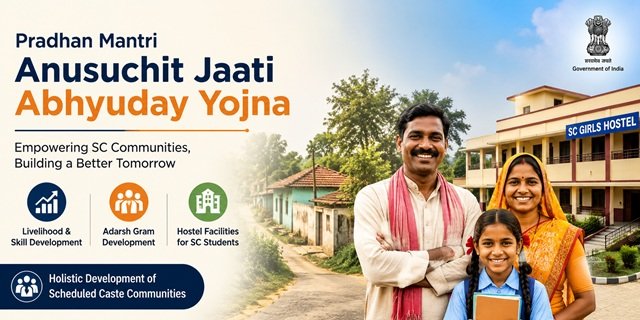
Pradhan Mantri Anusuchit Jaati Abhyuday Yojana (PM-AJAY) is a 100% Centrally Sponsored Scheme launched in FY 2021-22 by the Ministry of Social Justice and Empowerment to reduce poverty among SC communities through three components: Adarsh Gram development, Grants-in-Aid for livelihood and infrastructure projects, and Hostel construction in top-ranked institutions. The scheme covers 28 States and UTs with an annual outlay of Rs. 2,250 crore for 2025-26. For scheme details, visit the official PM-AJAY Portal.
Pradhan Mantri Anusuchit Jaati Abhyuday Yojana (PM-AJAY) Highlights | |
|---|---|
| Scheme Name | Pradhan Mantri Anusuchit Jaati Abhyuday Yojana (PM-AJAY) |
| Short Name | PM-AJAY |
| Type | Centrally Sponsored Scheme |
| Launched | FY 2021-22 |
| Ministry | Ministry of Social Justice and Empowerment |
| Department | Department of Social Justice and Empowerment |
| Funding | 100% Central Government funded |
| Annual Outlay 2025-26 | Rs. 2,250 crore |
| Coverage | 28 States and UTs |
| Merged Schemes | PMAGY, SCA to SCSP, and BJRCY |
| Main Objective | Reduce SC poverty, improve infrastructure in SC-dominated villages, and increase educational opportunities for SC communities |
| Component 1 | Adarsh Gram Development, up to 50% of annual funds |
| Component 2 | Grants-in-Aid for livelihood, skill development, and infrastructure projects |
| Component 3 | Hostel Construction in NIRF-ranked Government-funded institutions, up to 2% of annual funds |
| Adarsh Gram Village Eligibility | More than 40% SC population and the total population of 500 or more |
| Infrastructure Grant Eligibility | Villages with 50% or more SC population |
| Individual Beneficiary Eligibility | SC persons living below the poverty line |
| Adarsh Grams Declared Till March 2025 | More than 11,000 villages |
| FY 2024-25 Achievement | 4,991 Adarsh Grams declared, 4,25,821 beneficiaries |
| Villages Selected for 2025-26 | 29,846 villages |
| Grants-in-Aid Released 2023-24 and 2024-25 | Rs. 457.82 crore for 8,146 projects |
| Application Mode | State and District authorities apply through the PM-AJAY portal, no direct individual online portal |
| Phone | 011-26113342 |
| ds-pmajay-dosje@gov.in | |
| Official MIS Portal | pmajay.dosje.gov.in |
| Department Portal | socialjustice.gov.in |
Introduction of Pradhan Mantri Anusuchit Jaati Abhyuday Yojana: A Brief Insight
India has multiple programmes for Scheduled Caste welfare, but for years these programmes operated as separate schemes with separate portals, separate funds, and overlapping objectives. A village needing drinking water had to go to one scheme, a student needing a hostel had to go to another, and an SC farmer needing skill training had to go to a third. PM-AJAY was created to consolidate this fragmented approach into one unified, comprehensive scheme.The
Government of India launched Pradhan Mantri Anusuchit Jaati Abhyuday Yojana (PM-AJAY) in FY 2021-22 by merging three existing Centrally Sponsored Schemes, Pradhan Mantri Adarsh Gram Yojana (PMAGY), Special Central Assistance to Scheduled Castes Sub Plan (SCA to SCSP), and Babu Jagjivan Ram Chhatrawas Yojana (BJRCY). The Ministry of Social Justice and Empowerment implements the scheme with 100% Central Government funding across 28 States and UTs. The annual outlay for 2025-26 stands at Rs. 2,250 crore.
The scheme works through three components. The Adarsh Gram component transforms SC-majority villages into model villages by filling gaps in drinking water, sanitation, education, nutrition, and health services across 50 socio-economic indicators. Villages with more than 40% SC population and 500 or more total population qualify. Till March 2025, the government declared more than 11,000 villages as Adarsh Grams, benefiting lakhs of residents. The government selected 29,846 villages for 2025-26. The Grants-in-Aid component funds livelihood projects, skill development, infrastructure, and financial assistance for loans for SC communities below the poverty line. Ministry released Rs. 457.82 crore for 8,146 projects in 2023-24 and 2024-25. The Hostel Construction component funds hostels in top NIRF-ranked Government-funded institutions to support SC students in higher education.
PM-AJAY works alongside other Central Government schemes that support SC communities at different levels. SC families who own agricultural land can access the Stand Up India Scheme, which provides composite bank loans from Rs. 10 lakh to Rs. 1 crore to SC and ST entrepreneurs for greenfield enterprises. SC students who need scholarship support for higher education can explore the Post Matric Scholarship Scheme for SC Students, which provides financial assistance for post-matriculation studies. SC communities looking for housing support can check eligibility under the Pradhan Mantri Awas Yojana Gramin, which provides Rs. 1.20 lakh to Rs. 1.30 lakh to rural BPL families for house construction.
SC communities, state government officials, district programme officers, educational institutions, and anyone looking for more welfare schemes, livelihood support, educational assistance, and infrastructure development programmes for the Scheduled Castes can also explore other available initiatives under our Central Government Schemes List section.
Which Three Schemes Were Merged Into PM-AJAYThe
Government of India merged three existing Centrally Sponsored Schemes into PM-AJAY in FY 2021-22 to eliminate duplication, streamline fund flow, and create a single comprehensive framework for SC welfare. Beneficiaries of all three earlier schemes now receive support under PM-AJAY.
1. Pradhan Mantri Adarsh Gram Yojana (PMAGY)
Pradhan Mantri Adarsh Gram Yojana (PMAGY) focused on the holistic development of villages with high SC population density. The scheme covered infrastructure gaps in SC-dominated villages across drinking water, sanitation, education, health, and other basic services. Under PM-AJAY, PMAGY continues as the Adarsh Gram component, which transforms SC-majority villages into model villages by filling 50 socio-economic indicators across 10 development domains.
2. Special Central Assistance to Scheduled Castes Sub Plan (SCA to SCSP)
Special Central Assistance to Scheduled Castes Sub Plan (SCA to SCSP) provided financial assistance to States and UTs for income-generating schemes, skill development, and livelihood support for SC communities below the poverty line. Under PM-AJAY, SCA to SCSP continues as the Grants-in-Aid component, which funds district and state-level projects for socio-economic betterment, including livelihood projects, infrastructure creation, and financial assistance for loans for SC beneficiaries.
3. Babu Jagjivan Ram Chhatrawas Yojana (BJRCY)
Babu Jagjivan Ram Chhatrawas Yojana (BJRCY) funded the construction of hostels for SC students in educational institutions to encourage enrollment and reduce dropout rates. Under PM-AJAY, BJRCY continues as the Hostel Construction component, which funds the construction and expansion of hostels in top NIRF-ranked Central and State Government-funded higher educational institutions and Government-funded schools recommended by the Ministry of Education.
Benefits Provided Under PM-AJAY Scheme
PM-AJAY Scheme provides comprehensive support to SC communities across three major components covering village development, livelihood support, and educational infrastructure.
1. Adarsh Gram Development Benefits
- Government transforms SC-majority villages into fully developed Adarsh Grams by filling critical gaps in infrastructure and basic services
- Residents get access to drinking water, sanitation, education, nutrition, health services and other basic amenities
- The government covers 50 socio-economic indicators across 10 development domains in each selected village
- Up to 50% of the total annual scheme funds go towards Adarsh Gram development
- In FY 2024-25, the Government declared 4,991 villages as Adarsh Gram benefiting 4,25,821 people
- The government selected 29,846 villages for this component for 2025-26
- Till March 2025, the Government declared more than 11,000 villages as Adarsh Grams across India
2. Grants-in-Aid Benefits for SC Communities
- The government provides financial assistance for infrastructure creation in SC-dominated villages
- The government funds the construction of hostels and residential schools in SC-dominated areas
- Government supports comprehensive livelihood projects, including skill development programmes and related infrastructure
- The government provides financial assistance towards loans taken by SC beneficiaries for asset acquisition or creation required for livelihood generation
- The government supports entrepreneurship development and self-employment programmes for SC communities
- In 2023-24 and 2024-25, the Ministry released Rs. 457.82 crore for 8,146 projects, including 987 skill development projects across States
- In 2024-25, the Ministry sanctioned 83 projects from 234 state submissions, with Rs. 1.18 lakh funds released
3. Hostel Construction Benefits
- The government constructs and expands hostels in top NIRF-ranked Central and State Government-funded higher educational institutions
- The government also constructs hostels in Government-funded schools recommended by the Ministry of Education
- Up to 2% of total annual scheme funds go towards hostel construction
- Hostels provide SC students with quality residential facilities near reputed institutions, especially in aspirational districts and SC-dominated blocks
Financial Outlay (Year-wise)
- 2021-22: Rs. 1,800 crore
- 2022-23: Rs. 1,950 crore
- 2023-24: Rs. 2,050 crore
- 2024-25: Rs. 2,150 crore
- 2025-26: Rs. 2,250 crore
Eligibility Conditions Required to be Fulfilled
The following eligibility conditions apply to beneficiaries and villages seeking benefits under PM-AJAY Scheme as per the official guidelines issued by the Department of Social Justice and Empowerment, Ministry of Social Justice and Empowerment, Government of India.
For Skill Development and Income Generating Schemes
- Applicant must belong to the Scheduled Caste (SC) category
- Applicant must be living below the poverty line (BPL)
- Applicant must be a resident of any of the 28 covered States and UTs under the scheme
For Adarsh Gram Component
- The village must have more than 40% SC population
- The village must have a total population of 500 or more
- The village must be selected by the State Government under the Adarsh Gram component
For Infrastructure Development Under Grants-in-Aid
- Villages with 50% or more SC population are eligible for infrastructure grants
- Projects must be submitted by State or District level authorities through Annual Action Plans (AAPs) on the official PM-AJAY Portal
For Hostel Construction Component
- Institutions must be ranked under the National Institutional Ranking Framework (NIRF) of the Government of India
- The institution must be fully or partially funded by the Central or State or UT Government
- For school hostels: The institution must be recommended by the Ministry of Education
States and UTs Not Covered Under PM-AJAY
- Arunachal Pradesh, Nagaland, Meghalaya, Mizoram, Andaman and Nicobar Islands, Dadra Nagar Haveli, Daman and Diu, Ladakh, and Lakshadweep are not covered under the PM-AJAY Scheme
Documents Required to be Attached
Documents required under the PM-AJAY Scheme vary based on the component and type of benefit being availed. The following documents are generally required by eligible beneficiaries.
For Individual Beneficiaries (Skill Development and Income Generating Schemes)
- Aadhaar Card of the applicant
- Scheduled Caste (SC) Caste Certificate
- BPL Certificate or proof of belonging to the below poverty line category
- Residence Proof confirming residence in Haryana or the respective State
- Bank Account details with a passbook copy and IFSC code
- Passport-sized photograph
- Mobile number linked with Aadhaar
For Hostel and Infrastructure Projects
- Project proposal or Detailed Project Report (DPR) submitted by State or District authorities
- NIRF ranking certificate for hostels in higher educational institutions, wherever applicable
- Institutional documents confirming Central or State Government funding of the institution
- Relevant project-related documents as prescribed by the Ministry of Social Justice and Empowerment
Important: PM-AJAY is a State-implemented Centrally Sponsored Scheme. Actual document requirements vary based on the specific component, the State, and the nature of the project or benefit being availed. Beneficiaries must contact their nearest District Programme Officer or State-level implementing authority for the exact document checklist applicable to their case.
How States and Beneficiaries Can Apply Under the PM-AJAY Scheme
PM-AJAY Scheme works through a State-implemented framework. States and districts submit Annual Action Plans through the official portal and individual beneficiaries access benefits through State or District-level implementing authorities.
For State and District Governments
Step 1: State governments register on the official PM-AJAY portal at pmajay.dosje.gov.in using login credentials sent to the email of the Principal Secretary of the State.
Step 2: State and District level officers prepare Annual Action Plans (AAPs) online through the PM-AJAY portal. Two login IDs exist for each level, one for project creation and one for project approval.
Step 3: States submit Perspective Plans covering 3-year project proposals for the Grants-in-Aid component. As of 2025, 25 States submitted perspective plans for 2023-24, 2024-25, and 2025-26.
Step 4: The Ministry of Social Justice and Empowerment reviews and sanctions eligible projects. After the sanction, the Ministry releases funds directly to the States for implementation.
Step 5: States implement approved projects at the district and village level through District Programme Officers and Project Implementation Units (PIUs).
For Individual Beneficiaries
Step 1: Individual SC beneficiaries seeking skill development, income-generating support, or livelihood assistance contact the nearest District Programme Officer or District Social Welfare Office in their district.
Step 2: Beneficiary confirms eligibility by verifying SC category status and BPL status with supporting documents, including Aadhaar Card, caste certificate, BPL certificate, and bank account details.
Step 3: The concerned District or State authority registers eligible beneficiaries under the relevant component of the scheme based on the approved Annual Action Plan for that year.
Step 4: Selected beneficiaries participate in skill development programmes, livelihood projects, or income-generating schemes sanctioned under the Grants-in-Aid component in their State.
Step 5: Financial assistance for loans towards asset acquisition or creation gets credited directly into the beneficiary’s bank account after the implementing agency completes verification.
For Educational Institutions
Step 1: Eligible NIRF-ranked Central or State Government-funded institutions seeking hostel construction funding submit proposals through their State Government to the Ministry of Social Justice and Empowerment.
Step 2: Ministry reviews proposals against available funds under the hostel construction component (up to 2% of annual scheme outlay) and sanctions eligible projects.
Step 3: The Ministry releases funds directly to implementing agencies for hostel construction after sanction.
Important: PM-AJAY Scheme does not have a direct individual online application portal. Individual SC beneficiaries must approach their State or District level Social Welfare Department or District Programme Officer to access benefits under the scheme. Beneficiaries can visit the official PM-AJAY portal for scheme updates, sanction orders, and state-wise progress information.
Important Links Available
- PM-AJAY Scheme Official MIS Portal, Ministry of Social Justice and Empowerment.
- PM-AJAY Scheme Official Page, Department of Social Justice and Empowerment.
- PM-AJAY Scheme Guidelines May 2023, Department of Social Justice and Empowerment.
- Department of Social Justice and Empowerment, Ministry of Social Justice and Empowerment, Government of India.
Contact Details in Case of Help Needed
States, districts, institutions, and beneficiaries seeking information about PM-AJAY Scheme components, project submission, eligibility, or scheme-related queries can contact us through the following official channels.
- Phone: 011-26113342
- Email: ds-pmajay-dosje@gov.in
- Section Officer PM-AJAY Email: pmajay-sje@gov.in
- Department of Social Justice and Empowerment
Room No. 8402, 8th Floor, Zone-4,
GPOA-3, Netaji Nagar,
New Delhi 110023
Frequently Asked Questions (FAQs)
Q. What is the PM-AJAY Scheme?
Ans. Pradhan Mantri Anusuchit Jaati Abhyuday Yojana (PM-AJAY) is a Centrally Sponsored Scheme launched in FY 2021-22 by the Ministry of Social Justice and Empowerment to reduce poverty among SC communities, improve infrastructure in SC-dominated villages, and increase educational opportunities for Scheduled Castes across India.
Q. Which three schemes merged to form PM-AJAY?
Ans. The government merged three Centrally Sponsored Schemes into PM-AJAY. These are Pradhan Mantri Adarsh Gram Yojana (PMAGY), Special Central Assistance to Scheduled Castes Sub Plan (SCA to SCSP), and Babu Jagjivan Ram Chhatrawas Yojana (BJRCY).
Q. How many components does PM-AJAY have?
Ans. PM-AJAY has three main components. The first is Adarsh Gram Development, which transforms SC-majority villages into model villages. The second is Grants-in-Aid for district and state-level projects covering livelihood, skill development, and infrastructure. The third is Hostel Construction in the top NIRF-ranked Government-funded institutions.
Q. Who funds the PM-AJAY Scheme?
Ans. Central Government funds 100% of the PM-AJAY Scheme. States and UTs can provide additional funds from their own resources if they choose to do so.
Q. Which villages are eligible for the Adarsh Gram component?
Ans. Villages with more than 40% SC population and a total population of 500 or more are eligible for selection under the Adarsh Gram component of PM-AJAY.
Q. How many villages has the scheme covered so far?
Ans. Till March 2025, the government declared more than 11,000 villages as Adarsh Grams. In FY 2024-25, the Government declared 4,991 villages as Adarsh Gram benefiting 4,25,821 people. The government selected 29,846 villages for the 2025-26 cycle.
Q. Who is eligible for skill development and income-generating benefits under PM-AJAY?
Ans. SC persons living below the poverty line are eligible for skill development programmes and income-generating scheme benefits under PM-AJAY.
Q. Which states are not covered under PM-AJAY?
Ans. Arunachal Pradesh, Nagaland, Meghalaya, Mizoram, Andaman and Nicobar Islands, Dadra Nagar Haveli, Daman and Diu, Ladakh, and Lakshadweep are not covered under the PM-AJAY Scheme. The scheme covers 28 States and UTs.
Q. How do States apply for funds under PM-AJAY?
Ans. State governments submit Annual Action Plans (AAPs) online through the official PM-AJAY portal. Ministry reviews and sanctions eligible projects and releases funds to States for implementation.
Q. Is there a direct online application portal for individual beneficiaries?
Ans. No. PM-AJAY does not have a direct individual online application portal. Individual SC beneficiaries must contact their nearest District Programme Officer or District Social Welfare Office to access benefits under the scheme.
Q. What is the annual outlay for PM-AJAY in 2025-26?
Ans. The total outlay for PM-AJAY in 2025-26 is Rs. 2,250 crore. Out of this, up to 50% goes to Adarsh Gram development, up to 5% for administration and monitoring, up to 2% for hostel construction, and the balance for Grants-in-Aid to States.
Q. What type of hostel facilities does PM-AJAY provide?
Ans. The government constructs and expands hostels in top NIRF-ranked Central and State Government-funded higher educational institutions and in Government-funded schools recommended by the Ministry of Education. These hostels provide SC students with quality residential facilities near reputed institutions, especially in aspirational districts and SC-dominated blocks.
Q. How much funding has the scheme released for Grants-in-Aid projects so far?
Ans. Ministry released Rs. 457.82 crore for 8,146 projects, including 987 skill development projects, during 2023-24 and 2024-25. In 2024-25, the Ministry sanctioned 83 projects from 234 state submissions.
Q. Where can beneficiaries find more information about PM-AJAY?
Ans. Beneficiaries can visit the official PM-AJAY MIS portal at pmajay.dosje.gov.in for scheme updates, sanction orders, and state-wise progress or visit the Department of Social Justice and Empowerment portal at socialjustice.gov.in for scheme guidelines and official documents.

Tabassum is a government schemes researcher and writer with 5 years of experience tracking Central and State welfare scheme programmes across India. She has covered 500+ schemes spanning agriculture, women welfare, education, and housing, helping lakhs of beneficiaries understand their entitlements in simple language.