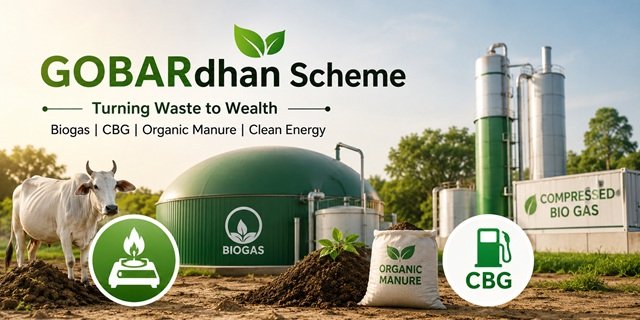
GOBARdhan Scheme (Galvanizing Organic Bio-Agro Resources Dhan) is a flagship waste-to-wealth initiative of the Government of India, coordinated by the Department of Drinking Water and Sanitation, Ministry of Jal Shakti. The scheme promotes the conversion of cattle dung, agricultural residue, and organic waste into biogas, Compressed Bio Gas (CBG), and organic manure, helping villages generate clean energy, improve sanitation, and create additional income opportunities. Community biogas projects can receive assistance of up to Rs. 50 lakh per district, while eligible commercial CBG developers can avail machinery assistance of up to Rs. 90 lakh under the BAM component. Registration of eligible projects can be completed through the official GOBARdhan Unified Registration Portal.
GOBARdhan Scheme Highlights | |
|---|---|
| Full Scheme Name | GOBARdhan (Galvanizing Organic Bio-Agro Resources Dhan) |
| Coordinating Department | Department of Drinking Water and Sanitation, Ministry of Jal Shakti |
| Associated Ministries | Ministry of New and Renewable Energy (MNRE), Ministry of Petroleum and Natural Gas (MoPNG), Department of Fertilisers |
| Main Objective | Convert cattle dung, agricultural residue, and organic waste into biogas, CBG, and organic manure while promoting a circular rural economy |
| Community & Cluster Biogas Plant Assistance | Up to Rs. 50 lakh per district under SBM-G Phase II (2020-21 to 2026-27) |
| Household Biogas Plant Support | Central Financial Assistance (CFA) along with additional incentives for eligible installations |
| Additional Toilet-Linked Incentive | Rs. 1,600 per eligible cattle dung-based biogas plant |
| Generator / Water Pump Incentive | Rs. 10,000 for eligible 10-25 M³ biogas plants |
| BAM Financial Assistance | 50% of machinery cost or Rs. 90 lakh per machinery set, whichever is lower |
| BAM Scheme Budget | Rs. 564.75 crore (FY 2023-24 to FY 2026-27) |
| Organic Manure Assistance (MDA) | Rs. 1,500 per Metric Tonne for eligible organic manure products |
| National Circular Bioenergy Scheme | Approved in 2026 with an outlay of Rs. 23,731 crore |
| Implementation Period | FY 2026-27 to FY 2035-36 |
| Nodal Ministry for National Bioenergy Scheme | Ministry of Petroleum and Natural Gas |
| Minimum Capacity for Portal Registration | 10 cubic metres/day for biogas projects |
| Minimum Capacity for BAM Assistance | 2 TPD CBG production capacity |
| Eligible Applicants | Gram Panchayats, SHGs, FPOs, Cooperatives, Private Developers, Waste Management Companies, and CBG Producers |
| BAM Application Cut-Off | 30 September 2026 (unless extended by the Government) |
| Official Registration Portal | gobardhan.sbm.gov.in |
| Swachh Bharat Mission Portal | sbm.gov.in |
| MNRE Biogas Information Portal | mnre.gov.in/en/bio-gas |
Introduction of GOBARdhan Scheme: A Brief Insight
Walk through any Indian village and you’ll often find cattle dung, crop residue, and organic waste lying unused, while households spend money on cooking fuel and farmers purchase chemical fertilisers. What many see as waste is actually a valuable resource. To convert this waste into wealth, the Government of India launched the GOBARdhan Scheme (Galvanizing Organic Bio-Agro Resources Dhan) on 30 April 2018 under Swachh Bharat Mission-Grameen (SBM-G).
The scheme is coordinated by the Department of Drinking Water and Sanitation, Ministry of Jal Shakti, in collaboration with the Ministry of New and Renewable Energy, the Department of Fertilizers, and the Ministry of Petroleum and Natural Gas. Its objective is simple but impactful – convert cattle dung, agricultural residue, kitchen waste, and other biodegradable waste into biogas, Compressed Bio-Gas (CBG), and organic manure, while promoting cleanliness, renewable energy, and rural income generation.
By encouraging the scientific management of organic waste, the scheme helps villages reduce pollution, improve sanitation, and create sustainable sources of energy. At the same time, farmers and rural communities can earn additional income from the sale of biogas, CBG, and organic manure, creating a circular economy where waste becomes a productive asset.
Under various components of the scheme, community and cluster biogas projects can receive financial support of up to Rs. 50 lakh per district. Individual households with sufficient cattle can avail Central Financial Assistance for small biogas plants, along with additional incentives for eligible toilet-linked units and biogas-powered equipment. Commercial CBG developers can receive financial assistance of up to 50% of machinery cost or Rs. 90 lakh per machinery set, whichever is lower, under the Biomass Aggregation Machinery (BAM) Scheme.
In a major boost to the sector, the Union Cabinet has approved GOBARdhan as the National Circular Bioenergy Scheme with a total outlay of Rs. 23,731 crore for implementation from FY 2026-27 to FY 2035-36. The initiative aims to significantly expand India’s bioenergy ecosystem, increase domestic CBG production, reduce stubble burning, and strengthen energy security.
Gram Panchayats, Self-Help Groups (SHGs), Farmer Producer Organisations (FPOs), cooperatives, government institutions, and private developers can register eligible biogas and CBG projects through the official GOBARdhan Unified Registration Portal. For most scheme-linked benefits and incentives, obtaining a GOBARdhan Registration Number is mandatory.
Applicants planning village-level projects should also coordinate with their respective State Rural Development Department, district SBM-G authorities, or implementing agencies, as funding availability and project approvals may vary from state to state.
Farmers looking for additional support can also explore the Pradhan Mantri Fasal Bima Yojana (PMFBY), which provides crop insurance against losses caused by natural calamities. Rural households seeking access to banking services can check the Pradhan Mantri Jan Dhan Yojana (PMJDY), which offers zero-balance bank accounts with financial inclusion benefits. Families interested in clean cooking energy may also explore the Pradhan Mantri Ujjwala Yojana (PMUY), which provides LPG connections to eligible women beneficiaries.
Farmers, entrepreneurs, village institutions, and rural communities looking for more agriculture, renewable energy, sanitation, and rural development initiatives can explore other programmes available on our Central Government Schemes page.
Benefits Provided to Eligible Beneficiaries
Under the GOBARdhan Scheme, different types of financial assistance and incentives are available for community biogas plants, household biogas units, Compressed Biogas (CBG) projects, and organic manure production. The benefits vary according to the category of project and the implementing ministry.
Financial Assistance for Community and Cluster Biogas Plants
- Support of up to Rs. 50 lakh per district is available for setting up community and cluster-based biogas plants under Swachh Bharat Mission-Grameen (SBM-G) Phase II
- Assistance is available for approved projects during the period 2020-21 to 2026-27
- The amount sanctioned depends on the approved project design, plant capacity, technical feasibility, and budget availability
- The assistance is meant to strengthen village-level waste management and bio-energy infrastructure
Support for Individual Household Biogas Plants
- Central Financial Assistance (CFA) is available for approved biogas plants ranging from 1 m³ to 25 m³ capacity
- An additional incentive of Rs. 1,600 is available for cattle dung-based biogas plants connected with sanitary toilets and slurry filtration systems
- Beneficiaries can receive an extra Rs. 10,000 for installing a biogas-powered generator or water pumping system in eligible plant categories
- 20% additional subsidy is available for eligible beneficiaries belonging to SC/ST categories, registered Gaushalas, North Eastern States, and Island regions
Financial Assistance for CBG Projects under BAM Scheme
- Eligible CBG producers can receive assistance equal to 50% of the biomass aggregation machinery cost, subject to a maximum of Rs. 90 lakh per machinery set
- Financial support can go up to Rs. 1.8 crore for a 4-TPD CBG plant, depending on project capacity
- The overall assistance ceiling for a single project is Rs. 9 crore
- The scheme helps reduce the cost of machinery required for collection, handling, storage, and transportation of agricultural residue biomass
Market Development Assistance for Organic Manure
- Producers of Fermented Organic Manure (FOM), Liquid Fermented Organic Manure (LFOM), and Phosphate Rich Organic Manure (PROM) can receive Rs. 1,500 per Metric Tonne
- The assistance is provided for the sale of organic manure produced from biogas and CBG plants
- Beneficiaries must comply with Fertilizer Control Order (FCO) standards and complete registration on the GOBARdhan Portal
Benefits under the National Circular Bioenergy Programme
- The Government of India has approved GOBARdhan as a National Circular Bioenergy Programme to promote large-scale CBG production across the country
- Eligible projects can receive capital support of up to Rs. 2 crore per TPD of CBG production capacity
- The programme also promotes market stability through demand support, infrastructure development, and financing assistance
- It aims to create a strong ecosystem for converting agricultural and organic waste into clean energy
Additional Advantages of the Scheme
- Produces clean and renewable energy from cattle dung, crop residue, and organic waste
- Generates high-quality organic manure that improves soil health
- Creates additional income opportunities for farmers and rural entrepreneurs
- Supports local employment in waste collection, transportation, and plant operations
- Helps reduce stubble burning and environmental pollution
- Promotes scientific waste management and a circular rural economy
Important: The amount of assistance under GOBARdhan depends on the type of project, plant capacity, category of beneficiary, and compliance with scheme guidelines. Registration on the portal alone does not guarantee approval or financial assistance.
Eligibility Conditions Required to be Fulfilled
Since GOBARdhan supports both community biogas projects and large-scale Compressed Biogas (CBG) plants, the eligibility conditions depend on the type of project being undertaken. Applicants should first identify the category under which they intend to participate before proceeding with registration.
For Registration on the GOBARdhan Portal
- Gram Panchayats and other local bodies can register eligible projects
- Government departments and public institutions are eligible
- Farmer Producer Organisations (FPOs) can participate
- Self-Help Groups (SHGs) and cooperatives are eligible
- Dairy farms, gaushalas, and cattle-based institutions can apply
- Private developers and waste-management companies can register projects
- Community organisations and registered entities involved in organic waste management are eligible
- Compressed Biogas (CBG) producers can register eligible plants through the prescribed process
Minimum Capacity Requirements
- Biogas plants registered on the GOBARdhan portal should have a minimum designed gas production capacity of 10 cubic metres per day
- Household biogas units are generally viable for families having three or more cattle, ensuring adequate feedstock availability
Eligibility for BAM (Biomass Aggregation Machinery) Financial Assistance
- Must be an existing or upcoming Compressed Biogas (CBG) project
- The project should use at least 50% agricultural residue biomass as feedstock, as mentioned in the Detailed Project Report (DPR)
- Installed or proposed CBG production capacity should be at least 2 tonnes per day (TPD)
- The project must be registered on the GOBARdhan Portal
- Under-construction projects should have achieved at least 50% physical progress
- The applicant must not have claimed any other Central or State Government subsidy for the same machinery
- The application for assistance must be submitted before purchasing the machinery
Who Is Not Eligible
- Individual households seeking support for a small domestic biogas unit are not eligible for BAM financial assistance
- Projects that are not registered on the GOBARdhan Portal
- Applicants who have already received another subsidy for the same machinery
- Projects that purchase machinery before obtaining approval under the BAM component
- CBG projects that do not meet the minimum capacity or biomass utilisation requirements
Important: The eligibility rules for a village-level community biogas plant and a commercial CBG project are different. Therefore, applicants should first determine whether they are applying under the community biogas component or the BAM/CBG component and then verify the applicable conditions with the concerned implementing authority before investing in the project.
Documents Required to be Attached
The documents required under the GOBARdhan Scheme depend on the type of project being undertaken. A Gram Panchayat registering a community biogas plant, for example, will need a different set of documents than a commercial Compressed Biogas (CBG) producer applying for financial assistance under the Biomass Aggregation Machinery (BAM) component. Applicants should therefore identify the relevant component before preparing their documents.
For registration of a Biogas or CBG Plant on the GOBARdhan Portal, applicants generally need:
- Details of the applicant entity – Gram Panchayat, SHG, FPO, cooperative society, private developer, or CBG producer
- Plant location details
- Feedstock availability and source information
- Designed gas production capacity details
- Technology and project specifications
- Authorised representative’s name, mobile number, and contact details
For availing financial assistance under the BAM component (applicable to eligible CBG producers), the following documents may be required:
- Project developer declaration or lender endorsement letter
- Detailed Project Report (DPR)
- Loan sanction letter, wherever applicable
- GOBARdhan Portal registration certificate
- Undertaking on Rs. 500 non-judicial stamp paper regarding non-availment of duplicate subsidy
- Geo-tagged and timestamped photographs of the project site
- Consent to Operate from the State Pollution Control Board
- PESO approval, consent, or plan approval, wherever applicable
- Consent to Establish from CPCB/SPCB, if required
- Non-NPA certificate from the financing institution
- OEM or authorised dealer machinery quotation
- Supplier’s undertaking regarding machinery delivery
- Bank account details
- Proof of promoter’s own contribution
- GST invoice and proof of machinery purchase/receipt
- Machinery registration or serial number certificate
Important: Applicants seeking assistance under the BAM component must submit their application and obtain the necessary approvals before purchasing the machinery. Any machinery purchased prior to approval is generally not eligible for financial assistance. Since document requirements may vary across project categories and implementation agencies, applicants should verify the latest checklist with the concerned district authority or nodal department before applying.
How to Register and Avail Benefits Under this Scheme
GOBARdhan works in two different ways. If you want to set up a biogas plant for your village, community, dairy, gaushala, or organisation, the process is quite simple. However, if you are planning a large Compressed Biogas (CBG) project and want financial assistance for machinery, the process is more detailed and involves additional approvals. Follow the steps below according to your project type.
Path 1: Registering a Biogas Plant on the GOBARdhan Portal
Step 1: Visit the official GOBARdhan Unified Registration Portal. This is the government’s single platform for registering biogas and CBG plants across the country.
Step 2: Identify your category before starting. You may be applying as an individual cattle owner, Self-Help Group (SHG), Farmer Producer Organisation (FPO), Gram Panchayat, cooperative society, dairy farm, gaushala, or private developer.
Step 3: Keep the basic details of your project ready, including the plant location, type of feedstock available (such as cattle dung, crop residue, kitchen waste, or organic waste), technology being used, and expected gas production capacity.
Step 4: Fill in the registration form carefully and submit the required information. Make sure all project details are entered correctly because these details are used for future verification and eligibility assessment.
Step 5: After successful registration, you will receive a unique GOBARdhan Registration Number. Think of this as your project’s identity number. You may need this registration number later while applying for subsidies, incentives, or other government support linked to the scheme.
Step 6: If you are planning a household, community, or village-level biogas plant and want financial assistance, contact the concerned District SBM-G office, Rural Development Department, or local implementing authority to understand the support available in your area.
Path 2: Applying for BAM (Biomass Aggregation Machinery) Assistance – CBG Producers Only
Step 1: First check whether your project qualifies for BAM assistance. Generally, the project should have a minimum CBG production capacity of 2 tonnes per day (TPD) and use at least 50% agricultural residue biomass as feedstock.
Step 2: Register your project on the GOBARdhan Portal. Without portal registration, you cannot proceed with the BAM assistance process.
Step 3: Prepare a detailed project plan or Detailed Project Report (DPR). This document explains how the project will operate, what feedstock will be used, how much gas will be produced, and how the project will be financed.
Step 4: Obtain all necessary approvals and permissions, including environmental and safety clearances, wherever required under the applicable regulations.
Step 5: Arrange the project’s financing. Whether you are using your own funds or taking a bank loan, the funding structure should be finalised before applying for assistance.
Step 6: Submit your BAM assistance application within the prescribed application window and before purchasing any machinery. This is one of the most important conditions of the scheme. Purchasing machinery before approval can make the project ineligible for financial assistance.
Step 7: Upload all required documents, project details, machinery specifications, and supporting certificates. The application is then examined by the designated technical and appraisal authorities.
Step 8: Wait for official approval. Only after receiving approval should you place orders and purchase the approved machinery from an authorised manufacturer or dealer.
Step 9: After installation, upload invoices, payment proofs, machinery details, serial numbers, and geo-tagged photographs. Officials may also conduct a physical inspection of the project site.
Step 10: Once verification is completed successfully, the approved financial assistance is released as per the scheme guidelines.
Important – Read This Before You Invest: If you are applying for BAM assistance, do not rush into purchasing machinery simply because you plan to apply later. First complete the registration, submit the application, obtain approval, and then make the purchase. Also remember that beneficiaries receiving assistance must follow the scheme conditions, including proper utilisation of machinery, maintaining records, submitting required reports, and complying with the obligations prescribed by the government after receiving support.
Important Links Available of the Scheme
- GOBARdhan Unified Registration Portal – Register Biogas and CBG Plants
- About GOBARdhan – Objectives, SBM-G Role, and District Assistance
- Swachh Bharat Mission (Grameen) – Official Portal
- Biogas Programme – Ministry of New and Renewable Energy
- National Bioenergy Programme – Application Portal, MNRE
- GOBARdhan National Circular Bioenergy Scheme – Official Cabinet Approval, PIB
Contact Details in Case of Help Needed
- Coordinating Department (Village-Level Biogas): Department of Drinking Water and Sanitation (DDWS), Ministry of Jal Shakti
- Nodal Ministry (National CBG Scheme): Ministry of Petroleum and Natural Gas (MoPNG)
- Individual Household Biogas Subsidy: Ministry of New and Renewable Energy (MNRE), through the National Bioenergy Programme
- Organic Manure MDA: Department of Fertilisers, Ministry of Chemicals and Fertilisers
- District Level: Contact the State Rural Development Department or SBM-G authority at your district for community/cluster biogas project procedures
Frequently Asked Questions (FAQs)
Q. What is GOBARdhan Scheme?
Ans. GOBARdhan (Galvanizing Organic Bio-Agro Resources Dhan) is a Government of India initiative launched on 30 April 2018 under the Swachh Bharat Mission-Grameen (SBM-G). It promotes the conversion of cattle dung, agricultural residue, and organic waste into biogas, Compressed Bio-Gas (CBG), and organic manure, helping create wealth from waste while supporting clean energy and sustainable agriculture.
Q. Who can apply under GOBARdhan?
Ans. Gram Panchayats, Self-Help Groups (SHGs), Farmer Producer Organisations (FPOs), cooperatives, government bodies, private developers, waste-management companies, dairy institutions, and CBG producers can register eligible projects under the scheme.
Q. Can individual farmers or households benefit from this scheme?
Ans. Yes. Individual households can avail assistance for small biogas plants under the Ministry of New and Renewable Energy (MNRE) component, while larger community and commercial projects can access benefits under SBM-G and CBG-related schemes.
Q. How can I register my biogas or CBG plant?
Ans. You must register your project on the official GOBARdhan Unified Registration Portal. After registration, you receive a unique registration number that is required for accessing various scheme benefits and incentives.
Q. What is the minimum capacity required for registration?
Ans. A biogas plant registering on the GOBARdhan portal should generally have a designed gas production capacity of at least 10 cubic metres per day. Capacity requirements may differ for specific programme components.
Q. How much financial assistance is available for community biogas plants?
Ans. Under SBM-G Phase II, financial assistance of up to Rs. 50 lakh per district is available for approved community and cluster biogas projects. The actual support depends on the project design, technical approval, and available budget.
Q. What subsidy is available for household biogas plants?
Ans. Eligible households can receive Central Financial Assistance for small biogas plants. Additional incentives are also available for toilet-linked plants, slurry management systems, and certain biogas-powered equipment, subject to applicable guidelines.
Q. What is the BAM Scheme under GOBARdhan?
Ans. The Biomass Aggregation Machinery (BAM) Scheme supports eligible commercial CBG projects by providing financial assistance for biomass collection and transportation machinery. Assistance is available up to 50% of the machinery cost or Rs. 90 lakh per machinery set, whichever is lower.
Q. Is BAM assistance available for small household biogas plants?
Ans. No. BAM assistance is meant for commercial CBG projects meeting the prescribed capacity and feedstock requirements. Small household biogas plants are not eligible under this component.
Q. Can I purchase machinery first and apply for BAM assistance later?
Ans. No. The application must be submitted and approved before purchasing the machinery. Procurement before approval makes the project ineligible for BAM financial assistance.
Q. What is Market Development Assistance (MDA)?
Ans. Under the GOBARdhan ecosystem, eligible producers can receive Rs. 1,500 per Metric Tonne for the sale of approved organic manure products such as FOM, LFOM, and PROM, subject to registration and compliance requirements.
Q. What is the National Circular Bioenergy Scheme approved in 2026?
Ans. The Union Cabinet approved GOBARdhan as a National Circular Bioenergy Scheme with an outlay of Rs. 23,731 crore for implementation from FY 2026-27 to FY 2035-36. The scheme aims to significantly increase India’s CBG production capacity and strengthen the bioenergy ecosystem.
Q. Can machinery purchased with BAM assistance be sold later?
Ans. No. Beneficiaries must execute a 5-year bond and cannot sell, transfer, or mortgage the assisted machinery during the prescribed period. The machinery must continue to be used for approved biomass collection and transport activities.
Q. Does GOBARdhan provide a fixed monthly income to farmers?
Ans. No. The scheme does not provide a guaranteed monthly income. Earnings depend on factors such as plant size, feedstock availability, gas production, manure sales, local demand, and operational efficiency.
Q. Is registration on the GOBARdhan portal mandatory?
Ans. Yes. Registration is mandatory for projects seeking recognition and benefits under various GOBARdhan-linked programmes and financial assistance schemes.
Q. Where can I get help regarding this scheme?
Ans. For village-level and community biogas projects, contact your local District SBM-G Office, Rural Development Department, or Gram Panchayat. For CBG projects and BAM assistance, visit the official GOBARdhan Portal and follow the latest guidelines issued by the concerned ministry.

Tabassum is a government schemes researcher and writer with 5 years of experience tracking Central and State welfare scheme programmes across India. She has covered 500+ schemes spanning agriculture, women welfare, education, and housing, helping lakhs of beneficiaries understand their entitlements in simple language.