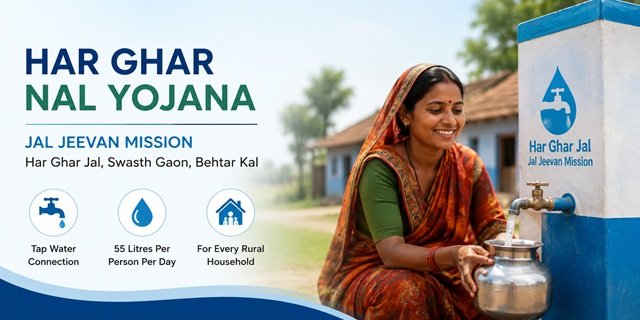
Har Ghar Nal Yojana – officially Jal Jeevan Mission (JJM) – Har Ghar Jal – is India’s largest rural drinking water programme launched on 15 August 2019 by PM Narendra Modi implemented by the Department of Drinking Water and Sanitation, Ministry of Jal Shakti that provides a free tap water connection supplying minimum 55 litres of potable water per person per day to all 19.36 crore rural households – extended to December 2028 under JJM 2.0. Check status at ejalshakti.gov.in.
Har Ghar Nal Yojana (Jal Jeevan Mission) Highlights | |
|---|---|
| Scheme Name | Har Ghar Nal Yojana – Jal Jeevan Mission (JJM) – Har Ghar Jal |
| Launched On | 15 August 2019 – Independence Day |
| Ministry | Ministry of Jal Shakti, Government of India |
| Department | Department of Drinking Water and Sanitation (DDWS) |
| Nodal Agency | National Jal Jeevan Mission (NJJM) |
| Previous Programme | National Rural Drinking Water Programme (NRDWP) – restructured into JJM |
| Objective | Provide free Functional Household Tap Connection (FHTC) to every rural household – minimum 55 LPCD potable water on a regular basis |
| Target Households | 19.36 crore rural households across India |
| Coverage as on March 2026 | 15.80 crore (81.61%) rural households |
| Villages Certified Har Ghar Jal | 2,77,000 villages |
| Water Supply Standard | Minimum 55 litres per capita per day (lpcd) |
| Water Quality Standard | BIS IS:10500 drinking water standards |
| Connection Cost to Household | Free – no payment required for installation |
| Income/Caste Condition | None – universal – all rural households eligible |
| Coverage Area | Rural areas only – urban areas covered under AMRUT |
| Original Total Outlay | Rs. 3.60 lakh crore (2019) |
| JJM 2.0 Cabinet Approval | 10 March 2026 |
| JJM 2.0 Extended Deadline | December 2028 |
| JJM 2.0 Total Outlay | Rs. 8.69 lakh crore |
| JJM 2.0 Central Assistance | Rs. 3.59 lakh crore |
| Budget 2026-27 Allocation | Rs. 67,670 crore |
| JJM 2.0 Key Features | Sujalam Bharat, Jal Arpan, Jal Utsav |
| Village-level Committee | Paani Samiti / VWSC – sub-committee of Gram Panchayat – minimum 10 members – 50% women |
| Fund Sharing – Hilly/NE States | Central 90% – State 10% |
| Fund Sharing – Other States | Central 50% – State 50% |
| Fund Sharing – UTs | 100% Central funding |
| Application Process | No individual application – contact Gram Panchayat or Paani Samiti |
| JJM Dashboard | ejalshakti.gov.in/jjmreport |
| Water Quality Portal | ejalshakti.gov.in/wqmis |
| JJM Field App | ejalshakti.gov.in/JJMapp |
| Official Portal | jaljeevanmission.gov.in |
| Jal Jeevan Kosh | jaljeevankosh.gov.in |
| DDWS Portal | jalshakti-ddws.gov.in |
| NJM Phone | 011-24362705 |
| NJM Email | njjm.ddws@gov.in |
Introduction of Har Ghar Nal Yojana: A Brief Insight
Har Ghar Nal Yojana, implemented under the Jal Jeevan Mission (JJM), is a flagship rural drinking water programme of the Government of India. Launched on 15 August 2019, the mission aims to provide a Functional Household Tap Connection (FHTC) to eligible rural households and ensure access to safe and adequate drinking water through sustainable village water supply systems. The programme is implemented by the Department of Drinking Water and Sanitation, Ministry of Jal Shakti in coordination with States, Union Territories, Gram Panchayats, and Village Water & Sanitation Committees (VWSCs)/Paani Samitis.
Instead of relying on individual water sources such as hand pumps, wells, ponds, or water tankers, the mission focuses on developing long-term village-level piped water supply infrastructure. This includes source strengthening, water treatment facilities, storage reservoirs, distribution networks, water quality monitoring, and operation and maintenance mechanisms to ensure a reliable drinking water supply in rural areas. The mission also promotes community participation by involving Gram Panchayats and VWSCs in the planning, implementation, and management of village water supply systems.
Jal Jeevan Mission primarily covers eligible rural households and selected public institutions such as Government schools, Anganwadi Centres, Health and Wellness Centres, Primary Health Centres (PHCs), and Gram Panchayat buildings in accordance with the applicable guidelines. The mission follows a service level norm of 55 litres per capita per day (LPCD) and aims to supply drinking water that meets the prescribed quality standards through Functional Household Tap Connections.
Har Ghar Nal Yojana is generally not an individual online application-based scheme. Household tap water connections are provided through the approved village implementation plan by the concerned State Government, Gram Panchayat, VWSC/Paani Samiti, and the implementing department. Households that have not yet received a tap water connection may contact their Gram Panchayat or the concerned implementing authority to know the applicable procedure in their area.
Rural households looking to improve sanitation facilities can also explore the Swachh Bharat Mission (Gramin), while eligible families planning to construct a permanent house may check the Pradhan Mantri Awas Yojana-Gramin (PMAY-G). Beneficiaries seeking information on other welfare programmes can visit our Central Government Schemes page for detailed guides on various Government of India schemes.
Benefits Provided to Eligible Beneficiaries
Har Ghar Nal Yojana (Jal Jeevan Mission) aims to provide safe and adequate drinking water to eligible rural households through a Functional Household Tap Connection (FHTC). The mission also strengthens rural water supply infrastructure and promotes long-term water security.
Household Tap Water Connection
- Provision of a Functional Household Tap Connection (FHTC) to eligible rural households.
- Supply of safe drinking water meeting the prescribed service level and quality standards.
- Regular water supply through village-level piped water distribution systems.
- Improved access to drinking water within the household, reducing the need to collect water from distant sources.
Rural Water Supply Infrastructure
- Development and strengthening of village piped water supply systems.
- Creation or augmentation of drinking water sources, wherever required.
- Construction of water storage facilities, pumping systems, and distribution networks.
- Installation of water treatment facilities in areas requiring water quality improvement.
- Retrofitting and upgrading of existing rural water supply schemes, wherever feasible.
Water Quality and Sustainability
- Regular monitoring and testing of drinking water quality.
- Community participation in water quality surveillance through Field Test Kits (FTKs).
- Measures to improve drinking water quality in areas affected by contaminants such as fluoride, arsenic, iron, salinity, and other water quality issues.
- Promotion of source sustainability, rainwater harvesting, groundwater recharge, and greywater management.
Community Participation
- Participation of Gram Panchayats and Village Water & Sanitation Committees (VWSCs)/Paani Samitis in planning, implementation, operation, and maintenance of water supply systems.
- Capacity building and training for local communities to support sustainable management of village water infrastructure.
Additional Support
- Improved access to safe drinking water for households, schools, Anganwadi Centres, health facilities, and other eligible public institutions covered under the mission.
- Support for long-term operation and maintenance of rural drinking water infrastructure in accordance with mission guidelines.
Eligibility Conditions Required to be Fulfilled
Har Ghar Nal Yojana (Jal Jeevan Mission) aims to provide a Functional Household Tap Connection (FHTC) to every eligible rural household. Households seeking a tap water connection should generally satisfy the following conditions, subject to the implementation guidelines of the concerned State Government or implementing agency.
General Eligibility
- The household should be located in a rural area covered under Jal Jeevan Mission.
- The applicant should ordinarily reside in the concerned rural household.
- The household should not already have a Functional Household Tap Connection (FHTC), wherever applicable.
- There is generally no income, caste, or religion-based restriction for providing household tap water connections under the mission.
Priority Areas
- Villages affected by poor drinking water quality, including fluoride, arsenic, iron, salinity, or other contaminants.
- Drought-prone, desert, tribal, and other water-stressed areas.
- Aspirational Districts and other priority areas identified by the Government.
- Villages affected by Japanese Encephalitis (JE) and Acute Encephalitis Syndrome (AES).
- Other priority areas identified under Jal Jeevan Mission implementation guidelines.
Public Institutions Covered
- Government schools.
- Anganwadi Centres.
- Gram Panchayat buildings.
- Primary Health Centres (PHCs) and Sub-Health Centres.
- Health and Wellness Centres.
- Other eligible public institutions covered under the mission.
Who Is Not Covered
- Households located outside the rural areas covered under Jal Jeevan Mission.
- Households that have already been provided a Functional Household Tap Connection, wherever applicable.
Note: The actual implementation process and connection priorities may vary depending on the annual action plan and guidelines issued by the concerned State Government or implementing agency.
Documents Required to be Attached
Har Ghar Nal Yojana (Jal Jeevan Mission) is an infrastructure programme implemented through the Gram Panchayat, Village Water & Sanitation Committee (VWSC)/Paani Samiti, and the concerned Public Health Engineering Department (PHED) or implementing agency. Individual online applications are generally not required. However, households seeking a new water connection may be asked to submit the following documents, wherever applicable:
- Aadhaar Card or any other valid government-issued identity proof.
- Proof of residence confirming that the applicant resides in the concerned rural village.
- House ownership or occupancy proof, wherever required by the implementing authority.
- Ration Card, if requested for household identification.
- Recent passport-size photograph of the applicant.
- Mobile number for communication regarding the connection process.
- Any other document or declaration prescribed by the Gram Panchayat, VWSC/Paani Samiti, or implementing department.
How Beneficiaries Can Get a Tap Water Connection Under This Scheme
Har Ghar Nal Yojana (Jal Jeevan Mission) is primarily an infrastructure programme implemented by the State Government, Gram Panchayats, Village Water & Sanitation Committees (VWSCs)/Paani Samitis, and the concerned implementing agencies. In most cases, there is no separate nationwide online application form for obtaining a household tap water connection. Households that have not yet received a connection may follow the steps below, wherever applicable.
Step 1: Check Whether Your Village Is Covered
Visit the official Jal Jeevan Mission dashboard at ejalshakti.gov.in to check the coverage status of your State, District, Block, and Village. You may also use the official JJM mobile application, wherever available, to view implementation progress.
Step 2: Contact the Gram Panchayat or VWSC/Paani Samiti
If your household has not received a tap water connection, contact your Gram Panchayat or the Village Water & Sanitation Committee (VWSC)/Paani Samiti. Inform them about your requirement and submit the documents, if requested by the implementing authority.
Step 3: Verification and Connection Process
The Gram Panchayat, VWSC/Paani Samiti, or the concerned implementing agency may verify the household details before including the household under the village water supply programme, wherever applicable. Water supply infrastructure and household connections are provided according to the approved village implementation plan.
Step 4: Contact the District Implementing Authority
If the issue is not resolved at the village level, applicants may contact the concerned Public Health Engineering Department (PHED), Jal Nigam, Rural Water Supply Department, or the District Water and Sanitation Mission (DWSM), depending on the implementation arrangement in their State.
Step 5: Submit a Grievance, If Required
If the matter remains unresolved, applicants may use the grievance redressal mechanism or contact details provided by their State Government or the official Jal Jeevan Mission portal for further assistance.
What If Your Household Has Not Received a Tap Water Connection?
If your village is covered under Jal Jeevan Mission but your household has not yet received a tap water connection, you may approach the following authorities in sequence:
- Gram Panchayat or Ward Member.
- Village Water & Sanitation Committee (VWSC)/Paani Samiti.
- Concerned PHED, Jal Nigam, or Rural Water Supply Department.
- District Water and Sanitation Mission (DWSM), wherever applicable.
- State Water and Sanitation Mission (SWSM), if further escalation is required.
Note: The procedure for providing household tap water connections may vary from one State to another. Applicants should follow the latest guidelines issued by the concerned State Government or implementing agency.
Paani Samiti (Village Water & Sanitation Committee – VWSC): Role Under Jal Jeevan Mission
The Paani Samiti, also known as the Village Water & Sanitation Committee (VWSC), plays an important role in implementing the Jal Jeevan Mission at the village level. Constituted under the Gram Panchayat in accordance with the applicable guidelines, the committee supports the planning, implementation, operation, and maintenance of village drinking water supply systems. Households seeking information about a tap water connection or related issues may contact the Gram Panchayat or the VWSC/Paani Samiti, wherever applicable.
Key Responsibilities of the Paani Samiti
- Participate in preparing and implementing the Village Action Plan (VAP) for rural water supply.
- Support the planning, execution, and monitoring of village drinking water infrastructure.
- Assist in the operation and maintenance of village water supply systems.
- Promote community participation in the management of drinking water services.
- Support water quality monitoring and awareness activities, including the use of Field Test Kits (FTKs), wherever applicable.
- Encourage source sustainability measures such as rainwater harvesting and groundwater recharge.
- Coordinate with the Gram Panchayat and the concerned implementing department for effective service delivery.
How Can You Contact the Paani Samiti?
- Visit your Gram Panchayat office and enquire about the Village Water & Sanitation Committee (VWSC)/Paani Samiti.
- Contact the concerned Public Health Engineering Department (PHED), Jal Nigam, or Rural Water Supply Department, wherever applicable in your State.
- If required, approach the District Water and Sanitation Mission (DWSM) or the designated district implementing authority.
- For official information, visit the Jal Jeevan Mission Portal.
Note: The composition, responsibilities, and functioning of the Paani Samiti/VWSC may vary in accordance with the guidelines issued by the respective State Government and implementing authority.
Important Links Available
- Jal Jeevan Mission (Har Ghar Nal Yojana) – Official Portal
- JJM Dashboard – Check Village and District-wise Coverage
- Water Quality Management Information System (WQMIS)
- Official Guidelines and Operational Documents
- Department of Drinking Water and Sanitation – Ministry of Jal Shakti
Contact Details in Case of Help Needed
- Nodal Department: Department of Drinking Water and Sanitation, Ministry of Jal Shakti, Government of India.
- National Jal Jeevan Mission (NJJM): Mission Director, Pandit Deendayal Antyodaya Bhawan, CGO Complex, Lodhi Road, New Delhi – 110003.
- Phone: 011-24362705
- Email: njjm.ddws@gov.in
- Official Website: jaljeevanmission.gov.in
- Village-Level Assistance: Contact your Gram Panchayat or Village Water & Sanitation Committee (VWSC)/Paani Samiti.
- District-Level Assistance: Contact the concerned PHED, Jal Nigam, Rural Water Supply Department, or District Water and Sanitation Mission (where applicable).
- State-Level Assistance: Contact the State Water and Sanitation Mission (SWSM) or the designated implementing department in your State.
Frequently Asked Questions (FAQs)
Q. What is Har Ghar Nal Yojana?
Ans. Har Ghar Nal Yojana is implemented under the Jal Jeevan Mission (JJM), a Government of India initiative launched on 15 August 2019. The mission aims to provide a Functional Household Tap Connection (FHTC) to eligible rural households and improve access to safe drinking water through sustainable village water supply systems.
Q. Who is eligible for Har Ghar Nal Yojana?
Ans. Eligible rural households covered under Jal Jeevan Mission may receive a Functional Household Tap Connection (FHTC) in accordance with the implementation guidelines of the concerned State Government. There is generally no income, caste, or religion-based restriction for providing household tap water connections under the mission.
Q. How can I get a tap water connection under this scheme?
Ans. Jal Jeevan Mission is generally not an individual online application-based scheme. If your household has not received a tap water connection, contact your Gram Panchayat, Village Water & Sanitation Committee (VWSC)/Paani Samiti, or the concerned implementing department. The exact procedure may vary from one State to another.
Q. My village is covered under Jal Jeevan Mission but my household has not received a connection. What should I do?
Ans. You should first contact your Gram Panchayat or VWSC/Paani Samiti. If the issue is not resolved, approach the concerned PHED, Jal Nigam, Rural Water Supply Department, or District Water and Sanitation Mission (DWSM), wherever applicable. You may also use the grievance redressal mechanism provided by your State Government.
Q. How can I check whether my village is covered under Jal Jeevan Mission?
Ans. Visit the official Jal Jeevan Mission dashboard at https://ejalshakti.gov.in/jjmreport/JJMIndia.aspx. Select your State, District, Block, and Village to view the latest implementation status and coverage details.
Q. How much drinking water is provided under Jal Jeevan Mission?
Ans. Jal Jeevan Mission adopts a service level norm of 55 litres per capita per day (LPCD) for rural drinking water supply systems. The actual water supply depends on the approved village water supply scheme and operational conditions.
Q. Does Har Ghar Nal Yojana cover urban areas?
Ans. No. Jal Jeevan Mission primarily covers rural areas. Drinking water supply in urban areas is managed under separate programmes and by the respective urban local bodies.
Q. What is a Village Water & Sanitation Committee (VWSC)/Paani Samiti?
Ans. A Village Water & Sanitation Committee (VWSC), also known as a Paani Samiti, is a committee constituted under the Gram Panchayat to support the planning, implementation, operation, and maintenance of village water supply systems under Jal Jeevan Mission.
Q. How is drinking water quality monitored under Jal Jeevan Mission?
Ans. Drinking water quality is monitored through laboratory testing and community-based surveillance. Field Test Kits (FTKs) and other quality monitoring mechanisms are used wherever applicable to help ensure that water supplied meets the prescribed standards.
Q. Where can I get help regarding Har Ghar Nal Yojana?
Ans. You may contact your Gram Panchayat, VWSC/Paani Samiti, the concerned State implementing department, or visit the official Jal Jeevan Mission website at https://jaljeevanmission.gov.in for the latest contact details and official information.

Tabassum is a government schemes researcher and writer with 5 years of experience tracking Central and State welfare scheme programmes across India. She has covered 500+ schemes spanning agriculture, women welfare, education, and housing, helping lakhs of beneficiaries understand their entitlements in simple language.