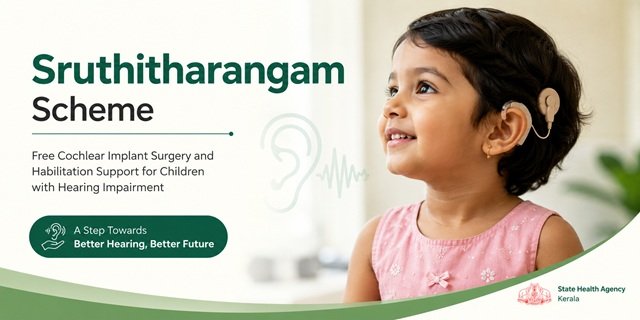
The Sruthitharangam Scheme is a healthcare initiative of the Kerala Government that supports children with severe to profound hearing loss through cochlear implantation surgery and long-term rehabilitation services. Implemented by the State Health Agency (SHA), Kerala, the scheme provides financial assistance for surgery, Auditory Verbal Habilitation Therapy, annual maintenance support, and speech processor upgrades. Eligible children can access treatment through empanelled hospitals approved under the scheme.
Kerala Sruthitharangam Scheme Highlights | |
|---|---|
| Scheme Name | Sruthitharangam Scheme (Cochlear Implantation Scheme) |
| Launch Year | 2012 |
| Earlier Implementing Agency | Kerala Social Security Mission |
| Current Implementing Agency | State Health Agency (SHA), Kerala |
| Implementing Department | Health and Family Welfare Department, Government of Kerala |
| Target Beneficiaries | Children with severe to profound hearing loss |
| Primary Benefit | Free Cochlear Implantation Surgery |
| Maximum Package Support | ₹4,98,050 per Beneficiary |
| Annual Maintenance Assistance | Up to ₹50,000 per Financial Year |
| Speech Processor Upgrade | Available up to 25 Years of Age |
| Application Process | Through Empanelled Hospitals Only |
| Application Mode | Offline Through Hospital-Based Referral Process |
| Official Website | State Health Agency Kerala |
Introduction of Kerala Sruthitharangam Scheme: A Brief Overview
The Sruthitharangam Scheme is a flagship healthcare initiative of the Government of Kerala that supports children suffering from severe to profound hearing loss through cochlear implantation and long-term rehabilitation services. The scheme was introduced to ensure that financial constraints do not prevent a child from receiving timely treatment during the most critical years of speech and language development.
The scheme was originally launched in 2012 under the Social Justice Department and was implemented through the Kerala Social Security Mission. From the financial year 2023-24 onwards, implementation shifted to the State Health Agency (SHA), Kerala, functioning under the Health and Family Welfare Department. This transition brought the programme under Kerala’s broader public healthcare framework and strengthened monitoring, funding, and treatment delivery mechanisms.
Hearing plays a vital role in the development of speech, communication skills, learning ability, and social interaction during childhood. Children born with profound hearing impairment often face lifelong communication challenges if appropriate intervention is delayed. Recognising the importance of early diagnosis and treatment, the Kerala Government designed the Sruthitharangam Scheme to provide comprehensive support from surgery to rehabilitation, helping children integrate more effectively into mainstream education and society.
Under the scheme, eligible beneficiaries receive cochlear implantation surgery through empanelled hospitals. The approved treatment package currently covers expenses up to ₹4,98,050 per beneficiary, including the cochlear implant device, surgical procedure, and implant programming. The scheme follows a cashless treatment model at empanelled Government hospitals, significantly reducing the financial burden on eligible families.
Support under the scheme does not end with surgery. Beneficiaries also receive Auditory Verbal Habilitation Therapy, which helps children learn to recognise sounds, develop listening skills, and improve speech abilities after implantation. In addition, the scheme provides annual maintenance assistance of up to ₹50,000 for spares and accessories, along with speech processor upgrade support up to the age of 25 years, ensuring continued functionality of the hearing device over the long term.
The scheme primarily focuses on young children because cochlear implantation produces the best outcomes when performed at an early age. Children between 0 and 5 years are generally considered for treatment, while certain post-lingual hearing loss cases and post-meningitis cases may also be considered beyond the standard age limit based on recommendations of the State Level Technical Committee. The child and family must satisfy the residency, income, and medical eligibility conditions prescribed under the scheme guidelines.
Applications are processed through empanelled hospitals rather than through direct online registration. Parents must approach an approved hospital where the child undergoes audiological, radiological, and ENT evaluations. The treating hospital prepares the required medical documentation and forwards the proposal to the State Level Technical Committee for approval. Once approved, treatment and rehabilitation services are initiated according to the prescribed protocol.
Families looking for healthcare support schemes may also explore the Ayushman Bharat PM-JAY Scheme, which provides cashless hospital treatment for eligible families, and the Ayushman Bharat Vay Vandana Card Scheme, which offers health coverage benefits to senior citizens aged 70 years and above. Together, these initiatives strengthen healthcare access for different sections of society.
The Sruthitharangam Scheme remains one of the most impactful healthcare programmes among All Kerala Government Schemes, helping children with hearing impairment receive timely medical intervention, rehabilitation support, and an improved opportunity to lead an independent and productive life.
Benefits Provided to Eligible Beneficiaries
The Sruthitharangam Scheme provides comprehensive support to children with severe hearing impairment by covering cochlear implantation, rehabilitation services, and long-term device maintenance assistance.
- Cashless cochlear implantation surgery at empanelled hospitals
- Financial assistance up to ₹4,98,050 per beneficiary under the approved package
- Coverage of cochlear implant cost, surgery expenses, and implant programming
- Post-surgery Auditory Verbal Habilitation Therapy support
- 10-year warranty on the cochlear implant device
- Annual maintenance assistance up to ₹50,000 per financial year
- Speech processor upgrade support up to 25 years of age
- Post-surgery monitoring by the State Level Technical Committee
- Reduced financial burden on families requiring cochlear implant treatment
Eligibility Conditions Required to be Fulfilled
The Sruthitharangam Scheme supports children with severe hearing impairment who require cochlear implantation and related assistance. The child must satisfy the age, residency, family, and medical eligibility conditions prescribed under the scheme.
Age-Related Eligibility
- Children between 0 and 5 years of age are eligible for cochlear implantation, with surgery preferably completed before 3 years of age
- Children aged between 3 and 5 years require approval from the State Level Technical Committee (SLTC)
- Children with post-lingual profound hearing loss may be considered up to 12 years of age, subject to SLTC approval
- Children affected by post-meningitis hearing loss may be considered beyond 5 years of age on the recommendation of the SLTC
- Speech processor replacement and annual maintenance support are available up to 25 years of age
General Eligibility Conditions
- The child and parents must be permanent residents of Kerala
- Neither parent should be employed under the Central Government or State Government
- The family should not belong to the Income Tax paying category
- The parent or legal guardian must submit the prescribed self-declaration form
Medical Eligibility Conditions
- The child must have bilateral severe to profound hearing loss confirmed through prescribed audiological assessments
- The child must have shown limited benefit from hearing aids despite regular use along with speech therapy for at least two months
- Medical evaluation must confirm suitability for cochlear implantation
- Radiological investigations must show normal cochlear anatomy and a visible cochlear nerve
- The child should not have major congenital abnormalities or neurological conditions affecting cochlear implant outcomes
- The child must complete all mandatory vaccinations prescribed before cochlear implantation, including Pneumococcal and H Influenza vaccinations
Documents Required to be Attached
Applicants seeking benefits under the Sruthitharangam Scheme must submit certain identity, family, and medical documents. While parents or guardians initiate the application process, the treating hospital is responsible for submitting the required medical evaluations and specialist certificates.
Documents Required for Application Submission
- Ration Card containing the name of the child or either parent
- Birth Certificate (required only if the child is below 2 years of age and not included in the Ration Card)
- Self-Declaration Form signed by the parent or guardian and countersigned by the Hospital Nodal Officer
- Aadhaar Card of the child
- Aadhaar Card of the parent or guardian
- Mobile Number linked with Aadhaar for OTP verification
Medical Documents Required from the Treating Hospital
- Duly filled and signed application form with complete family details
- Hearing Evaluation Certificate issued jointly by an Audiologist and Speech Language Pathologist
- Recommendation Certificate issued by the treating ENT Surgeon
- Joint Checklist signed and sealed by the Audiologist, Speech Language Pathologist, and ENT Surgeon
- Reports of prescribed diagnostic tests, including BERA, ASSR, OAE, and HRCT Temporal Bone examinations
Documents Required After Approval
- Affidavit on Stamp Paper signed by both parents after approval by the State Level Technical Committee (SLTC)
How Beneficiaries Can Apply to Avail the Benefit of this Scheme
The application process under the Sruthitharangam Scheme begins at an empanelled hospital and not through a direct online application by the parent. The entire proposal is prepared, verified, and submitted by the treating hospital after completing the required medical evaluations. Parents only need to provide the prescribed documents and cooperate during the assessment process.
The first step is to visit a hospital empanelled under the Sruthitharangam Scheme. Parents may approach eligible Government Medical Colleges or any private hospital approved by the State Health Agency, Kerala, for cochlear implantation treatment under the scheme.
At the hospital, the parent or guardian submits the required documents, including the ration card, Aadhaar details, birth certificate where applicable, and the prescribed self-declaration. The hospital verifies the family’s eligibility before proceeding further.
After document verification, the child undergoes a detailed pre-implant assessment. This evaluation includes ENT examination, hearing assessments such as BERA, ASSR, OAE, aided audiogram, and radiological investigations including HRCT of the temporal bone and other tests prescribed under the scheme guidelines.
Based on the evaluation results, the Audiologist, Speech Language Pathologist, and ENT Surgeon prepare the required medical certificates and jointly complete the technical checklist prescribed for cochlear implantation cases.
Once all documents and medical reports are complete, the empanelled hospital forwards the proposal to the State Level Technical Committee (SLTC) for scrutiny and approval. Parents are not required to submit the proposal directly to the State Health Agency.
The State Level Technical Committee examines the medical eligibility, hearing assessment reports, radiological findings, and supporting documents before taking a decision on the case. Eligible applications are approved for treatment under the scheme.
After receiving SLTC approval, both parents must execute and submit the prescribed affidavit on stamp paper as required under the scheme guidelines. The hospital then initiates the treatment process.
Following completion of these formalities, cochlear implantation surgery is performed at the empanelled hospital. The beneficiary subsequently receives Auditory Verbal Habilitation Therapy and other post-operative support covered under the scheme.
The treating hospital submits the treatment claim to the State Health Agency through the prescribed system, while the family continues follow-up therapy and medical review as advised by the treating specialists.
Where Families Can Get Treatment Under Sruthitharangam Scheme
Treatment under the Sruthitharangam Scheme is available only through hospitals empanelled by the State Health Agency, Kerala. After receiving approval from the State Level Technical Committee, beneficiaries can undergo treatment at any of the approved government or private hospitals listed under the scheme.
Government Medical Colleges
- Government Medical College, Thiruvananthapuram – 9747211427
- Government Medical College, Kottayam – 7034725777
- Government Medical College, Kozhikode – 0495-2350216
Empanelled Private Hospitals
- Dr Noushad’s ENT Hospital, Ernakulam – 9447071644
- Medical Trust Hospital, Ernakulam – 9847075102
- Dr Manoj’s ENT Hospital, Kozhikode – 8606383838
- Ascent Hospital, Malappuram – 0495-2370707
- KIMSHEALTH, Thiruvananthapuram – 7736569053
- Baby Memorial Hospital, Kozhikode – 0495-2723272
- Amrita Institute of Medical Sciences and Research Centre, Ernakulam – 0484-6685986
Auditory Verbal Habilitation Centre
- National Institute of Speech and Hearing (NISH), Thiruvananthapuram – 0471-2944666
Important Links Available
- State Health Agency Kerala Official Website
- Empanelled Hospital List for Sruthitharangam Scheme
- Official Scheme Note
- Government Order and Implementation Guidelines
- Online Grievance Redressal Portal
Contact Details in Case of Help Needed
- State Health Agency Kerala, 5th & 8th Floor, Artech Meenakshi Plaza, Opposite Government Women and Children’s Hospital, Thycaud, Thiruvananthapuram – 695014
- Phone Number: 0471-4063121, 0471-2960221
- SHA Helpline Number: 1056
- Email ID: statehealthagencykerala@gmail.com
- DISHA Health Helpline and Grievance Number: 14555
- Beneficiaries may also contact the empanelled hospital where the child is undergoing evaluation or treatment for scheme-related assistance.
Frequently Asked Questions (FAQs)
Q. What is the Sruthitharangam Scheme?
Ans. Sruthitharangam Scheme is a Kerala Government initiative that provides cochlear implantation surgery and post-operative rehabilitation support for children with severe to profound hearing loss.
Q. Which department implements the Sruthitharangam Scheme?
Ans. The State Health Agency, Kerala, under the Health and Family Welfare Department, currently implements the scheme. Earlier, it was administered by the Kerala Social Security Mission under the Social Justice Department.
Q. How much financial assistance is available under the scheme?
Ans. The approved treatment package currently provides support up to ₹4,98,050 per beneficiary, covering the cochlear implant, surgery, and programming charges.
Q. What is the eligible age limit for cochlear implantation under the scheme?
Ans. Children from birth to 5 years of age are generally eligible. Surgery is preferably completed before the age of 3 years. Certain post-lingual and post-meningitis cases may be considered beyond this age limit with approval from the State Level Technical Committee.
Q. Does the scheme provide support after surgery?
Ans. Yes. The scheme covers Auditory Verbal Habilitation Therapy, annual maintenance support up to ₹50,000 per financial year, and speech processor upgrades up to the age of 25 years.
Q. Can parents apply directly online for the Sruthitharangam Scheme?
Ans. No. Applications are processed through empanelled hospitals. The hospital completes the medical evaluation, verifies documents, and forwards the proposal to the State Level Technical Committee.
Q. Is cochlear implantation completely free under the scheme?
Ans. Treatment is provided cashlessly at empanelled Government hospitals. In empanelled private hospitals, beneficiaries may be required to pay the amount specified under the scheme guidelines.
Q. What documents are required to apply for the scheme?
Ans. Applicants generally need a ration card, Aadhaar cards of the child and parent, birth certificate where applicable, self-declaration, and the prescribed medical certificates prepared by the treating hospital.
Q. How long does the State Level Technical Committee take to review applications?
Ans. The committee normally reviews applications within 10 working days of receipt. Cases may also be considered during committee meetings conducted periodically as per the scheme guidelines.
Q. How can beneficiaries raise a grievance related to the scheme?
Ans. Beneficiaries may contact the DISHA Health Helpline at 14555, approach the District Grievance Redressal Committee, or submit complaints through the online grievance redressal mechanism.

Tabassum is a government schemes researcher and writer with 5 years of experience tracking Central and State welfare scheme programmes across India. She has covered 500+ schemes spanning agriculture, women welfare, education, and housing, helping lakhs of beneficiaries understand their entitlements in simple language.