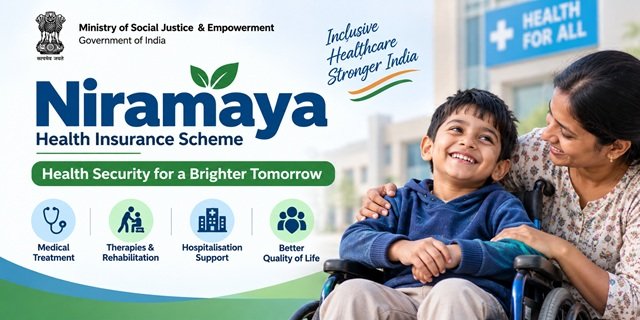
Niramaya Health Insurance Scheme is a disability-focused health insurance scheme implemented by The National Trust, Ministry of Social Justice & Empowerment, Government of India. The scheme provides eligible persons with Autism, Cerebral Palsy, Intellectual Disability, and Multiple Disabilities with annual health coverage of up to Rs. 1,00,000 for medical treatment, therapies, hospitalisation, and rehabilitation expenses. Beneficiaries can enrol through a Registered Organisation (RO), National Institute, CRC, or the online portal using a valid UDID Card.
Niramaya Health Insurance Scheme Highlights | |
|---|---|
| Scheme Name | Niramaya Health Insurance Scheme |
| Launched By | The National Trust |
| Nodal Ministry | Ministry of Social Justice & Empowerment, Government of India |
| Implementing Authority | The National Trust for the Welfare of Persons with Autism, Cerebral Palsy, Mental Retardation and Multiple Disabilities |
| Objective | Provide affordable health insurance and rehabilitation support to persons with specified disabilities |
| Eligible Beneficiaries | Persons with Autism, Cerebral Palsy, Intellectual Disability, and Multiple Disabilities |
| Annual Insurance Coverage | Up to Rs. 1,00,000 per beneficiary |
| Coverage Mode | Reimbursement-based health insurance |
| Hospitalization Coverage | Up to Rs. 55,000 |
| OPD Coverage | Up to Rs. 19,000 |
| Therapy Coverage | Up to Rs. 20,000 |
| AYUSH Treatment Coverage | Up to Rs. 4,000 |
| Transportation Coverage | Up to Rs. 2,000 |
| Pre-Insurance Medical Test | Not required |
| Coverage of Pre-Existing Disability Conditions | Available from the beginning of the policy period |
| Age Limit | No minimum or maximum age limit |
| Mandatory Document | Valid UDID Card |
| Treatment Facility | Eligible treatment can be availed from authorised healthcare providers across India |
| Policy Validity | Annual policy with renewal facility |
| Application Mode | Through Registered Organisation (RO), National Institute, CRC, or online enrolment |
| Claim Mode | Reimbursement after submission of bills and supporting documents |
| Official Portal | thenationaltrust.gov.in |
Introduction of Niramaya Health Insurance Scheme: A Brief Insight
Caring for a person with Autism, Cerebral Palsy, Intellectual Disability, or Multiple Disabilities often involves more than occasional doctor visits. Many families face recurring expenses on therapies, medicines, diagnostic tests, rehabilitation services, and specialist consultations throughout the year. These costs can place a significant financial burden on households, especially when such services are not fully covered under conventional health insurance plans.
To address this challenge, the Government of India operates the Niramaya Health Insurance Scheme through the National Trust. The scheme has been specially designed to provide health insurance support to persons covered under the National Trust Act, ensuring that they can access essential healthcare and rehabilitation services without facing excessive financial hardship.
The scheme is implemented by The National Trust for the Welfare of Persons with Autism, Cerebral Palsy, Mental Retardation and Multiple Disabilities, under the Ministry of Social Justice & Empowerment. Its primary objective is to make healthcare more accessible and affordable for eligible beneficiaries by covering a wide range of medical and therapy-related expenses.
One of the biggest advantages of the scheme is that beneficiaries are not required to undergo any pre-insurance medical examination before enrolment. In addition, disability-related pre-existing conditions are covered from the very beginning of the policy period, providing immediate protection to eligible individuals and their families.
Under the scheme, beneficiaries can receive health coverage of up to Rs. 1,00,000 per year on a reimbursement basis. The coverage includes hospitalisation expenses, OPD treatment, medicines, diagnostic tests, corrective surgeries, physiotherapy, occupational therapy, speech therapy, AYUSH treatment, and transportation expenses, subject to the limits prescribed under the scheme.
The scheme also recognises that rehabilitation is just as important as medical treatment. Therefore, dedicated financial support is available for ongoing therapies that help improve communication skills, mobility, daily living abilities, and overall quality of life for persons with disabilities.
Eligible individuals with Autism Spectrum Disorder, Cerebral Palsy, Intellectual Disability, or Multiple Disabilities can enrol by obtaining a valid UDID Card and completing the enrolment process through a Registered Organisation (RO), National Institute, Composite Regional Centre (CRC), or the National Trust’s online platform.
Families looking for broader healthcare support can also explore the Ayushman Bharat Pradhan Mantri Jan Arogya Yojana (AB-PMJAY), which offers cashless hospitalisation coverage for eligible families. Senior citizens in the household may additionally benefit from the Ayushman Vay Vandana Card Scheme, which provides dedicated health coverage for individuals aged 70 years and above.
Persons with disabilities, caregivers, and families interested in learning about similar welfare, healthcare, and social security initiatives can explore our dedicated section on Welfare Schemes of Central Government for more useful programmes and benefits.
Benefits Provided to Eligible Beneficiaries
The Niramaya Health Insurance Scheme, implemented by the National Trust under the Ministry of Social Justice & Empowerment, provides comprehensive health coverage for persons with Autism, Cerebral Palsy, Intellectual Disability, and Multiple Disabilities. The scheme focuses on reducing the financial burden of medical treatment, therapies, and disability-related healthcare needs.
Annual Health Insurance Coverage
- Health coverage of up to Rs. 1,00,000 per beneficiary per year
- Coverage available on a reimbursement basis
- No pre-insurance medical examination required for enrolment
- Treatment can be taken from any recognised medical practitioner, clinic, hospital, or healthcare facility across India
- Coverage includes both disability-related and general healthcare expenses as per scheme guidelines
Coverage Available Under Different Categories
| Category | Coverage Details | Maximum Limit |
|---|---|---|
| Hospitalisation | Corrective surgeries and non-surgical hospital treatment | Up to Rs. 55,000 |
| Out-Patient (OPD) Care | Consultation, medicines, pathology tests, diagnostics, and dental care | Up to Rs. 19,000 |
| Therapies | Physiotherapy, Occupational Therapy, Speech Therapy, Behaviour Therapy, and similar services | Up to Rs. 20,000 |
| AYUSH Treatment | Ayurveda, Yoga, Naturopathy, Unani, Siddha, and Homoeopathy | Up to Rs. 4,000 |
| Transportation | Travel expenses incurred for treatment purposes | Up to Rs. 2,000 |
| Total Annual Coverage | Combined yearly benefit | Up to Rs. 1,00,000 |
Major Medical Expenses Covered
- Hospital admission and treatment expenses
- Corrective surgeries for congenital and existing disabilities
- Doctor consultations and follow-up visits
- Medicines and prescribed medical equipment
- Diagnostic tests, pathology investigations, and medical reports
- Dental treatment under the prescribed limit
- Regular health check-ups and preventive healthcare services
- Long-term therapies required for disability management
- AYUSH-based treatment and wellness services
- Travel expenses incurred while seeking treatment
Special Advantages of the Scheme
- Pre-existing disability-related conditions are covered
- No waiting period for eligible beneficiaries
- No age restriction for enrolment
- Coverage available throughout India
- Supports both medical treatment and rehabilitation needs
- Helps families manage recurring therapy and healthcare expenses
Eligibility Conditions Required to be Fulfilled
The Niramaya Health Insurance Scheme is administered by the National Trust under the Ministry of Social Justice & Empowerment. To avail the benefits of this scheme, applicants must satisfy the following eligibility conditions.
Eligible Disability Categories
The scheme is specifically designed for persons covered under the National Trust Act, 1999. The beneficiary must have at least one of the following disabilities:
- Autism Spectrum Disorder (ASD)
- Cerebral Palsy (CP)
- Intellectual Disability (ID)
- Multiple Disabilities
Basic Eligibility Conditions
- Must possess a valid UDID Card (Unique Disability ID) or a valid UDID enrolment number
- Must have a recognised disability certificate corresponding to the eligible disability category
- No minimum or maximum age limit applies
- No medical examination is required before enrolment
- Available to eligible beneficiaries across India
Income Criteria
- There is no income limit for joining the scheme
- Income level only determines the premium payable by the beneficiary
- Beneficiaries belonging to BPL families can avail coverage at a highly subsidised premium
Major Advantage for Beneficiaries
- Coverage is available for pre-existing disability-related medical conditions
- No waiting period applies for eligible disability-related treatments and healthcare needs
- Beneficiaries can avail reimbursement benefits immediately after enrolment, subject to scheme guidelines
Who Is Not Eligible?
- Persons whose disabilities are not covered under the National Trust Act, 1999
- Applicants who do not possess a valid UDID Card or UDID enrolment number
- Individuals applying solely on the basis of disabilities such as visual impairment, hearing impairment, speech impairment, locomotor disability, or mental illness, unless they qualify under the eligible National Trust categories
Important: Many families mistakenly assume that a disability certificate alone is sufficient. However, a valid UDID Card has become the primary document for enrolment and should be obtained before applying for the scheme.
Documents Required to be Attached
To enrol in the Niramaya Health Insurance Scheme and claim reimbursement benefits, beneficiaries must keep the following documents ready. Submitting complete and accurate documents helps avoid delays during enrolment and claim settlement.
Documents Required for Enrolment
- Valid UDID Card (Unique Disability ID) – mandatory for enrolment
- Aadhaar Card of the beneficiary
- Recent passport-size photographs
- Bank passbook copy or cancelled cheque
- BPL Certificate or Income Certificate (for concessional premium category, if applicable)
Documents Required for Claim Reimbursement
- Duly filled and signed claim form
- Niramaya Scheme E-Card
- Copy of UDID Card
- Copy of Aadhaar Card
- Original medical bills and payment receipts
- Doctor’s prescriptions related to the treatment
- Diagnostic reports, laboratory reports, or investigation records
- Hospital discharge summary, if hospitalisation was involved
- Surgery records or treatment notes, wherever applicable
- Bank account details for reimbursement transfer
How Beneficiaries Can Apply to Avail the Benefit of the Scheme
Using the Niramaya Health Insurance Scheme is not difficult. You first need to enrol yourself in the scheme and get your Niramaya E-card. After that, whenever you spend money on eligible medical treatment, you can submit a claim and get reimbursement as per the scheme rules.
To make things easy, let’s understand the complete process step by step.
Part 1: How to Enrol in the Niramaya Scheme
Step 1: First, check whether the beneficiary has a valid UDID Card (Unique Disability ID Card). This is the most important requirement. Without a UDID Card, enrolment cannot be completed.
Step 2: Keep all basic documents ready before starting the application process. These generally include the UDID Card, Aadhaar Card, passport-size photograph, bank account details, and income/BPL certificate (if applicable).
Step 3: Choose the method through which you want to apply. You can enrol through a Registered Organisation (RO), a National Institute/Composite Regional Centre (CRC), or through the official online enrolment system.
Step 4: Submit your details and required documents. If you are applying through an RO or CRC, their staff will help you fill out the application form and verify your documents.
Step 5: Pay the applicable premium amount according to your category. The premium varies depending on the beneficiary’s income status and eligibility category.
Step 6: After submission, your application will be checked and verified by the concerned authorities. During this stage, you may be contacted if any document or information is missing.
Step 7: Once your application is approved, you will receive your Niramaya E-card. This card contains your policy details and insurance information. Keep it safely because it will be required whenever you submit a claim.
Part 2: How to Claim Reimbursement After Treatment
Step 8: Whenever the beneficiary requires treatment, visit a qualified doctor, hospital, therapy centre, or healthcare facility and receive the required medical services.
Step 9: Since Niramaya works on a reimbursement basis, you must first pay the treatment expenses yourself. The scheme does not provide cashless treatment.
Step 10: After treatment, carefully keep all original documents safe. These include doctor’s prescriptions, hospital bills, pharmacy bills, receipts, discharge summaries, therapy records, diagnostic reports, and any other supporting medical documents.
Step 11: Download or obtain the official claim form and fill in all required details correctly, including the beneficiary’s information, treatment details, and expenses incurred.
Step 12: Attach all required documents with the claim form, including the Niramaya E-card copy, UDID Card copy, Aadhaar Card copy, original bills, medical records, and bank account details.
Step 13: Submit the completed claim through your nearest Registered Organisation (RO) or through the claim submission process prescribed by the National Trust and the authorised Third Party Administrator (TPA).
Step 14: The claim will be examined and verified. If any clarification or additional document is required, the concerned authority may contact you.
Step 15: Once the claim is approved, the eligible reimbursement amount will be transferred directly to the beneficiary’s registered bank account.
Important: Always keep original bills and medical documents safely until the claim is settled. Missing documents can delay or even lead to rejection of the claim.
Also Remember: The Niramaya policy is valid for a limited period and needs to be renewed from time to time. Make sure your policy remains active so that you can continue receiving benefits under the scheme whenever required.
Important Links Available of the Scheme
- Niramaya Health Insurance Scheme Official Page, The National Trust
- Niramaya Scheme National Trust Portal
- Niramaya Enrolment Form for PwD
- Niramaya E-Card and Claim Status Check
- All National Trust Schemes at a Glance
Contact Details in Case of Help Needed
- Nodal Ministry: Ministry of Social Justice & Empowerment, Government of India
- Implementing Body: The National Trust for the Welfare of Persons with Autism, Cerebral Palsy, Mental Retardation and Multiple Disabilities
- Local Level: Contact your nearest Registered Organisation (RO), National Institute, or Composite Regional Centre (CRC) for enrolment and claim assistance
Frequently Asked Questions (FAQs)
Q. What is the Niramaya Health Insurance Scheme?
Ans. The Niramaya Health Insurance Scheme is a welfare initiative of The National Trust, under the Ministry of Social Justice & Empowerment, Government of India. It provides health insurance coverage of up to Rs. 1,00,000 per year to eligible persons with Autism, Cerebral Palsy, Intellectual Disability, and Multiple Disabilities.
Q. Who can apply for the Niramaya Scheme?
Ans. Individuals covered under the National Trust Act, 1999 and possessing a valid UDID Card can enrol in the scheme. Eligible disability categories include Autism Spectrum Disorder, Cerebral Palsy, Intellectual Disability, and Multiple Disabilities.
Q. Is there any age limit for joining the scheme?
Ans. No. The scheme is open to eligible beneficiaries of all age groups, from children to senior citizens.
Q. Is a medical examination required before enrolment?
Ans. No. Beneficiaries are not required to undergo any pre-insurance medical test before joining the scheme.
Q. Does the scheme cover pre-existing disability-related conditions?
Ans. Yes. Disability-related conditions are covered from the beginning of the policy period, which is one of the major advantages of the Niramaya Scheme.
Q. How much insurance coverage is available under the scheme?
Ans. Eligible beneficiaries can receive benefits of up to Rs. 1,00,000 annually, including coverage for hospitalisation, OPD treatment, therapies, AYUSH treatment, and transportation expenses, subject to prescribed limits.
Q. Is treatment provided on a cashless basis?
Ans. No. The Niramaya Scheme operates entirely on a reimbursement basis. Beneficiaries must first pay the treatment expenses and later submit a claim to receive reimbursement.
Q. Can treatment be taken from any hospital?
Ans. Yes. Treatment can generally be taken from qualified medical practitioners, hospitals, therapy centres, and healthcare facilities as permitted under the scheme guidelines.
Q. What types of expenses are covered?
Ans. The scheme covers hospitalisation expenses, surgeries, OPD consultations, medicines, diagnostic tests, physiotherapy, occupational therapy, speech therapy, AYUSH treatments, and transportation expenses within the approved limits.
Q. How can I enrol in the scheme?
Ans. You can enrol through a Registered Organisation (RO), a National Institute, a Composite Regional Centre (CRC), or through the official online enrolment facility provided by The National Trust.
Q. What documents are required for enrolment?
Ans. Generally, you need a valid UDID Card, Aadhaar Card, passport-size photograph, bank account details, and an income/BPL certificate if applying under the subsidised premium category.
Q. Do I need to renew the policy every year?
Ans. Yes. The Niramaya Health Insurance Scheme requires periodic renewal to keep the insurance coverage active and continue receiving benefits.
Q. What should I do if my claim is rejected?
Ans. If a claim is rejected, review the reason provided by the concerned authority, arrange any missing documents if required, and follow the prescribed appeal or resubmission process.
Q. Is this the same scheme as Odisha’s Niramaya Free Medicine Scheme?
Ans. No. The two schemes are completely different. Odisha’s Niramaya Scheme provides free medicines at government health facilities, whereas the Niramaya Health Insurance Scheme of The National Trust offers health insurance coverage to persons with specified disabilities.
Q. Where can I get more information or assistance?
Ans. You can contact your nearest Registered Organisation (RO) associated with The National Trust or visit the official portal of The National Trust for the latest enrolment, renewal, and claim-related information.

Tabassum is a government schemes researcher and writer with 5 years of experience tracking Central and State welfare scheme programmes across India. She has covered 500+ schemes spanning agriculture, women welfare, education, and housing, helping lakhs of beneficiaries understand their entitlements in simple language.