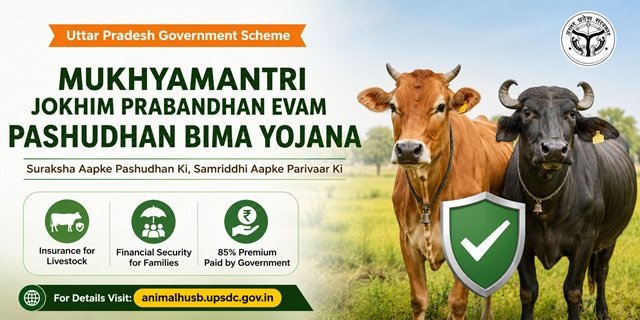
Mukhyamantri Jokhim Prabandhan Evam Pashudhan Bima Yojana is a livestock insurance scheme launched by the Government of Uttar Pradesh to protect farmers from financial losses caused by the death or permanent disability of insured livestock. Approved by the Uttar Pradesh Cabinet on 6 July 2026, the scheme offers insurance coverage with the government paying 85% of the premium, while beneficiaries contribute only 15%. It has been allocated a budget of Rs. 60 crore for FY 2026-27. Eligible livestock owners can obtain coverage through their nearest Government Veterinary Hospital.
Uttar Pradesh Mukhyamantri Jokhim Prabandhan Evam Pashudhan Bima Yojana Highlights | |
|---|---|
| Scheme Name | Mukhyamantri Jokhim Prabandhan Evam Pashudhan Bima Yojana |
| Cabinet Approval Date | 6 July 2026 |
| Implementing Department | Livestock and Dairy Development Department, Government of Uttar Pradesh |
| Previous Scheme Name | Kamadhenu Pashu Bima Yojana / Pashudhan Bima Yojana |
| Purpose | Insurance protection against livestock death and permanent disability |
| Government Premium Share | 85% (Central Government 51% + State Government 34%) |
| Beneficiary Contribution | 15% of the insurance premium |
| Death Compensation | 100% of the insured amount through DBT |
| Permanent Disability Benefit | Up to 75% of the insured amount |
| Covered Risks | Epidemics, natural disasters, accidents, and permanent disability |
| Eligible Animal Age | 2 to 10 years (Large Milch Cattle) |
| Ear Tag Requirement | Mandatory |
| Coverage Target (FY 2026-27) | 2,28,350 livestock |
| General Category Coverage | 1,86,800 animals |
| SC/ST Component | 41,550 animals |
| Budget Allocation | Rs. 60 crore (FY 2026-27) |
| Coverage Area | All 75 districts of Uttar Pradesh |
| Eligible Beneficiaries | Small and marginal farmers, landless livestock owners, and dairy farmers |
| Application Mode | Offline through the nearest Government Veterinary Hospital (Rajkiya Pashu Chikitsalay) |
| Claim Payment Mode | Direct Benefit Transfer (DBT) |
| Official Website | animalhusb.upsdc.gov.in |
| UPLDB Portal | upldb.up.gov.in |
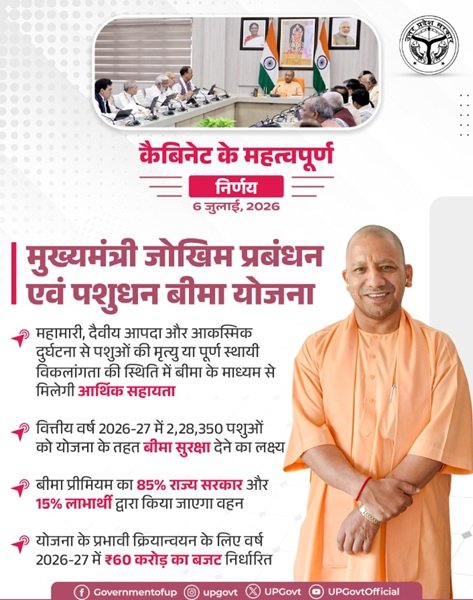
Introduction of Uttar Pradesh Mukhyamantri Jokhim Prabandhan Evam Pashudhan Bima Yojana: A Brief Insight
For millions of farmers in Uttar Pradesh, livestock is much more than a source of income. A cow or buffalo supports the family’s daily earnings through milk production, and for many small and marginal farmers, it is their most valuable asset. However, if an animal dies due to disease, floods, lightning, accidents, or other unforeseen incidents, the financial loss can be devastating. Until now, many livestock owners either remained uninsured or found insurance premiums difficult to afford.
To provide affordable insurance protection, the Uttar Pradesh Cabinet, chaired by Chief Minister Yogi Adityanath, approved the Mukhyamantri Jokhim Prabandhan Evam Pashudhan Bima Yojana on 6 July 2026. The scheme replaces the earlier Kamadhenu Pashu Bima Yojana with significantly higher government support. Under the new scheme, the government bears 85% of the insurance premium, while beneficiaries contribute only 15%, making livestock insurance accessible to a much larger number of farmers.
If an insured animal dies because of an epidemic, natural disaster, or accident, the livestock owner receives 100% of the insured amount through Direct Benefit Transfer (DBT). In cases of permanent disability, compensation of up to 75% of the insured value is provided, subject to the applicable guidelines. The scheme aims to reduce financial risks and help livestock owners recover quickly from unexpected losses.
Small and marginal farmers, landless livestock owners, and dairy farmers residing in Uttar Pradesh can avail the benefit, provided the animal satisfies the prescribed eligibility conditions. Large milch cattle between 2 and 10 years of age with a valid ear tag are eligible for insurance. The scheme will be implemented across all 75 districts of the state with a budget allocation of Rs. 60 crore for FY 2026-27, targeting insurance coverage for more than 2.28 lakh livestock. Interested beneficiaries can contact their nearest Government Veterinary Hospital (Rajkiya Pashu Chikitsalay) or the office of the Chief Veterinary Officer for enrollment.
Livestock owners looking to improve milk production can also explore the Mukhyamantri Pragatisheel Pashupalak Protsahan Yojana, which rewards dairy farmers for maintaining high-yield indigenous cattle. Farmers interested in expanding their herd with recognised indigenous breeds can check the Mukhyamantri Swadeshi Gau Samvardhan Yojana.
Farmers and livestock owners can also explore our List of Welfare Schemes of Uttar Pradesh Government page to learn about other welfare programmes related to agriculture, dairy farming, animal husbandry, and rural development.
Benefits Provided to Eligible Beneficiaries
Eligible livestock owners receive the following benefits under the Mukhyamantri Jokhim Prabandhan Evam Pashudhan Bima Yojana:
Insurance Coverage
- Compensation up to the full insured value if an insured animal dies due to an epidemic, natural disaster, or accidental incident.
- Compensation of up to 75% of the insured value if the animal suffers Permanent Total Disability (PTD) and becomes permanently unfit for production.
- Claim amount transferred directly to the beneficiary’s Aadhaar-linked bank account through Direct Benefit Transfer (DBT).
- Approved claims are to be settled by the insurance company within the prescribed time limit.
Premium Sharing Pattern
| Premium Contribution | Share |
|---|---|
| Central Government | 51% |
| Government of Uttar Pradesh | 34% |
| Total Government Support | 85% |
| Beneficiary Contribution | 15% |
Scheme Coverage
- Implemented across all 75 districts of Uttar Pradesh.
- Insurance coverage is planned for 2,28,350 livestock during FY 2026-27.
- General Component: 1,86,800 animals.
- SCSP Component: 41,550 animals.
- Budget allocation of Rs. 60 crore for FY 2026-27.
Eligibility Conditions Required to be Fulfilled
Applicants must fulfil the following eligibility conditions to avail the benefits of the Mukhyamantri Jokhim Prabandhan Evam Pashudhan Bima Yojana:
- Must be a permanent resident of Uttar Pradesh.
- Must be a small or marginal farmer, landless livestock owner, or dairy farmer.
- The animal should be healthy at the time of insurance, supported by a Veterinary Health Certificate.
- The insured animal should be between 2 and 10 years of age (applicable to eligible large milch cattle).
- The animal must have a valid ear tag or approved identification as prescribed under the scheme.
- Animals covered under eligible state livestock development programmes may be given preference, as per the scheme guidelines.
Who Is Not Eligible
- Applicants who are not residents of Uttar Pradesh.
- Animals declared unhealthy during veterinary inspection.
- Animals outside the prescribed age limit.
- Animals without the required identification, such as an ear tag.
Documents Required to be Attached
Applicants should keep the following documents ready while visiting the nearest Government Veterinary Hospital (Rajkiya Pashu Chikitsalay) for livestock insurance registration:
- Aadhaar Card.
- Residence Certificate or any valid proof of residence in Uttar Pradesh.
- Bank passbook of the Aadhaar-linked bank account.
- Veterinary Health Certificate issued by the authorised Veterinary Officer.
- Animal identification details, including the ear-tag number or other approved identification.
- Caste Certificate, if applying under the SCSP component.
- Any other document required by the implementing department or insurance company.
How Beneficiaries Can Apply to Avail the Benefit of this Scheme
The Mukhyamantri Jokhim Prabandhan Evam Pashudhan Bima Yojana is being implemented by the Livestock and Dairy Development Department across Uttar Pradesh. Livestock owners can enrol their eligible animals through the nearest Government Veterinary Hospital (Rajkiya Pashu Chikitsalay). The department may issue additional operational guidelines or online services from time to time, so applicants should regularly check the official portal for updates.
Step 1: Visit the nearest Government Veterinary Hospital (Rajkiya Pashu Chikitsalay) and contact the Veterinary Officer for information about livestock insurance under the scheme.
Step 2: The Veterinary Officer will examine the animal to verify that it satisfies the prescribed eligibility conditions. A Veterinary Health Certificate may be issued after successful inspection, wherever required.
Step 3: Ensure that the animal has a valid ear tag or other approved identification as prescribed under the scheme. If required, the identification process will be completed before insurance registration.
Step 4: Fill in the insurance application form and submit the required documents, including identity proof, residence proof, bank account details, animal identification details, and any other documents prescribed by the department.
Step 5: After verification, the application is forwarded to the concerned insurance company for policy issuance. Once approved, the beneficiary pays the prescribed 15% premium, while the remaining premium is borne by the Central and State Governments under the scheme.
Step 6: Keep the insurance policy, animal identification details, and other relevant records safely, as these may be required while filing a future insurance claim.
For the latest operational guidelines and enrollment updates, visit animalhusb.upsdc.gov.in or contact your nearest Government Veterinary Hospital.
What Happens if an Insured Animal Dies or Suffers Permanent Disability?
If an insured animal dies or suffers permanent disability, the livestock owner should report the incident as soon as possible and follow the claim procedure prescribed by the insurance company and the Livestock and Dairy Development Department.
Step 1: Immediately inform the nearest Government Veterinary Hospital and the concerned insurance company about the death or permanent disability of the insured animal.
Step 2: The Veterinary Officer will inspect the animal and issue the required documents, such as a post-mortem report in case of death or a Permanent Total Disability (PTD) certificate, wherever applicable.
Step 3: Submit the insurance claim along with the prescribed documents, including the insurance policy, animal identification details, Veterinary Officer’s report, Aadhaar Card, bank account details, and any other documents required by the insurer.
Step 4: The insurance company will verify the claim in accordance with the scheme guidelines. Eligible claims are settled through Direct Benefit Transfer (DBT). In the event of death, compensation up to the insured value is payable, while permanent disability claims are settled as per the approved policy terms.
Important Links Available
- Animal Husbandry Department, Government of Uttar Pradesh
- Uttar Pradesh Livestock Development Board (UPLDB)
- Nand Baba Dugdh Mission
Contact Details in Case of Help Needed
- Department: Livestock and Dairy Development Department, Government of Uttar Pradesh
- Local Assistance: Contact your nearest Government Veterinary Hospital (Rajkiya Pashu Chikitsalay) or the district Chief Veterinary Officer for enrollment and claim-related guidance.
Frequently Asked Questions (FAQs)
Q. What is Mukhyamantri Jokhim Prabandhan Evam Pashudhan Bima Yojana?
Ans. Mukhyamantri Jokhim Prabandhan Evam Pashudhan Bima Yojana is a livestock insurance scheme approved by the Uttar Pradesh Cabinet on 6 July 2026. It protects eligible livestock owners against financial losses arising from the death or permanent disability of insured animals. Under the scheme, the government bears 85% of the insurance premium, while beneficiaries contribute only 15%.
Q. How much premium does a livestock owner have to pay?
Ans. The beneficiary contributes only 15% of the insurance premium. The remaining 85% is shared by the Central Government (51%) and the Government of Uttar Pradesh (34%).
Q. What benefit is provided if an insured animal dies?
Ans. If an insured animal dies due to eligible causes such as an epidemic, natural disaster, or accidental incident, compensation up to the insured value is paid to the beneficiary through Direct Benefit Transfer (DBT), subject to claim approval and the scheme guidelines.
Q. What happens if the animal becomes permanently disabled?
Ans. If an insured animal suffers Permanent Total Disability (PTD) and is declared permanently unfit for production, compensation of up to 75% of the insured value is payable as per the insurance policy.
Q. Who is eligible for this scheme?
Ans. Permanent residents of Uttar Pradesh who are small or marginal farmers, landless livestock owners, or dairy farmers can apply, provided their animals fulfil the prescribed eligibility conditions, including the applicable age limit and identification requirements.
Q. Is ear-tagging mandatory for livestock insurance?
Ans. Yes. Eligible animals must have a valid ear tag or other approved identification as prescribed under the scheme. Animals without the required identification are not eligible for insurance.
Q. How can I apply for Mukhyamantri Jokhim Prabandhan Evam Pashudhan Bima Yojana?
Ans. Eligible livestock owners should visit their nearest Government Veterinary Hospital (Rajkiya Pashu Chikitsalay) for enrollment. The Veterinary Officer will guide applicants regarding animal inspection, document verification, and the insurance registration process. Latest updates are available at animalhusb.upsdc.gov.in.
Q. How many animals will be covered under this scheme?
Ans. The Government has planned insurance coverage for 2,28,350 animals during FY 2026-27, including 1,86,800 animals under the General Component and 41,550 animals under the SCSP Component.
Q. In how many districts is the scheme available?
Ans. The scheme is being implemented across all 75 districts of Uttar Pradesh.
Q. What is the budget allocated for this scheme?
Ans. The Uttar Pradesh Government has allocated Rs. 60 crore for implementing the scheme during FY 2026-27.
Q. Is there any separate provision for SC/ST beneficiaries?
Ans. Yes. The scheme includes a dedicated SCSP Component under which insurance coverage is planned for 41,550 animals. Eligible applicants may be required to submit a valid caste certificate while applying under this component.
Q. How long does claim settlement take?
Ans. Claims are processed by the insurance company after verification of all required documents and are settled in accordance with the timelines prescribed under the scheme guidelines. The approved claim amount is transferred to the beneficiary through Direct Benefit Transfer (DBT).

Tabassum is a government schemes researcher and writer with 5 years of experience tracking Central and State welfare scheme programmes across India. She has covered 500+ schemes spanning agriculture, women welfare, education, and housing, helping lakhs of beneficiaries understand their entitlements in simple language.