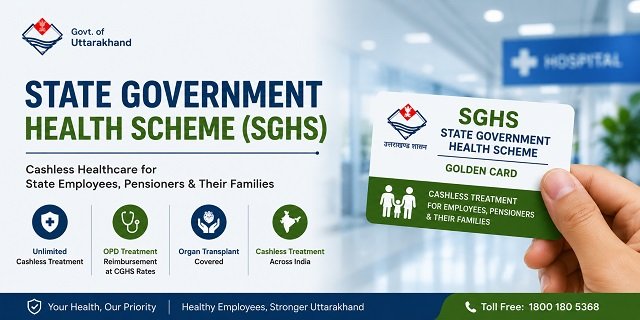
State Government Health Scheme (SGHS) is a cashless health scheme launched by the Government of Uttarakhand from 1 January 2021 that provides unlimited cashless treatment, OPD reimbursement at CGHS rates, and Organ Transplant facility to state government employees, pensioners, and their eligible dependents at empanelled hospitals across India. No upper limit applies on coverage. Get your Golden Card at sha.uk.gov.in.
Uttarakhand State Government Health Scheme (SGHS) Highlights | |
|---|---|
| Scheme Name | State Government Health Scheme (SGHS) |
| Government Order | 4 May 2020, amended 25 November 2021 |
| Launch Date | 1 January 2021 |
| Implementing Authority | State Health Authority, Government of Uttarakhand |
| Eligible Beneficiaries | State government employees, pensioners, family pensioners, State PSUs, Autonomous Bodies, Local Bodies, Aided Institutions, Universities, and their eligible dependents |
| Coverage Limit | Unlimited – no annual cap |
| OPD Treatment | Available on reimbursement at CGHS rates |
| Organ Transplant | Covered |
| Ayush Treatment | Covered from 31 March 2023 on reimbursement at CGHS rates |
| Referral Required | No – direct access to any empanelled hospital |
| National Portability | Yes – valid at empanelled hospitals across India |
| Scheme Type | Contributory – monthly deduction from salary or pension |
| Contribution (Level 1 to 5) | Rs. 250 per month |
| Contribution (Level 6) | Rs. 450 per month |
| Contribution (Level 7 to 11) | Rs. 650 per month |
| Contribution (Level 12 and above) | Rs. 1,000 per month |
| Golden Card Documents | Employee Code or GRD Number and Aadhaar Card |
| Claim Submission Deadline | Within 6 months of treatment completion |
| Helpline | 155368 |
| Toll Free | 18001805368 |
| Official Portal | sha.uk.gov.in |
Introduction of Uttarakhand State Government Health Scheme (SGHS): A Brief Insight
State government employees and pensioners in Uttarakhand were long dependent on medical reimbursement – a slow, paperwork-heavy process where they paid hospital bills from their own pocket and waited months to get the money back. To replace this system with a modern, cashless, and transparent health coverage framework, the Government of Uttarakhand launched the State Government Health Scheme (SGHS) from 1 January 2021 vide Government Order dated 4 May 2020.
The State Health Authority, Government of Uttarakhand, implements the scheme using the same BIS and TMS IT platform used for PM-JAY, ensuring the same quality of care and transparency for government employees that general beneficiaries receive under the national scheme. The same empanelled hospitals that serve PM-JAY and Atal Ayushman beneficiaries also serve SGHS Golden Card holders.
SGHS is a contributory scheme – a fixed monthly amount is deducted from the employee or pensioner’s salary or pension based on their 7th Pay Commission pay level. In return, they receive cashless treatment at empanelled hospitals with no upper limit on coverage. Unlike the Ayushman Bharat Pradhan Mantri Jan Arogya Yojana, which caps coverage at Rs. 5 lakh per family per year, SGHS provides unlimited cashless treatment. It also covers OPD treatment on reimbursement at CGHS rates, Organ Transplant, and Ayush treatment from 31 March 2023 – none of which are available under PM-JAY or Atal Ayushman Uttarakhand Yojana.
The scheme covers state government employees, pensioners, family pensioners, and employees of State PSUs, Autonomous Bodies, Local Bodies, Aided Institutions, and Universities – along with their eligible dependents. No referral is required to visit any empanelled hospital. The Golden Card is issued at Jan Seva Kendras, UTI offices, or empanelled hospitals using just the Employee Code or GRD Number and Aadhaar card.
Government employees in Uttarakhand who want to know about the broader health coverage available to the general public can explore the Atal Ayushman Uttarakhand Yojana, which provides cashless treatment up to Rs. 5 lakh per year to all permanent resident families of Uttarakhand at empanelled hospitals across India.
State government employees, pensioners, and anyone looking for more health and welfare schemes available under the Uttarakhand Government can explore all available programmes on our Uttarakhand Government Schemes page.
Benefits Provided to Eligible Beneficiaries
The State Health Authority, Government of Uttarakhand, provides the following medical benefits to eligible state government employees, pensioners, and their dependents under the State Government Health Scheme (SGHS) at empanelled hospitals across India:
IPD (Inpatient) Benefits
- Cashless treatment at empanelled hospitals with no upper limit on coverage – unlike PM-JAY and AAUY, which cap at Rs. 5 lakh per year
- No Rs. 1 lakh upper limit for Unspecified Package surgical treatment
- Treatment rates as per the Central Government Health Scheme (CGHS) rates
- No referral required – beneficiaries can directly visit any empanelled hospital
- Organ Transplant covered – not available under PM-JAY or Atal Ayushman Uttarakhand Yojana
- Reimbursement of medical expenses at CGHS rates for treatment taken at non-empanelled hospitals
- National portability – Golden Card valid at empanelled hospitals across India
- If a beneficiary passes away during treatment, reimbursement is paid to the Nominee, Legal Heir, or Spouse
OPD (Outpatient) Benefits
- OPD treatment available on a reimbursement basis at CGHS rates
- Covers consultancy fee, diagnostic tests, radiology, and medicines at empanelled and non-empanelled clinics and hospitals
- Ayush treatment – Ayurveda, Homoeopathy, Unani, Siddha, and Naturopathy – covered under SGHS from 31 March 2023 on a reimbursement basis at CGHS rates
- OPD reimbursement claims must be submitted within 6 months of treatment completion
Bed Entitlement Based on Pay Level
| Pay Level | Bed Category | Bed Charges |
|---|---|---|
| Level 1 to 5 | General Ward | Not applicable |
| Level 6 | Semi-Private Ward | Rs. 2,000 |
| Level 7 to 11 | Private Ward | Rs. 3,000 |
| Level 12 and above | Deluxe Ward | Rs. 4,000 |
What Is Not Covered
- Cosmetic treatment and cosmetic products
- Non-medical consumables
Eligibility Conditions Required to be Fulfilled
The State Health Authority, Government of Uttarakhand, has defined the following eligibility conditions for the State Government Health Scheme (SGHS). The scheme is specifically for state government employees, pensioners, and their eligible dependents – it is not available to the general public:
- Serving state government employees of Uttarakhand who have opted to remain in the scheme
- State government pensioners of Uttarakhand who have opted to remain in the scheme
- Family pensioners of deceased state government employees
- Employees of Autonomous Bodies, Corporations, Authorities, Universities, and Aided Institutions – if the concerned body has approved and adopted the scheme from their parent institution
- Eligible dependent family members, as defined under the Uttarakhand Retirement Benefits Act 2018
Who Counts as a Dependent Under SGHS
- Spouse (husband or wife), dependent on the employee or pensioner
- Sons and daughters up to 25 years of age, dependent on the employee or pensioner
- Unmarried, divorced, separated, or widowed daughter with no age limit if dependent on the employee or pensioner
- Parents of the employee or pensioner, if dependent on them
- Disabled son or daughter with a 40% disability certificate issued by a Medical Board – no age limit
Who Is Not Eligible
- General public residents of Uttarakhand who are not state government employees or pensioners
- Employees already covered under the Central Government Health Scheme (CGHS)
- Employees already covered under Ex-Servicemen Contributory Health Scheme (ECHS)
- Employees already covered under Employees’ State Insurance (ESI)
- Pensioners who have submitted an Opt-Out option – currently no provision to rejoin after opting out
Documents Required to be Attached
State government employees and pensioners must carry the following documents to the nearest Jan Seva Kendra, UTI office, or empanelled hospital to get their SGHS Golden Card made under the State Government Health Scheme:
- Employee Code or GRD Number of the employee or pensioner
- Aadhaar Card for KYC verification
For Adding Dependents to the Golden Card:
- Family data must be approved by the Drawing Disbursing Officer (DDO) on the portal before dependents can be added to the Golden Card
For OPD Reimbursement Claims:
- Original bills and prescriptions from the treating doctor
- Diagnostic reports and radiology reports
- Countersigned claim form approved by the designated countersigning officer
- For Ayush treatment claims – countersigning by Director Ayurveda, Homoeopathy, Unani, Siddha, or Naturopathy as applicable
For IPD Reimbursement Claims at Non-Empanelled Hospitals:
- Original hospital bills and discharge summary
- Treatment documents and prescriptions
- Prescribed claim form with mandatory certificate
- Claim submitted through the Head of Department or the Administrative Department as per the delegation of financial powers
Important: Cosmetic treatment products and non-medical consumables are not reimbursable under any circumstances. All OPD and IPD reimbursement claims must be submitted within 6 months of treatment completion. Amount mismatch, unreadable documents, and late submission are the most common reasons for claim rejection. Visit sha.uk.gov.in for the latest document guidelines and claim forms.
How Beneficiaries Can Apply to Avail the Benefit of this Scheme
To avail cashless treatment under the State Government Health Scheme (SGHS), every eligible state government employee and pensioner must first obtain an SGHS Golden Card. The monthly contribution is deducted automatically from salary or pension. Once the Golden Card is obtained, the beneficiary can use it for cashless treatment at any empanelled hospital across India or submit OPD and IPD reimbursement claims through their Drawing Disbursing Officer.
Step 1: Confirm Your Monthly SGHS Contribution
Before applying for the Golden Card, confirm that the monthly SGHS contribution is deducted from your salary or pension as per your 7th Pay Commission level:
- Level 1 to 5: Rs. 250 per month
- Level 6: Rs. 450 per month
- Level 7 to 11: Rs. 650 per month
- Level 12 and above: Rs. 1,000 per month
If the deduction does not reflect on your salary or pension slip, contact your Drawing Disbursing Officer or the nearest Treasury Office immediately.
Step 2: Special Provision for New Pension Scheme Retirees
Employees retiring under the New Pension Scheme have two options to avail the SGHS Golden Card after retirement:
- After completing 10 years of service, obtain the card by paying the annual contribution
- Pay 10 years of contributions as a lump sum at one time – receive a lifetime Golden Card
Step 3: Get Your SGHS Golden Card Made
Visit the nearest location with your Employee Code or GRD Number and Aadhaar Card for KYC verification. Golden Cards are issued at:
- Nearest Jan Seva Kendra in your district
- UTI (Unit Trust of India) identified office
- Any empanelled government or private hospital through the Arogya Mitra
To add dependent family members to your Golden Card, your DDO must first approve your family data on the portal. After DDO approval, the Arogya Mitra at any empanelled hospital can add dependents to your card.
Step 4: Avail Cashless IPD Treatment at Empanelled Hospitals
Step 1: Visit any empanelled hospital in India. SGHS has no referral requirement – you can directly approach any empanelled hospital without a government hospital referral. Check the latest empanelled hospital list at sha.uk.gov.in.
Step 2: Go to the hospital’s Arogya Mitra helpdesk and show your SGHS Golden Card along with your Aadhaar card. The Arogya Mitra will verify your eligibility and complete the admission process.
Step 3: After treatment and discharge, the hospital submits the claim directly to the State Health Authority. You do not need to pay and seek reimbursement for IPD treatment at empanelled hospitals covered under the scheme.
Step 5: Treatment Outside Uttarakhand
For treatment at hospitals outside Uttarakhand, a referral from a government hospital is required. However, in emergency cases, no referral is needed. Employees currently posted outside Uttarakhand also do not need a referral for treatment in the state where they are posted.
Step 6: Submit OPD Reimbursement Claims
Step 1: Collect all original bills, prescriptions, diagnostic reports, and radiology reports from your OPD treatment. For Ayush treatment (Ayurveda, Homoeopathy, Unani, Siddha, Naturopathy), the countersigning must be done by the Director of the respective Ayush department. Ayush treatment is covered under SGHS from 31 March 2023.
Step 2: Submit the completed OPD claim form with all original documents to your Drawing Disbursing Officer (DDO) within 6 months of treatment completion. The DDO will forward the claim through the IFMS Portal to the State Health Authority for payment at CGHS rates.
Step 3: Check your OPD claim status by logging into the SGHS section at sha.uk.gov.in.
Step 7: Submit IPD Reimbursement Claims for Non-Empanelled Hospitals
Step 1: If you availed treatment at a non-empanelled hospital due to emergency or unavailability, collect all original hospital bills, discharge summary, and treatment documents.
Step 2: Submit the reimbursement claim on the prescribed form within 6 months of treatment completion through your Head of Department or Administrative Department, as per the claim approval level:
- Up to Rs. 1.5 lakh: Head of Office approves
- Rs. 1.5 lakh to Rs. 3 lakh: Head of Office and Director Medical Health approve
- Rs. 3 lakh to Rs. 5 lakh: Head of Department and Director General Medical Health approves
- Above Rs. 5 lakh: The Administrative Division and the Director General of Medical Health approve
Step 3: For pensioners living outside Uttarakhand, submit the original claim to your DDO. For reimbursement claims from treatment in other states, the countersigning must be done by the Chief Medical Officer, Principal Medical Officer, Regional Director, or Director General of Health Services of Uttarakhand.
Important: If a beneficiary passes away during treatment, the reimbursement claim is paid to the Nominee, Legal Heir, or Spouse. For any technical issues with the portal or TMS screen, send a screenshot to dirit-shauk@uk.gov.in. For general complaints and suggestions, write to support-shauk@uk.gov.in. Call toll-free 155368 for assistance.
Difference Between SGHS and Atal Ayushman Uttarakhand Yojana
Many state government employees in Uttarakhand are unsure whether they fall under SGHS or Atal Ayushman Uttarakhand Yojana or both. The two schemes are completely different in terms of who they cover, what they provide, and how they work. The table below clearly explains the difference:
| Particulars | State Government Health Scheme (SGHS) | Atal Ayushman Uttarakhand Yojana (AAUY) |
|---|---|---|
| Target Beneficiaries | State government employees, pensioners, family pensioners, and their eligible dependents | All permanent resident families of Uttarakhand |
| General Public Eligible | No | Yes |
| Annual Coverage Limit | Unlimited – no annual cap | Rs. 5 lakh per family per year |
| OPD Treatment | Yes – on reimbursement at CGHS rates | No |
| Organ Transplant | Yes – covered | No – not covered |
| Ayush Treatment | Yes – covered from 31 March 2023 | No |
| Referral Required | No – direct access to any empanelled hospital | Yes – for non-emergency private hospital treatment |
| Contributory Scheme | Yes – monthly deduction from salary or pension | No – fully funded by the state government |
| Income Restriction | No income restriction – for government employees only | No income restriction – for all Uttarakhand residents |
| National Portability | Yes | Yes |
| IT Platform | BIS and TMS – same as PM-JAY | Same as PM-JAY |
| Implementing Authority | State Health Authority, Uttarakhand | State Health Authority, Uttarakhand |
| Official Portal | sha.uk.gov.in | sha.uk.gov.in |
In simple terms, if you are a state government employee or pensioner in Uttarakhand, your primary health scheme is SGHS, which provides unlimited cashless coverage with OPD and Organ Transplant facility. The Atal Ayushman Uttarakhand Yojana covers the general public who are not government employees or pensioners. Both schemes use the same empanelled hospitals and the same IT platform, but serve completely different beneficiary groups.
Important Links Available
- State Government Health Scheme Official Page – State Health Authority Uttarakhand
- Empanelled Hospitals List Under SGHS
- SGHS Guidelines and Government Orders
- Check SGHS OPD Claim Status
- State Health Authority, Government of Uttarakhand Official Portal
- Health Department, Government of Uttarakhand
- Medical Reimbursement Procedure – eKosh Uttarakhand
Contact Details in Case of Help Needed
- Office: State Health Authority, Uttarakhand, Weblan, 3rd Floor, Plot No. 45-B, IT Park, Sahastradhara Road, Dehradun, Uttarakhand
- Office Phone: 0135-2609522
- Helpline: 155368
- Toll Free: 18001805368
- Email: ceo-shauk@uk.gov.in
- Grievance: Raise any issue through the Grievance tab at sha.uk.gov.in
Frequently Asked Questions (FAQs)
Q. What is the State Government Health Scheme (SGHS)?
Ans. The State Government Health Scheme (SGHS) is a cashless medical treatment scheme launched by the Government of Uttarakhand on 1 January 2021 for state government employees, pensioners, and their eligible dependents. The scheme provides cashless treatment at empanelled hospitals with no upper limit on coverage, OPD reimbursement at CGHS rates, and national portability across all empanelled hospitals in India.
Q. Who is eligible for the SGHS Golden Card?
Ans. State government employees and pensioners of Uttarakhand who have opted to remain in the scheme are eligible. Employees of Autonomous Bodies, Corporations, Authorities, Universities, and Aided Institutions are also eligible if their institution has adopted the scheme. Eligible dependent family members, as defined under the Uttarakhand Retirement Benefits Act 2018, are also covered.
Q. Who counts as a dependent under SGHS?
Ans. Dependents include the spouse, sons and daughters up to 25 years of age, unmarried or divorced or widowed daughters with no age limit, parents of the employee or pensioner if dependent on them, and disabled sons or daughters with a 40% disability certificate from a Medical Board with no age limit.
Q. What documents are required to make an SGHS Golden Card?
Ans. Only two documents are required – the Employee Code or GRD Number and the Aadhaar Card for KYC verification. The Golden Card can be made at any Jan Seva Kendra, UTI office, or empanelled hospital through the Arogya Mitra.
Q. Is treatment completely cashless under SGHS?
Ans. Yes. IPD treatment at empanelled hospitals is completely cashless with no upper limit on coverage. For OPD treatment and treatment at non-empanelled hospitals, reimbursement is available at CGHS rates on submission of claims within 6 months of treatment completion.
Q. What is the monthly contribution under SGHS?
Ans. Monthly contributions based on 7th Pay Commission levels are, Level 1 to 5: Rs. 250, Level 6: Rs. 450, Level 7 to 11: Rs. 650, and Level 12 and above: Rs. 1,000 per month. The contribution is deducted automatically from salary or pension.
Q. What is the provision for New Pension Scheme retirees under SGHS?
Ans. New Pension Scheme retirees can get the SGHS card after completing 10 years of service by paying an annual contribution. Alternatively, they can pay 10 years of contributions as a lump sum at one time and receive a lifetime Golden Card.
Q. Is OPD treatment covered under SGHS?
Ans. Yes. OPD treatment is covered on a reimbursement basis at CGHS rates. This includes consultancy fees, diagnostic tests, radiology, and medicines at both empanelled and non-empanelled clinics and hospitals. Claims must be submitted within 6 months of treatment completion through the Drawing Disbursing Officer.
Q. Is Ayush treatment covered under SGHS?
Ans. Yes. Ayush treatment, including Ayurveda, Homoeopathy, Unani, Siddha, and Naturopathy, is covered under SGHS from 31 March 2023 on reimbursement basis at CGHS rates. The claim must be countersigned by the Director of the respective Ayush department.
Q. Is referral required for cashless treatment at empanelled hospitals?
Ans. No. SGHS has no referral requirement for treatment at empanelled hospitals within India. Beneficiaries can directly visit any empanelled hospital. However, for treatment at non-empanelled hospitals outside Uttarakhand, a referral from a government hospital is required except in emergency cases.
Q. What is the difference between SGHS and Atal Ayushman Uttarakhand Yojana?
Ans. SGHS is specifically for state government employees, pensioners, and their dependents. It provides unlimited cashless coverage, OPD reimbursement, and an Organ Transplant facility. Atal Ayushman Uttarakhand Yojana is for the general public of Uttarakhand and provides cashless coverage up to Rs. 5 lakh per family per year for hospitalisation only. OPD and Organ Transplant are not covered under AAUY.
Q. Can family pensioners get benefits under SGHS?
Ans. Yes. Family pensioners of deceased state government employees are eligible for SGHS benefits along with their eligible dependents as defined under the Uttarakhand Retirement Benefits Act 2018.
Q. How can I check the empanelled hospitals under SGHS?
Ans. Visit sha.uk.gov.in/CMS/GetHospitalList to check the latest district-wise list of all empanelled government and private hospitals under SGHS. Always check the latest list before availing treatment, as empanelment changes periodically.
Q. How can I check my OPD claim status?
Ans. Visit sha.uk.gov.in/CMS/ClaimStatus and log in to the SGHS section to check the current status of your OPD reimbursement claim.
Q. What should I do if a hospital refuses cashless treatment?
Ans. Call the SGHS helpline at 155368 or toll-free at 18001805368 immediately. You can also raise a grievance through the Grievance tab at sha.uk.gov.in or write to ceo-shauk@uk.gov.in.
Q. What happens to the reimbursement claim if a beneficiary passes away during treatment?
Ans. If a beneficiary passes away during treatment, the reimbursement claim is paid to the Nominee, Legal Heir, or Spouse of the deceased beneficiary.
Q. Can a pensioner who has opted out of SGHS rejoin the scheme?
Ans. No. Currently, there is no provision available for a pensioner who has submitted an Opt-Out option to rejoin the SGHS scheme.
Q. My SGHS card is lost, and I cannot download it. What should I do?
Ans. The SGHS card is sent to your registered email ID. Contact the State Health Authority with your email ID to get the card resent. You can also write to support-shauk@uk.gov.in for assistance.

Tabassum is a government schemes researcher and writer with 5 years of experience tracking Central and State welfare scheme programmes across India. She has covered 500+ schemes spanning agriculture, women welfare, education, and housing, helping lakhs of beneficiaries understand their entitlements in simple language.