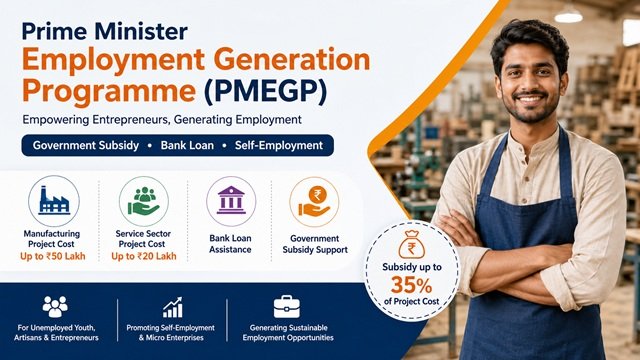
Prime Minister Employment Generation Programme (PMEGP) is a central government self-employment scheme launched to help unemployed youth and aspiring entrepreneurs establish new businesses through bank loans and subsidy support. Under the revised guidelines, manufacturing projects can receive support up to ₹50 lakh, while service-sector projects can receive support up to ₹20 lakh. The scheme primarily promotes micro-enterprise development, self-employment, and rural entrepreneurship across India.
Prime Minister Employment Generation Programme (PMEGP) Highlights | |
|---|---|
| Scheme Name | Prime Minister’s Employment Generation Programme (PMEGP) |
| Launch Year | 2008-09 |
| Ministry | Ministry of Micro, Small and Medium Enterprises (MSME), Government of India |
| Nodal Agency | Khadi and Village Industries Commission (KVIC) |
| State Level Agencies | KVIC State Directorates, KVIBs, District Industries Centres (DICs), Banks |
| Scheme Type | Credit-Linked Margin Money Subsidy Scheme |
| Employment Generated (Since inception) | Over 78.84 lakh persons (Source: PIB, 2026) |
| Apply Online | kviconline.gov.in/pmegpeportal |
Introduction of Prime Minister Employment Generation Programme (PMEGP): A Brief Insight
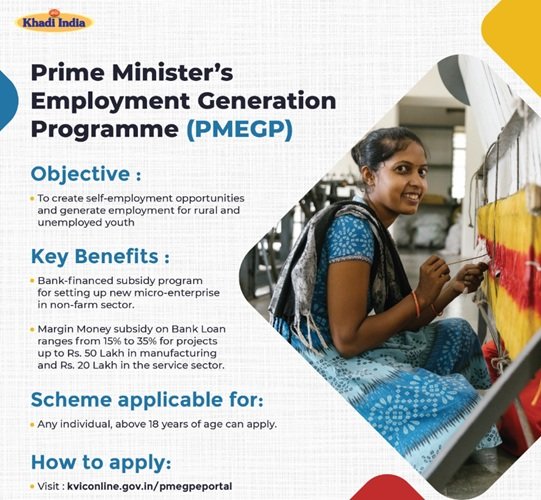
Prime Minister Employment Generation Programme (PMEGP) is a central government credit-linked subsidy scheme launched in 2008-09 by the Ministry of MSME to promote self-employment and micro-enterprise development across India. The scheme helps unemployed youth, artisans, traditional workers, and aspiring entrepreneurs establish new manufacturing and service-based businesses through bank loan assistance and government subsidy support.
The Khadi and Village Industries Commission (KVIC) acts as the nodal implementing agency for PMEGP at the national level, while KVIBs, District Industries Centres (DICs), and financing banks manage implementation at state and district levels. The Government launched the scheme to generate sustainable employment opportunities in both rural and urban areas while reducing migration caused by unemployment and lack of local business opportunities.
Unlike traditional subsidy schemes that provide direct financial assistance, PMEGP works through a bank-linked business funding model. Under this structure, the applicant contributes a small portion of the project cost, the bank provides loan assistance, and the Government adjusts the margin money subsidy according to category and area eligibility. This system helps first-time entrepreneurs establish businesses with a lower financial burden.
The Government significantly revised PMEGP guidelines in December 2023 and increased project cost limits under the scheme. Manufacturing sector projects can now receive support up to ₹50 lakh, while service and business sector projects can receive support up to ₹20 lakh. Existing eligible PMEGP and MUDRA enterprises may also receive a second loan support under prescribed conditions.
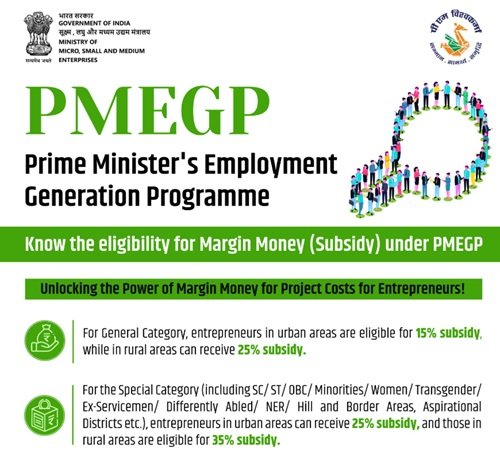
One of the biggest strengths of PMEGP lies in its inclusive subsidy structure. General category applicants can receive a subsidy of up to 25% in rural areas, while special category beneficiaries such as SC, ST, OBC, Women, Minority, Ex-Servicemen, Divyang, Transgender, Hill Area, Border Area, and North Eastern Region applicants, can receive a subsidy of up to 35% under rural category provisions.
According to recent official government data, PMEGP has already supported lakhs of enterprises and generated large-scale employment opportunities across India. The scheme has become particularly important for rural entrepreneurship because a major share of PMEGP units operate in villages and semi-rural regions.
PMEGP also works closely with India’s broader entrepreneurship and self-employment ecosystem. Applicants exploring business funding opportunities often compare the scheme with initiatives such as Pradhan Mantri Mudra Yojana (PMMY), and PM Vishwakarma Yojana. While these schemes target different beneficiary groups and business stages, PMEGP mainly focuses on supporting new micro enterprises through subsidy-backed bank financing.
Applicants can apply online through the official PMEGP portal by submitting business details, project report, educational qualification, and category-related documents. After application submission, implementing agencies, banks, and the District Level Task Force Committee (DLTFC) evaluate project viability before loan sanction and subsidy approval.
Prime Minister Employment Generation Programme has emerged as one of the most important self-employment schemes in India because it combines entrepreneurship development, employment generation, business financing, and government subsidy support under a single framework. People who want to explore more business, startup, subsidy, agriculture, pension, and welfare initiatives can also visit our All Central Government Schemes List section for more scheme-related information and updates.
How PMEGP Loan and Subsidy System Actually Works?
Many applicants mistakenly think PMEGP provides free government money directly into bank accounts. However, the Prime Minister Employment Generation Programme actually works through a credit-linked subsidy model involving applicant contribution, bank loan, and government margin money subsidy.
Under PMEGP, the applicant first contributes a small portion of the project cost from their side. General category applicants usually contribute at least 10% of the project cost, while special category applicants contribute at least 5% according to official guidelines.
After the applicant’s contribution, the financing bank sanctions the remaining project amount as a business loan. The Government then provides a margin money subsidy under PMEGP, which gets adjusted according to category and area eligibility after successful completion of the required conditions.
For example, if an applicant establishes a rural manufacturing business under special category provisions, the Government may provide a subsidy up to 35% of the project cost under prescribed limits. However, the remaining amount still works as a repayable bank loan according to banking terms and repayment schedule.
The subsidy amount does not directly transfer to the beneficiary as a free cash withdrawal. Banks keep the margin money subsidy under lock-in conditions for the prescribed period according to PMEGP guidelines.
This system helps first-time entrepreneurs establish businesses with a lower financial burden while encouraging responsible business financing and enterprise sustainability.
Benefits Provided to Eligible Beneficiaries
Prime Minister Employment Generation Programme (PMEGP) helps unemployed youth and aspiring entrepreneurs establish new micro enterprises through bank loans and government subsidy support. The scheme mainly promotes self-employment generation, rural entrepreneurship, and small business development across manufacturing and service sectors.
- Applicants can establish new manufacturing or service-based micro-enterprises under the scheme
- Manufacturing sector projects can receive support up to ₹50 lakh
- Service and business sector projects can receive support up to ₹20 lakh
- General category applicants can receive a subsidy of up to 15% in urban areas and 25% in rural areas
- Special category applicants can receive a subsidy of up to 25% in urban areas and 35% in rural areas
- Special category applicants need to contribute only 5% of the project cost from their side
- General category applicants need to contribute only 10% of the project cost
- No collateral security is generally required for eligible projects up to ₹10 lakh, according to RBI guidelines
- Applicants can establish businesses in manufacturing, food processing, repair services, village industries, handicrafts, and several other approved sectors
- The scheme promotes self-employment opportunities in both rural and urban areas
- Women entrepreneurs, SC/ST/OBC applicants, minorities, ex-servicemen, and Divyang beneficiaries receive higher subsidy benefits under special category provisions
- Existing PMEGP, REGP, and eligible MUDRA units may also become eligible for second loan support under prescribed conditions
- Entrepreneurship Development Programme (EDP) training helps applicants understand business management and enterprise operations
One of the biggest advantages of PMEGP is that the scheme combines bank loan assistance with government subsidy support, which reduces the financial burden on first-time entrepreneurs while helping them establish long-term income-generating businesses.
PMEGP Subsidy Structure – Category-wise and Area-wise Breakdown
The subsidy amount under PMEGP depends on two factors — your category and the location (urban or rural) of your proposed business. Here is the complete verified subsidy structure from the official msme.gov.in scheme page :
| Category | Beneficiary Contribution | Urban Subsidy | Rural Subsidy |
| General Category | 10% of the project cost | 15% | 25% |
| Special Category (SC, ST, OBC, Women, Minority, Ex-Servicemen, Transgender, Differently Abled, NER, Aspirational Districts, Hill and Border Areas) | 5% of the project cost | 25% | 35% |
2nd Loan for Upgradation of Existing PMEGP / MUDRA Units
| Category | Beneficiary Contribution | Subsidy Rate | Maximum Project Cost |
| All Categories | 10% of the project cost | 15% (20% for NER and Hill States) | Rs. 1 crore (Manufacturing) / Rs. 25 lakh (Service) |
Important: The bank provides the remaining project cost as a bank loan after deducting the applicant’s contribution and government subsidy. The subsidy amount (Margin Money) is not paid as cash – it is kept in the loan account under lock-in conditions as per PMEGP guidelines.
Is Collateral Required Under PMEGP?
One of the biggest concerns among first-time entrepreneurs is whether banks demand property papers or collateral security under PMEGP. According to official guidelines and RBI-linked provisions, collateral security is generally not required for eligible PMEGP projects up to ₹10 lakh.
This provision helps unemployed youth, small entrepreneurs, artisans, and self-employment seekers apply for business funding even if they do not possess large assets or property for collateral purposes.
However, applicants should understand that financing banks still evaluate project viability, repayment capacity, business feasibility, and applicant profile before sanctioning a loan under PMEGP.
For higher-value projects above prescribed collateral-free limits, banks may follow applicable RBI guidelines and internal banking norms regarding additional security requirements.
Applicants should discuss collateral conditions clearly with the financing bank branch before final project approval and the loan sanction process.
Eligibility Conditions Required to be Fulfilled
Prime Minister Employment Generation Programme (PMEGP) mainly targets unemployed youth, aspiring entrepreneurs, artisans, and individuals who want to establish new micro enterprises in the manufacturing or service sector. The scheme supports self-employment generation through bank-linked subsidy assistance under the Ministry of MSME.
- The applicant must be at least 18 years of age
- Any individual entrepreneur can apply under PMEGP
- Self-help groups (SHGs), registered institutions, production cooperative societies, and charitable trusts may also become eligible according to official guidelines
- Only new micro-enterprises are eligible under the scheme
- Existing units already receiving subsidy under PMEGP or other government subsidy schemes are not eligible for fresh PMEGP assistance
- For manufacturing projects above ₹10 lakh, the applicant should have passed at least Class 8
- For service or business projects above ₹5 lakh, the applicant should have passed at least Class 8
- Applicants from the General Category need to contribute a minimum 10% of the project cost from their side
- Applicants belonging to Special Categories such as SC, ST, OBC, Women, Minority, Ex-Servicemen, Divyang, Transgender, North Eastern Region, Hill Areas, and Border Areas need to contribute a minimum 5% of the project cost
- The proposed business activity should fall under the eligible activities approved under the PMEGP guidelines
- Applicants should possess a valid Aadhaar, PAN, and required business-related documents during the application process
PMEGP mainly supports first-time entrepreneurs and self-employment seekers who want to establish manufacturing or service-based micro enterprises through bank loans and government subsidy support.
Documents Required to be Attached
Applicants need to upload different personal, educational, category, business, and project-related documents while applying under the Prime Minister Employment Generation Programme (PMEGP). Banks, KVIC, DIC, and other implementing agencies verify these documents during the scrutiny and loan approval process.
- Aadhaar Card
- PAN Card
- Passport Size Photograph
- Educational Qualification Certificate, wherever applicable
- Project Report or Detailed Business Project Proposal
- Caste Certificate for SC/ST/OBC applicants
- Special Category Certificate for Women, Ex-Servicemen, Divyang, Minority, Transgender, or other eligible categories
- Rural Area Certificate, wherever required
- Address Proof
- Bank Account Details and Passbook
- Business-related quotations or machinery quotations if required by the financing bank
- Entrepreneurship Development Programme (EDP) Training Certificate, wherever applicable
Important Things Applicants Should Know
- Applicants should prepare a proper project report before applying under PMEGP
- Project details mentioned in the application form and the project report should match correctly
- Applicants applying under the special category benefits should upload valid category certificates
- Scanned documents should remain clear and readable during the upload process
- Banks or implementing agencies may ask for additional documents during the loan appraisal process
Applicants should upload genuine and updated documents only because KVIC, DIC, banks, and the District Level Task Force Committee (DLTFC) verify all information during the PMEGP application scrutiny and loan sanction process.
How Beneficiaries Can Apply to Avail the Benefit of this Scheme
Prime Minister Employment Generation Programme (PMEGP) follows a multi-stage process involving online application, project scrutiny, bank appraisal, training, loan sanction, and subsidy adjustment. The scheme does not provide direct cash assistance. Instead, eligible applicants receive bank loan support along with a government subsidy under the PMEGP framework.
Step-by-Step PMEGP Online Application Process
Step 1: First, visit the official PMEGP Online Application Portal.
Step 2: Select the appropriate applicant category and start the online registration process.
Step 3: Enter personal details carefully, such as applicant name, Aadhaar number, PAN details, mobile number, educational qualification, category information, and address.
Step 4: Fill in complete business details, including proposed business activity, project cost, location, employment potential, and sector category.
Step 5: Upload all required documents such as Aadhaar Card, PAN Card, photograph, educational certificates, category certificates, and project report.
Step 6: Select the preferred financing bank branch and implementing agency during the application process.
Step 7: Carefully review all entered information because incorrect details may lead to rejection during the scrutiny stage.
Step 8: Submit the PMEGP application form online and save the application ID or acknowledgement number safely for future tracking.
What Happens After PMEGP Application Submission?
Step 1: The concerned implementing agency, such as KVIC, KVIB, or District Industries Centre (DIC) scrutinises the application and forwards eligible cases to the District Level Task Force Committee (DLTFC).
Step 2: DLTFC may conduct an interview, project discussion, or application assessment before recommending eligible proposals to financing banks.
Step 3: The selected bank verifies the applicant profile, project viability, repayment capacity, and submitted documents during the loan appraisal process.
Step 4: If the bank approves the proposal, the applicant may need to complete the mandatory Entrepreneurship Development Programme (EDP) training before final loan disbursal.
Step 5: After completion of the required formalities, the bank sanctions the loan and the government margin money subsidy gets adjusted under PMEGP guidelines.
Step 6: The applicant can then establish the approved business unit and begin enterprise operations according to the sanctioned project plan.
Important Things Applicants Should Know
- PMEGP works through a bank loan plus government subsidy model and not as a direct free grant scheme
- Applicants need to contribute the prescribed margin contribution from their side
- Project report preparation plays a very important role during the approval process
- Mandatory EDP training may become necessary before subsidy adjustment and loan disbursal
- Interest rates are decided by financing banks according to applicable banking norms
- No collateral security is generally required for eligible projects up to ₹10 lakh, according to RBI guidelines
- Applicants should regularly track application status through the official portal and maintain communication with the financing bank
Applicants should provide realistic business information, practical project cost estimates, and genuine documents during the PMEGP application process because banks and implementing agencies carefully evaluate business viability before sanctioning assistance under the scheme.
Common Reasons Why PMEGP Applications Get Rejected
Many PMEGP applications face rejection because applicants submit incomplete business information, weak project reports, or incorrect documents during the application process. Applicants should carefully prepare business proposals and upload genuine information to improve approval chances.
- Incomplete or unrealistic project report
- Mismatch in Aadhaar, PAN, or bank details
- Incorrect category certificate or invalid documents
- Applying for business activities not allowed under PMEGP guidelines
- Poor business viability or impractical project cost estimation
- The existing business is already receiving government subsidy support
- Failure to attend the DLTFC interview or the EDP training process
- Incorrect information regarding business location or activity
- Duplicate PMEGP applications from the same applicant
Applicants should prepare realistic business plans, maintain proper documentation, and provide accurate information during the PMEGP application process because banks and implementing agencies carefully verify project viability before approving assistance.
Important Links Available
- PMEGP Official Portal.
- Apply Online for PMEGP.
- Download PMEGP Offline Application Form.
- PMEGP Scheme Details on MSME Portal.
- PMEGP Revised Guidelines PDF (English).
- PMEGP Revised Guidelines PDF (Hindi).
- PMEGP Second Loan Guidelines.
- KVIC Official Website.
Contact Details in Case of Help Needed
- PMEGP Helpline Number: 1800 3000 0034
- KVIC Phone Number: 022-26711017
- Email Support: pmegp.kvic@gov.in
- Applicants can also contact their nearest District Industries Centre (DIC), KVIC State Office, or financing bank branch for application and loan-related assistance
- PMEGP Official Contact and Portal Page.
Frequently Asked Questions (FAQs)
Q. What is the Prime Minister Employment Generation Programme (PMEGP)?
Ans. PMEGP is a central government self-employment and micro-enterprise promotion scheme implemented by the Ministry of MSME through KVIC to help individuals establish new manufacturing and service businesses through bank loans and subsidy support.
Q. Is PMEGP a free loan scheme?
Ans. No. PMEGP is not a free loan scheme. It works through a bank loan plus government subsidy model, where applicants also contribute a small percentage of the project cost from their side.
Q. What is the maximum project cost allowed under PMEGP?
Ans. Manufacturing sector projects can receive support up to ₹50 lakh, while service and business sector projects can receive support up to ₹20 lakh under revised PMEGP guidelines.
Q. How much own contribution is required from applicants?
Ans. General category applicants need to contribute a minimum 10% of the project cost, while special category applicants need to contribute a minimum 5% contribution from their side.
Q. Is collateral security required under PMEGP?
Ans. Generally, no collateral security is required for eligible projects up to ₹10 lakh according to RBI guidelines and official PMEGP provisions.
Q. Who implements PMEGP?
Ans. The Ministry of MSME implements PMEGP through Khadi and Village Industries Commission (KVIC) as the nodal agency along with KVIBs, DICs, and financing banks.
Q. Can existing businesses apply under PMEGP?
Ans. No. PMEGP mainly supports new microenterprises. Existing units already receiving government subsidy under other schemes are generally not eligible for fresh PMEGP assistance.
Q. Is an educational qualification mandatory under PMEGP?
Ans. Educational qualification becomes mandatory only for manufacturing projects above ₹10 lakh and service projects above ₹5 lakh, where applicants should have passed at least Class 8.
Q. Is EDP training compulsory under PMEGP?
Ans. Yes. Entrepreneurship Development Programme (EDP) training is generally mandatory before final loan disbursal and subsidy adjustment under PMEGP.
Q. Which businesses are not allowed under PMEGP?
Ans. Activities related to tobacco products, liquor, intoxicants, banned plastic products, and certain prohibited industries mentioned in the official PMEGP guidelines are not eligible under the scheme.

Tabassum is a government schemes researcher and writer with 5 years of experience tracking Central and State welfare scheme programmes across India. She has covered 500+ schemes spanning agriculture, women welfare, education, and housing, helping lakhs of beneficiaries understand their entitlements in simple language.