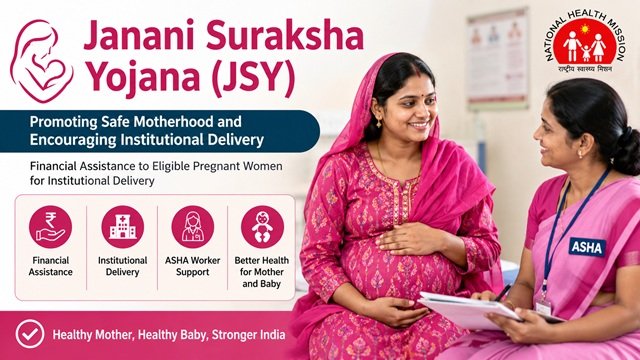
Janani Suraksha Yojana (JSY) is a maternity welfare scheme launched by the Government of India to encourage safe institutional delivery among pregnant women. Under this scheme, eligible women receive financial assistance through DBT after delivery in government or accredited health institutions. The scheme mainly supports poor pregnant women and aims to reduce maternal and newborn health risks across the country.
Janani Suraksha Yojana (JSY) Highlights | |
|---|---|
| Scheme Name | Janani Suraksha Yojana (JSY) |
| Scheme Type | Safe Motherhood and Institutional Delivery Scheme |
| Launched On | 12 April 2005 |
| Implemented Under | National Health Mission (NHM) |
| Implementing Ministry | Ministry of Health and Family Welfare |
| Funding Pattern | 100% Centrally Sponsored Scheme |
| Main Objective | Promote Institutional Delivery and Reduce Maternal & Neonatal Mortality |
| Main Benefit | Cash Assistance for Institutional Delivery |
| Beneficiaries | Eligible Pregnant Women |
| Payment Mode | Direct Benefit Transfer (DBT) |
| Key Health Worker | ASHA Worker |
| Institution Type | Government and Accredited Private Health Institutions |
| Official NHM Portal | https://nhm.gov.in/ |
Introduction of Janani Suraksha Yojana (JSY): A Brief Insight
Janani Suraksha Yojana (JSY) is a maternity welfare scheme launched by the Government of India under the National Health Mission (NHM) to encourage safe institutional delivery among pregnant women. The Government launched the scheme on 12 April 2005 with the objective of reducing maternal and newborn health risks by promoting delivery at government health institutions and accredited healthcare centres.
Under Janani Suraksha Yojana, eligible pregnant women receive financial assistance directly into their bank accounts through the DBT system after institutional delivery. The scheme especially focuses on economically weaker pregnant women and women living in Low Performing States (LPS), where institutional delivery rates were previously low. Through this financial support, the Government aims to reduce complications during pregnancy and childbirth while encouraging women to access proper medical care during delivery.
One of the most important features of JSY is that the scheme does not impose any restriction related to the age of the mother or the number of children, according to official guidelines. In Low Performing States (LPS), all pregnant women delivering in government health institutions become eligible under applicable conditions. In High Performing States (HPS), BPL, SC, and ST pregnant women can receive benefits according to the prescribed rules.
The amount of assistance under Janani Suraksha Yojana differs according to the state category and whether the beneficiary belongs to a rural or urban area. Women in low-performing states generally receive higher financial assistance because these states require additional institutional delivery support and maternal healthcare intervention.
The scheme also gives an important role to ASHA workers (Accredited Social Health Activists), who help pregnant women with registration, ANC check-ups, hospital delivery support, transport coordination, and benefit facilitation. Beneficiaries should therefore stay in regular contact with the nearest ASHA worker, ANM, PHC, CHC, or government hospital during pregnancy.
Pregnant women should complete registration properly, maintain ANC records, obtain the JSY card, and keep Aadhaar-linked bank account details updated for smooth DBT transfer. Women delivering in accredited private health institutions under eligible categories may also need to submit BPL or SC/ST documents according to the official guidelines.
Janani Suraksha Yojana works alongside several other maternal and child healthcare schemes of the Government. Pregnant women can also benefit from schemes like Pradhan Mantri Matru Vandana Yojana (PMMVY), which provides maternity benefit assistance for eligible mothers.
Janani Suraksha Yojana has become one of the largest maternal healthcare schemes in India because it has significantly increased institutional delivery rates and improved access to maternity healthcare services across the country.
Women who want to explore more central and state government schemes related to maternity support, healthcare, nutrition, DBT assistance, women’s welfare, and child development can also visit our All Central Government Schemes section for more latest scheme-related updates and information.
Benefits Provided to Eligible Beneficiaries
The Janani Suraksha Yojana (JSY) provides financial assistance and maternity support to pregnant women to encourage safe institutional delivery and reduce maternal and neonatal health risks.
- Cash assistance for institutional delivery
- DBT benefit transfer directly into bank accounts
- Higher financial assistance for beneficiaries in Low Performing States (LPS)
- ASHA support for registration, ANC follow-up, and delivery assistance
- Financial support for delivery in government and accredited private health institutions
- Home delivery assistance of ₹500 for eligible BPL pregnant women
- Support for safe motherhood and maternal healthcare
- Encouragement for institutional delivery and skilled birth attendance
Important: The amount of financial assistance under JSY differs according to state category, rural or urban area, and eligibility conditions prescribed under the official guidelines.
Janani Suraksha Yojana Amount List
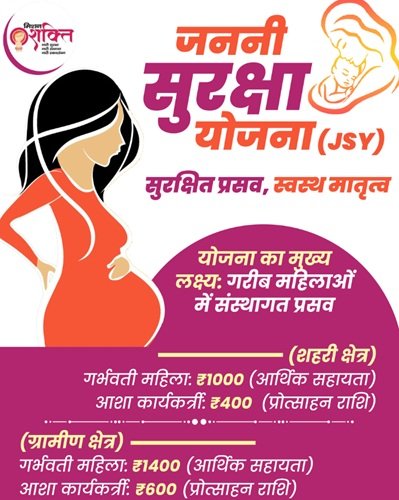
The amount of financial assistance under Janani Suraksha Yojana (JSY) differs according to the state category and whether the beneficiary belongs to a rural or urban area.
| Category | Rural Area | Urban Area |
|---|---|---|
| Low Performing States (LPS) – Mother Assistance | ₹1,400 | ₹1,000 |
| Low Performing States (LPS) – ASHA Assistance | ₹600 | ₹400 |
| High Performing States (HPS) – Mother Assistance | ₹700 | ₹600 |
| High Performing States (HPS) – ASHA Assistance | ₹600 | ₹400 |
Important: The eligibility conditions and assistance amount depend upon the applicable JSY guidelines, institutional delivery conditions, and state category.
Difference Between Janani Suraksha Yojana and JSSK
Many beneficiaries confuse Janani Suraksha Yojana (JSY) with Janani Shishu Suraksha Karyakram (JSSK). However, both schemes provide different types of maternity support.
| Feature | JSY | JSSK |
|---|---|---|
| Main Benefit | Cash Assistance for Institutional Delivery | Free Delivery and Treatment Services |
| Support Type | Financial Assistance | Free Healthcare Support |
| Delivery Benefit | Cash Incentive | Free Normal and C-Section Delivery |
| Medicines and Diagnostics | Not Main Benefit | Provided Free of Cost |
| Transport Facility | Limited Role Through ASHA Support | Free Transport Facility Available |
| Target | Promote Institutional Delivery | Reduce Out-of-Pocket Delivery Expenses |
Eligible pregnant women can receive benefits under both schemes according to applicable government guidelines.
Eligibility Conditions Required to be Fulfilled
Pregnant women must fulfil the following eligibility conditions to receive benefits under the Janani Suraksha Yojana (JSY).
- The applicant should be a pregnant woman
- Delivery should take place in a government health institution or an accredited private health institution
- Women belonging to Low Performing States (LPS) can receive benefits according to applicable JSY guidelines
- In High Performing States (HPS), BPL, SC, and ST pregnant women become eligible for institutional delivery benefits
- Applicant should possess a valid JSY registration record or JSY card
- The applicant should have a bank account for the DBT benefit transfer
- BPL Card or SC/ST Certificate may become necessary in HPS states and accredited private institutions
Important: Janani Suraksha Yojana does not impose any restriction related to the age of the mother or the number of children according to the official guidelines.
Low Performing States (LPS) vs High Performing States (HPS)
Janani Suraksha Yojana classifies states into Low Performing States (LPS) and High Performing States (HPS) according to institutional delivery performance and maternal healthcare indicators.
Low Performing States (LPS)
In low-performing states, all pregnant women delivering in government health institutions can receive benefits according to applicable JSY conditions.
LPS States Include: Uttar Pradesh, Uttarakhand, Bihar, Jharkhand, Madhya Pradesh, Chhattisgarh, Assam, Rajasthan, Odisha, and Jammu & Kashmir.
High Performing States (HPS)
In High-Performing States, only pregnant women belonging to the BPL, SC, and ST categories can receive JSY benefits according to official guidelines.
Women delivering in accredited private institutions under HPS categories may also need valid BPL or SC/ST documents during verification.
Documents Required to be Attached
Pregnant women applying under the Janani Suraksha Yojana (JSY) may need the following documents during registration, institutional delivery, and the benefit verification process.
- JSY Card issued during registration
- Mother and Child Health (MCH) Card
- Aadhaar Card
- Aadhaar-linked Bank Passbook
- Mobile Number
- BPL Card, wherever applicable
- SC/ST Certificate, wherever applicable
- Pregnancy-related medical records and ANC details
- Hospital discharge or delivery-related documents
Important: Women applying in High Performing States (HPS) or accredited private institutions may need to submit a valid BPL Card or SC/ST Certificate to claim JSY benefits.
How Beneficiaries Can Apply to Avail the Benefit of this Scheme
Pregnant women can apply for benefits under the Janani Suraksha Yojana (JSY) through ASHA workers, ANMs, Sub-Centres, Primary Health Centres (PHCs), Community Health Centres (CHCs), government hospitals, and accredited health institutions. The scheme operates under the National Health Mission (NHM) to promote safe institutional delivery and maternal healthcare support.
Women should complete registration during pregnancy and maintain proper ANC (Ante Natal Care) follow-up records to receive benefits smoothly under the scheme. The Government transfers JSY financial assistance directly into the beneficiary’s bank account through the DBT system.
Step-by-Step Application Process
Step 1: Contact the nearest ASHA worker, ANM, Sub-Centre, PHC, CHC, or government health institution for pregnancy registration under JSY.
Step 2: Complete the required pregnancy registration process and obtain the JSY Card and Mother and Child Health (MCH) Card.
Step 3: Attend the recommended ANC check-ups and maintain pregnancy-related medical records properly.
Step 4: Submit Aadhaar details, bank account details, BPL or SC/ST documents wherever required, and other necessary records during verification.
Step 5: Deliver the child in a government health institution or an accredited private health institution according to JSY guidelines.
Step 6: After verification and successful institutional delivery, the Government transfers the applicable JSY assistance amount directly into the beneficiary’s bank account through DBT.
Important Things Applicants Should Know
- ASHA workers play an important role in registration and delivery support
- Women should keep Aadhaar-linked bank account details updated for DBT transfer
- Institutional delivery is necessary for most JSY benefits
- Women in High Performing States (HPS) may need BPL or SC/ST proof
- Pregnant women should avoid fake agents demanding money for JSY registration
Role of ASHA Worker Under JSY
ASHA workers play a very important role in the implementation of Janani Suraksha Yojana. They act as a link between pregnant women and government healthcare services.
- Help pregnant women complete JSY registration
- Guide ANC check-ups
- Motivate women for institutional delivery
- Assist beneficiaries in reaching health institutions
- Help with JSY card and documentation process
- Support beneficiaries during the delivery and post-delivery process
Pregnant women should stay in regular contact with the nearest ASHA worker for proper guidance and timely JSY benefit support.
Important Links Available
- Janani Suraksha Yojana Official NHM Page.
- Janani Suraksha Yojana Official Guidelines.
- Janani Shishu Suraksha Karyakram (JSSK) Official Page.
- National Health Mission (NHM)
- Ministry of Health and Family Welfare (MoHFW)
Contact Details in Case of Help Needed
Pregnant women facing issues related to Janani Suraksha Yojana registration, JSY payment, institutional delivery assistance, or DBT transfer may contact the concerned health authorities through the following support channels.
- Implementing Ministry: Ministry of Health and Family Welfare, Government of India
- Programme: National Health Mission (NHM)
- Local Support: ASHA Worker, ANM, Sub-Centre, PHC, CHC, Government Hospital, or District Hospital
Beneficiaries should first contact the nearest ASHA Worker or government health institution because ASHA workers play an important role in JSY registration, institutional delivery support, and benefit facilitation.
Frequently Asked Questions (FAQs)
Q. What is Janani Suraksha Yojana (JSY)?
Ans. Janani Suraksha Yojana (JSY) is a safe motherhood intervention scheme launched under the National Health Mission (NHM) to promote institutional delivery and reduce maternal and neonatal mortality.
Q. When did the Government launch Janani Suraksha Yojana?
Ans. The Government launched Janani Suraksha Yojana on 12 April 2005.
Q. Which ministry implements JSY?
Ans. The Ministry of Health and Family Welfare, Government of India, implements the scheme under the National Health Mission (NHM).
Q. What is the main objective of JSY?
Ans. The scheme aims to encourage institutional delivery and improve maternal and newborn healthcare outcomes.
Q. Who can receive benefits under Janani Suraksha Yojana?
Ans. Eligibility depends upon the state category, institutional delivery conditions, and applicable BPL or SC/ST criteria according to official JSY guidelines.
Q. What is the difference between Low Performing States (LPS) and High Performing States (HPS)?
Ans. In Low Performing States (LPS), all pregnant women delivering in government health institutions can receive JSY benefits. In High Performing States (HPS), only BPL, SC, and ST pregnant women become eligible according to the scheme conditions.
Q. Does Janani Suraksha Yojana impose any age limit?
Ans. No. Official JSY guidelines do not impose any age-related restriction for eligible pregnant women.
Q. Is there any restriction on the number of children under JSY?
Ans. No. The scheme does not impose any restriction related to birth order according to official guidelines.
Q. How much financial assistance does JSY provide?
Ans. The assistance amount depends upon whether the beneficiary belongs to a Low Performing State (LPS) or a High Performing State (HPS), and whether the delivery takes place in a rural or urban area.
Q. What is the role of ASHA workers under JSY?
Ans. ASHA workers help pregnant women with registration, ANC follow-up, institutional delivery support, transport coordination, and benefit facilitation under the scheme.
Q. Does JSY provide benefits for home delivery?
Ans. Yes. Eligible BPL pregnant women opting for home delivery can receive assistance of ₹500 per delivery according to applicable guidelines.
Q. How does the Government transfer JSY money?
Ans. The Government transfers JSY financial assistance directly into the beneficiary’s bank account through the DBT system.
Q. Is an Aadhaar-linked bank account important for JSY?
Ans. Yes. Beneficiaries should keep Aadhaar-linked bank account details updated for smooth DBT transfer.
Q. What is the difference between JSY and JSSK?
Ans. JSY mainly provides cash assistance for institutional delivery, while Janani Shishu Suraksha Karyakram (JSSK) provides free delivery services, medicines, diagnostics, transport, and treatment support in public health institutions.

Tabassum is a government schemes researcher and writer with 5 years of experience tracking Central and State welfare scheme programmes across India. She has covered 500+ schemes spanning agriculture, women welfare, education, and housing, helping lakhs of beneficiaries understand their entitlements in simple language.