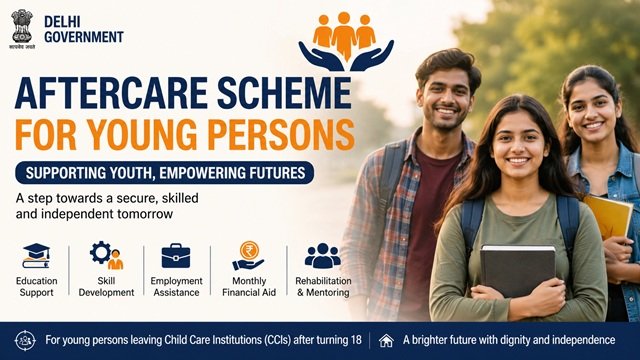
Aftercare Scheme for Young Persons is a newly approved rehabilitation and support scheme of the Delhi Government, launched for youth leaving Child Care Institutions (CCIs) after turning 18 years of age. Under this scheme, eligible beneficiaries may receive support related to higher education, skill development, employment assistance, rehabilitation planning, internship opportunities, and monthly financial aid to help them build independent and dignified lives.
Delhi Aftercare Scheme for Young Persons Highlights | |
|---|---|
| Scheme Name | Aftercare Scheme for Young Persons |
| Announcement Date | 11 May 2026 |
| Implementing Department | Women and Child Development Department, Delhi |
| Budget Allocation | ₹3.5 Crore (FY 2026-27) |
| Target Beneficiaries | Youth Leaving Child Care Institutions (CCIs) After Turning 18 |
| Estimated Annual Beneficiaries | 150 to 200 Young Persons |
| Main Benefits | Education Support, Skill Development, Employment Assistance, Monthly Financial Aid, Rehabilitation Support |
| Special Feature | Individual Care Plan (ICP)-Based Support System |
| Existing Infrastructure | 88 Child Care Institutions and 2 Aftercare Homes |
| Current Status | Approved; Operational Guidelines Awaited |
Introduction of Delhi Aftercare Scheme for Young Persons: A Brief Insight
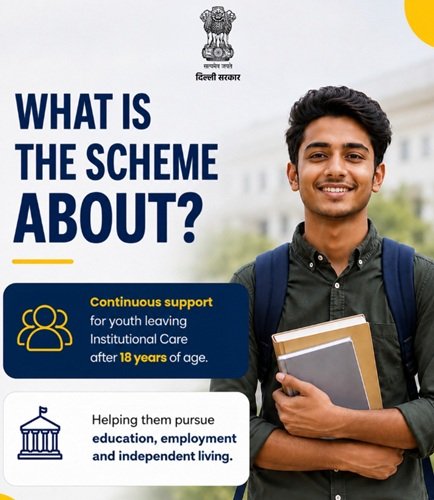
Aftercare Scheme for Young Persons is a newly approved welfare and rehabilitation support scheme of the Delhi Government, launched to help young adults leaving Child Care Institutions (CCIs) after turning 18 years of age. Through this scheme, the Government aims to provide long-term support related to higher education, skill development, employment assistance, career guidance, rehabilitation, and monthly financial aid so that beneficiaries can transition towards independent and dignified lives.
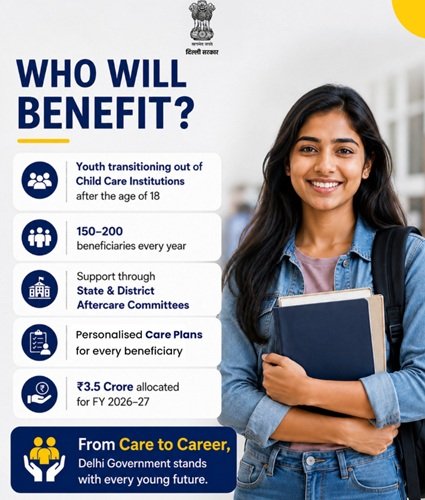
Delhi Chief Minister Smt. Rekha Gupta approved the scheme on 11 May 2026 on the occasion of Mother’s Day during a programme held at Village Cottage Home, Lajpat Nagar, New Delhi. The Government has allocated around ₹3.5 crore for the scheme during the financial year 2026-27 to strengthen aftercare and rehabilitation support for youth leaving institutional care.
The main objective behind the Aftercare Scheme for Young Persons is to ensure that children and young adults do not suddenly lose support after leaving Child Care Institutions upon attaining adulthood. Many young people face serious educational, financial, emotional, and livelihood-related difficulties after turning 18 because they often struggle to continue their studies, develop skills, find employment opportunities, or manage independent living without family support. Through this scheme, the Delhi Government aims to provide continued guidance and structured support during this critical transition phase.
According to the announced framework, the scheme will support beneficiaries through higher education assistance, vocational training, internship opportunities, employment support, mentoring, rehabilitation planning, and monthly financial aid. The Government has also proposed a personalised support model through Individual Care Plans (ICPs), under which the educational, emotional, livelihood, and rehabilitation needs of each beneficiary may be assessed separately instead of following a one-size-fits-all approach.
One of the biggest highlights of the scheme is that it focuses on long-term rehabilitation and independent living support instead of providing only temporary financial assistance. The Government has also proposed regular monitoring and review mechanisms through State Aftercare Committees and District Aftercare Committees to ensure proper support, supervision, and rehabilitation planning for beneficiaries.
Delhi currently has around 88 Child Care Institutions (CCIs) operated by the Government and NGOs, and approximately 150 to 200 young persons leave institutional care every year after turning 18. The Government has also stated that two aftercare homes, one for boys and one for girls, are already operational to support young adults with accommodation, education, food, and rehabilitation-related facilities.
Beneficiaries interested in livelihood and self-employment opportunities may also explore schemes like PM Vishwakarma Yojana, PM SVANidhi Scheme and other scholarship or skill-development programmes. Similarly, women-focused welfare initiatives such as Mahila Samriddhi Yojana also form part of the broader social support framework being expanded in Delhi.
The Delhi Government has approved the Aftercare Scheme framework, but the detailed operational guidelines, registration process, stipend amount, and beneficiary application mechanism are still awaited. Applicants should therefore rely only on official government announcements and avoid fake registration websites or misleading social media claims regarding early registration or guaranteed approval.
Aftercare Scheme for Young Persons has emerged as one of the most important child rehabilitation and youth transition support initiatives announced by the Delhi Government because it focuses on dignity, rehabilitation, education continuity, and long-term independent living support for vulnerable young adults.
Readers who want to explore more Delhi Government welfare schemes related to education, rehabilitation, women empowerment, employment, healthcare, scholarship, and social security can also visit our All Welfare Schemes of Delhi Government section for more latest scheme-related updates and information.
Benefits Provided to Eligible Beneficiaries
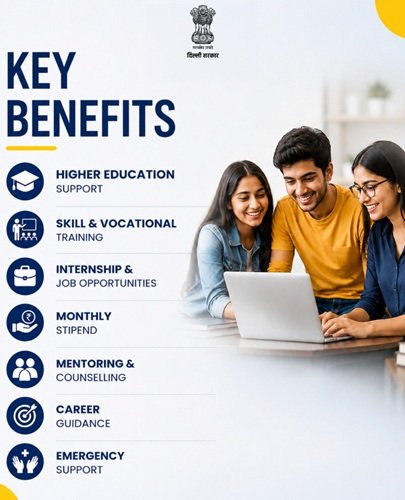
The Aftercare Scheme for Young Persons aims to support young adults leaving Child Care Institutions (CCIs) by helping them continue education, develop skills, access livelihood opportunities, and transition towards independent living with dignity and long-term support.
- Support for higher education and college studies
- Skill development and vocational training assistance
- Career mentoring and guidance support
- Employment and job assistance
- Internship opportunity support
- Monthly financial assistance or stipend support
- Emergency and case-specific assistance, wherever required
- Rehabilitation and independent living support
- Individual Care Plan (ICP)-based support system
- Regular monitoring and welfare support through district and state-level mechanisms
Important: The Delhi Government has approved the scheme framework, but the exact monthly stipend amount and detailed operational guidelines are still awaited.
Eligibility Conditions Required to be Fulfilled
Detailed eligibility guidelines for the Aftercare Scheme for Young Persons have not yet been officially released by the Delhi Government. However, based on the approved framework and official announcement, the following categories are expected to become eligible under the scheme.
- Applicant should be a young person leaving a Child Care Institution (CCI) after turning 18 years of age
- The beneficiary should be associated with recognised Child Care Institutions operating in Delhi
- Applicant may need educational, rehabilitation, livelihood, or skill-development support
- The applicant may need a valid Aadhaar and bank account details
- Additional eligibility verification may be conducted through the concerned authorities or committees
- Further eligibility conditions may be notified officially after the scheme implementation begins
Important: The Delhi Government has not yet released the final eligibility rules, beneficiary selection process, age-related conditions, or detailed operational guidelines for the scheme.
Documents Required to be Attached
The Delhi Government has approved the Aftercare Scheme for Young Persons for youth leaving Child Care Institutions (CCIs) after turning 18. However, the detailed operational guidelines and official document verification framework are still awaited. Based on the announced structure and expected rehabilitation support process, beneficiaries may need the following documents.
- Aadhaar Card
- Delhi Residence Proof, wherever applicable
- Age Proof or Birth Certificate
- Child Care Institution (CCI) related documents
- Educational qualification documents
- Bank Passbook
- Passport Size Photograph
- Mobile Number linked with Aadhaar
- Skill training or vocational documents, wherever applicable
- Identity and rehabilitation-related records, wherever required
Important: The Delhi Government has not yet released the final registration guidelines, official application process, or complete beneficiary verification framework for the Aftercare Scheme for Young Persons.
How Beneficiaries Can Apply to Avail the Benefit of this Scheme
The Delhi Government has approved the Aftercare Scheme for Young Persons to support youth leaving Child Care Institutions (CCIs) after turning 18 years of age. However, the official application process, operational guidelines, beneficiary selection framework, and registration system have not yet been fully released.
According to the announced framework, the scheme is expected to operate through the Women and Child Development Department, Child Care Institutions, district-level committees, and rehabilitation support mechanisms after the official implementation process begins.
Expected Application and Support Process
Step 1: Eligible young persons leaving Child Care Institutions may be identified through recognised CCIs and the concerned authorities.
Step 2: Beneficiary details, educational background, rehabilitation needs, and livelihood-related requirements may be assessed through Individual Care Plans (ICPs) and verification mechanisms.
Step 3: The concerned district-level committees or authorised officials may review the beneficiary’s support requirements related to education, skill development, internship opportunities, employment assistance, or financial aid.
Step 4: After verification and approval, eligible beneficiaries may receive support under the applicable scheme framework according to their individual rehabilitation and transition requirements.
Step 5: Regular monitoring and follow-up support may also be provided through the concerned authorities after implementation.
Important Things Beneficiaries Should Know
- The official registration process has not started yet
- Detailed operational guidelines are still awaited from the Delhi Government
- No separate application portal has been launched currently
- The exact monthly financial assistance amount has not yet been officially announced
- Applicants should avoid fake registration websites and unofficial agents
Important Links Available
- Women and Child Development Department, Delhi
- Department of Social Welfare, Delhi.
- Rehabilitation and Social Reintegration – WCD Delhi
- Delhi Commission for Protection of Child Rights (DCPCR)
Contact Details in Case of Help Needed
The Delhi Government has not yet released separate official helpline numbers, nodal officer details, or dedicated beneficiary support contact information specifically for the Aftercare Scheme for Young Persons.
Since the scheme currently remains in the approved and announcement stage, the official contact details, registration support system, and beneficiary assistance framework are expected to be released after the official implementation and operational rollout of the scheme.
Frequently Asked Questions (FAQs)
Q. What is the Aftercare Scheme for Young Persons?
Ans. The Aftercare Scheme for Young Persons is a newly approved welfare and rehabilitation support scheme of the Delhi Government, launched for youth leaving Child Care Institutions (CCIs) after turning 18 years of age.
Q. Who announced the Aftercare Scheme for Young Persons?
Ans. Delhi Chief Minister Smt. Rekha Gupta approved and announced the scheme on 11 May 2026 on the occasion of Mother’s Day.
Q. What is the main objective of the scheme?
Ans. The scheme aims to support young adults leaving institutional care by helping them continue their education, develop skills, access employment opportunities, and transition towards independent living with dignity and long-term support.
Q. Which beneficiaries are expected to receive support under the scheme?
Ans. The scheme mainly targets young persons leaving Child Care Institutions (CCIs) after turning 18 years of age.
Q. How many beneficiaries may receive support every year?
Ans. According to the announced framework, around 150 to 200 young people leaving CCIs every year may receive support under the scheme.
Q. Which department is expected to implement the scheme?
Ans. The Women and Child Development Department, Delhi, is expected to play an important role in the implementation process.
Q. What type of support may beneficiaries receive under the scheme?
Ans. Eligible beneficiaries may receive support related to higher education, skill development, vocational training, internship opportunities, employment assistance, rehabilitation support, and monthly financial assistance.
Q. Has the Delhi Government announced the monthly stipend amount?
Ans. No. The Government has confirmed monthly financial assistance support, but the exact stipend amount has not yet been officially announced.
Q. What are Individual Care Plans (ICPs)?
Ans. Individual Care Plans (ICPs) are personalised support and rehabilitation plans prepared according to the educational, emotional, livelihood, and rehabilitation needs of each beneficiary.
Q. Has the official registration process started?
Ans. No. The Delhi Government has not yet launched the official registration process or application portal for the scheme.
Q. Are detailed operational guidelines available currently?
Ans. No. The detailed operational guidelines, beneficiary selection process, and implementation framework are still awaited.
Q. Why is the scheme considered important?
Ans. Many young adults face financial, educational, and emotional difficulties after leaving institutional care at the age of 18. The scheme aims to provide long-term support so that beneficiaries can build safe, independent, and dignified lives.
Q. Should applicants avoid fake registration websites?
Ans. Yes. Applicants should avoid unofficial registration links, fake agents, and misleading social media posts because the official application process has not started yet.

Tabassum is a government schemes researcher and writer with 5 years of experience tracking Central and State welfare scheme programmes across India. She has covered 500+ schemes spanning agriculture, women welfare, education, and housing, helping lakhs of beneficiaries understand their entitlements in simple language.