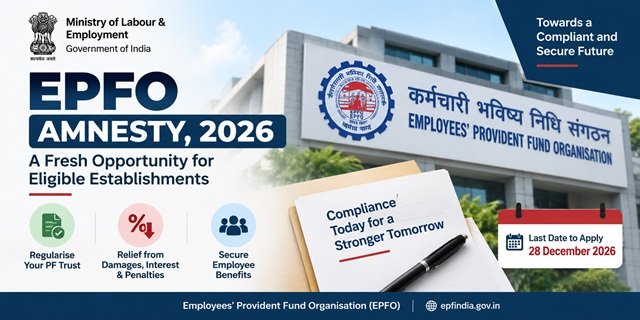
AMNESTY, 2026 is a one-time regularisation initiative launched by the Employees’ Provident Fund Organisation (EPFO) to help eligible establishments operating Income Tax-recognised PF Trusts without a formal exemption notification. The scheme offers an opportunity to regularise past compliance issues and avail relief from certain damages, interest liabilities, and penalties, subject to prescribed conditions. Eligible establishments can apply until 28 December 2026 by contacting their concerned EPFO Regional Office.
EPFO Amnesty Scheme (AMNESTY, 2026) Highlights | |
|---|---|
| Scheme Name | AMNESTY, 2026 |
| Launched By | Ministry of Labour & Employment, Government of India |
| Implementing Authority | Employees’ Provident Fund Organisation (EPFO) |
| Notification Date | 29 June 2026 |
| Effective Date | 1 July 2026 |
| Last Date to Apply | 28 December 2026 |
| Extension Provision | Up to 6 months, subject to CBT recommendation and Government approval |
| Main Objective | Regularisation of eligible PF Trusts lacking formal exemption status |
| Eligible Entities | Income Tax-recognised PF Trusts without Section 17 exemption notification |
| Key Requirement | Employees must have received benefits equal to or better than the statutory EPF Scheme |
| Relief Available | Waiver of eligible damages, interest, and penalties, subject to approval |
| Category I | Regularisation followed by compliance as an unexempted establishment |
| Category II | Regularisation while continuing as an exempted establishment |
| Application Mode | Through the concerned EPFO Regional Office |
| Verification Process | Document scrutiny, inspection, and audit (where required) |
| Related Initiative | VISHWAS, 2026 – dispute resolution scheme for eligible damages cases |
| Helpdesk Email | rc.exemption@epfindia.gov.in |
| Official Website | epfindia.gov.in |
Introduction of EPFO Amnesty Scheme (AMNESTY, 2026): A Brief Insight
Over the years, many establishments created and managed their own Provident Fund (PF) Trusts for employees and regularly provided benefits in line with statutory requirements. However, several of these trusts never obtained the formal exemption notification required under the EPF & MP Act, despite operating for years. Following changes introduced through the Finance Act, 2026, the compliance status of such establishments came under greater scrutiny, creating the need for a structured regularisation mechanism.
To address this situation, the Ministry of Labour & Employment introduced AMNESTY, 2026, a one-time regularisation scheme notified on 29 June 2026. The scheme provides eligible establishments with an opportunity to resolve long-pending exemption-related issues and bring their PF Trusts within the formal regulatory framework.
The scheme is administered by the Employees’ Provident Fund Organisation (EPFO). Its primary objective is to allow establishments operating Income Tax-recognised PF Trusts, but lacking a formal exemption notification, to regularise their position retrospectively while ensuring that employees’ interests remain fully protected.
Under AMNESTY, 2026, establishments that have consistently provided employees with benefits equal to or better than those available under the statutory EPF Scheme may become eligible for significant relief. This includes retrospective regularisation and waiver of certain damages, interest liabilities, and penalties, subject to verification by EPFO.
The scheme also gives employers flexibility in deciding their future compliance structure. After approval, an establishment may continue operating its own exempted PF Trust under EPFO oversight, or choose to transition to the regular EPFO-administered provident fund system.
The application window opened on 1 July 2026 and is currently scheduled to remain available until 28 December 2026. Establishments interested in availing the scheme should begin preparations well in advance, as document verification, audits, and compliance reviews may require considerable time.
To initiate the process, eligible establishments are required to submit an Expression of Interest to their concerned EPFO Regional Office and subsequently file a detailed application along with supporting records, audited financial statements, and employee benefit comparison documents.
For official guidance, establishments may contact their concerned EPFO Regional Office, write to rc.exemption@epfindia.gov.in, or visit the official EPFO portal at epfindia.gov.in for the latest notifications, circulars, and operational guidelines.
Entrepreneurs and business owners looking to strengthen their enterprises can also explore the Pradhan Mantri Mudra Yojana (PMMY), which offers collateral-free business loans, and the Prime Minister’s Employment Generation Programme (PMEGP), which supports new micro-enterprises through credit-linked subsidies. Employers planning workforce expansion may additionally benefit from the PM Viksit Bharat Rojgar Yojana, designed to encourage formal job creation across sectors.
Employers, HR professionals, compliance officers, and organisations seeking information on labour welfare, social security, and employee benefit initiatives can explore additional programmes through our Central Government Welfare Schemes section.
Benefits Provided to Eligible Establishments
AMNESTY, 2026 offers a one-time compliance relief opportunity to eligible establishments that have been operating recognised PF Trusts without a formal exemption order. The scheme aims to regularise such cases while protecting employee interests and reducing long-pending compliance disputes.
Relief from Damages, Interest, and Penalties
- Waiver of damages leviable under Section 14B of the EPF & MP Act, 1952
- Waiver of interest payable under Section 7Q, subject to the scheme conditions
- Waiver of applicable penalties under Section 14
- Available only where employees have received benefits equal to or better than those provided under the statutory EPF Scheme
Retrospective Regularisation of PF Trusts
- Opportunity to regularise past operations of the PF Trust from its inception date
- Eligible establishments may obtain a formal exemption order after approval
- Pending proceedings relating to damages, interest, or similar liabilities may be withdrawn, settled, or otherwise dealt with as per the scheme provisions
- Provides long-term legal and regulatory clarity for employers and employees alike
Relaxation from Certain Compliance Requirements
- Relief from selected eligibility conditions prescribed under the Code on Social Security, 2020
- Relaxation relating to minimum employee strength requirements
- Relaxation relating to minimum corpus requirements
- Relief from the condition of maintaining a specified period of prior compliance history
Choice of Future Compliance Model
- Continue as an exempted establishment and manage the PF Trust under EPFO supervision
- Shift to the regular EPFO-administered Provident Fund system as an unexempted establishment
- Select the option that best suits the organisation’s future compliance strategy
Important Dates
| Particular | Date |
|---|---|
| Scheme Notification | 29 June 2026 |
| Effective Date | 1 July 2026 |
| Last Date to Apply | 28 December 2026 |
| Extension Provision | Up to 6 months, subject to approval by the Central Board of Trustees (CBT) |
Eligibility Conditions Required to be Fulfilled
EPFO has introduced AMNESTY, 2026 to provide a one-time opportunity for certain establishments operating Provident Fund Trusts without a formal exemption order. To avail the benefits of the scheme, the establishment must satisfy the following conditions.
Basic Eligibility Conditions
- Must be operating a Provident Fund Trust recognised under the Income Tax Act, 1961
- Must not possess a valid exemption notification issued under Section 17 of the EPF & MP Act, 1952 or the corresponding provision under the Code on Social Security, 2020
Eligible Categories of Establishments
- Category I: Establishments willing to regularise their past position and function as unexempted establishments under the EPFO-administered Provident Fund Scheme going forward
- Category II: Establishments seeking retrospective regularisation while continuing to manage their own recognised PF Trust as an exempted establishment, subject to EPFO oversight and compliance requirements
Mandatory Compliance Requirements
- Employees must have received benefits equal to or better than those available under the statutory EPF Scheme
- Employer and employee contributions must have been deposited at the prescribed statutory rate
- Interest credited to members’ accounts must be equal to or higher than the rate declared by EPFO for the relevant years
- The establishment should be able to furnish documentary proof supporting its compliance history
Who Is Not Eligible?
- Trusts that are not recognised under the Income Tax Act
- Establishments already holding a valid EPFO exemption order
- Establishments that have provided lower contributions, lower interest, or reduced benefits compared to statutory EPF provisions
- Cases involving fraud, misrepresentation, or serious trust-related irregularities
Documents Required to be Attached
Employers seeking relief under AMNESTY, 2026 are required to submit supporting documents to the concerned EPFO Regional Office for verification of their exempted Provident Fund Trust and compliance history.
Trust-Related Documents
- Registered PF Trust Deed containing the trust’s objectives, rules, and regulations
- Income Tax recognition/approval certificate of the PF Trust
- Trust registration certificate issued under the applicable law
- PAN Card of the PF Trust
Financial Documents
- Audited financial statements of the Trust for the previous 3-5 years
- Annual accounts and balance sheets of the PF Trust
- Records showing the rate of interest credited to members’ accounts
Employee-Related Documents
- Employee-wise list containing PF account details, UAN, salary, and contribution information
- Records of employer and employee PF contributions
- Interest credit statements of member accounts
- Comparative statement demonstrating that trust members received benefits equal to or higher than those available under the statutory EPF Scheme
Compliance Documents
- Declaration confirming compliance with EPF benefit requirements
- Certificate issued by a Chartered Accountant or authorised auditor
- Affidavit verifying the correctness of all information and records submitted
Establishment-Related Documents
- Registration certificate of the establishment
- PAN Card of the establishment
- Authorised signatory details along with address and contact information
How Beneficiaries Can Apply to Avail the Benefit of the Scheme
If your establishment has been running a recognised PF Trust for years but never received a formal EPFO exemption order, this scheme allows you to regularise the situation. The process may look technical at first, but if you follow it step by step, it becomes much easier to understand.
Step 1: First, check whether your PF Trust is recognised under the Income Tax Act, 1961. Also verify that your establishment does not already have a formal exemption notification under Section 17 of the EPF & MP Act. This is the basic condition for applying under AMNESTY, 2026.
Step 2: Decide what you want to do in the future. You have two options. Either continue operating your own PF Trust as an exempted establishment (Category II), or move completely under the EPFO-managed system as an unexempted establishment (Category I).
Step 3: Inform EPFO that you wish to avail the scheme. You can send an Expression of Interest to your concerned EPFO Regional Office. This is simply a way of telling EPFO that your establishment wants to participate in AMNESTY, 2026.
Step 4: Start collecting all required documents. Keep your Trust Deed, Income Tax recognition documents, audited financial statements, employee contribution records, and interest credit details ready before filing the formal application.
Step 5: Prepare a comparison statement showing that employees have received benefits, PF contributions, and interest equal to or higher than the benefits available under the statutory EPF Scheme. This is one of the most important documents in the entire process.
Step 6: Get your accounts reviewed and audited by a Chartered Accountant. Also obtain the required declarations, certificates, and affidavits confirming that the information provided is correct and complete.
Step 7: Submit the complete application along with all supporting documents through your EPFO Regional Office before the prescribed deadline. Incomplete applications may lead to delays or rejection.
Step 8: After submission, EPFO will examine your records carefully. Officers may verify employee benefit details, contribution history, trust operations, and other compliance-related information.
Step 9: In some cases, EPFO may ask for a special audit or additional verification. If such directions are issued, make sure the audit is completed within the time allowed by EPFO.
Step 10: Once verification is completed, the application is processed for approval. If your establishment satisfies all conditions, the competent authority can grant retrospective regularisation and provide the relief available under the scheme.
Step 11: After approval, follow the compliance route you selected earlier. If you chose to remain exempted, continue managing the PF Trust under EPFO oversight. If you opted to become unexempted, begin depositing PF contributions directly with EPFO.
Important Links Available of the Scheme
- EPFO Launches VISHWAS, 2026 and AMNESTY, 2026 Official PIB Press Release
- AMNESTY, 2026 Scheme Details PIB Announcement
- Employees’ Provident Fund Organisation (EPFO) Official Portal
- Ministry of Labour & Employment Official Portal
Contact Details in Case of Help Needed
- Nodal Ministry: Ministry of Labour & Employment, Government of India
- Implementing Body: Employees’ Provident Fund Organisation (EPFO)
- General Application Email: rc.exemption@epfindia.gov.in
- Example Regional Office Email (Thane): ro.thanenorth@epfindia.gov.in
- Local Level: Contact your concerned EPFO Regional Office – dedicated AMNESTY Helpdesks have been set up at several Regional Offices, including Thane and Goa
Frequently Asked Questions (FAQs)
Q. What is EPFO Amnesty Scheme (AMNESTY, 2026)?
Ans. AMNESTY, 2026 is a one-time regularisation scheme introduced by the Employees’ Provident Fund Organisation (EPFO) under the Ministry of Labour & Employment. It allows eligible establishments operating Income Tax-recognised PF Trusts, but lacking a formal exemption notification, to regularise their status and resolve long-pending compliance issues.
Q. Who can apply under AMNESTY, 2026?
Ans. Establishments running a PF Trust recognised under the Income Tax Act, 1961, but not holding a formal exemption notification under Section 17 of the EPF & MP Act, 1952 (or the corresponding provision under the Code on Social Security, 2020), can apply if they have provided employees benefits equal to or better than the statutory EPF Scheme.
Q. What is the last date to apply?
Ans. Applications can be submitted up to 28 December 2026. The scheme may be extended for an additional period on the recommendation of the Central Board of Trustees (CBT), but no such extension has been officially announced so far.
Q. What benefits does the scheme provide?
Ans. Eligible establishments may receive retrospective regularisation, exemption-related relief, and waiver of certain damages, interest, and penalties, subject to fulfilment of all conditions prescribed by EPFO.
Q. Can an establishment continue operating its own PF Trust after approval?
Ans. Yes. Eligible establishments may choose to continue operating as an exempted establishment with a self-managed PF Trust under EPFO supervision, or shift to the regular EPFO-managed system as an unexempted establishment.
Q. How can an establishment apply for the scheme?
Ans. The process begins by submitting an Expression of Interest to the concerned EPFO Regional Office. After that, the establishment must submit the prescribed application along with supporting documents, audit records, and benefit comparison details.
Q. Is AMNESTY, 2026 the same as the Employees’ Enrolment Campaign (EEC)?
Ans. No. Both are separate initiatives. AMNESTY, 2026 deals with PF Trust exemption regularisation, whereas the Employees’ Enrolment Campaign focuses on bringing uncovered employees under EPF coverage.
Q. What happens after submitting the application?
Ans. EPFO examines the submitted records, may conduct inspections or audits if required, and verifies whether employees have received benefits at least equal to the statutory EPF Scheme before taking a final decision.
Q. What if my application is rejected?
Ans. The establishment will be informed about the reasons for rejection. It may also be allowed to respond or pursue the appeal process as per the applicable rules and procedures.
Q. Is there any separate scheme for pending damages and penalty disputes?
Ans. Yes. EPFO has also introduced VISHWAS, 2026, a separate dispute-resolution scheme aimed at resolving certain damages and penalty-related cases. Its eligibility conditions and benefits are different from AMNESTY, 2026.
Q. What documents are generally required for application?
Ans. Establishments usually need to submit the PF Trust deed, Income Tax recognition certificate, audited financial statements, employee contribution records, interest credit details, and a comparison statement showing that employees received benefits equal to or better than the statutory EPF Scheme.
Q. Can a trust with compliance irregularities apply?
Ans. Minor procedural issues may be examined during verification. However, establishments involved in fraudulent activities or those that failed to provide statutory-level benefits to employees are generally not eligible for relief under the scheme.
Q. Where can I get help regarding AMNESTY, 2026?
Ans. You can contact your concerned EPFO Regional Office, write to rc.exemption@epfindia.gov.in, or visit the official EPFO website at epfindia.gov.in for the latest notifications, SOPs, and application-related updates.

Tabassum is a government schemes researcher and writer with 5 years of experience tracking Central and State welfare scheme programmes across India. She has covered 500+ schemes spanning agriculture, women welfare, education, and housing, helping lakhs of beneficiaries understand their entitlements in simple language.