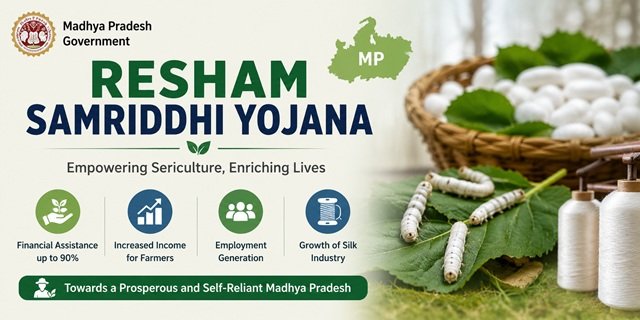
Resham Samriddhi Yojana is a sericulture promotion scheme approved by the Madhya Pradesh Cabinet on 14 October 2025, which implements the Government of India’s Silk Samagra-2 programme in Madhya Pradesh with a 25% state contribution. The scheme provides 75% assistance to general category farmers and 90% assistance to SC/ST beneficiaries on an approved unit cost of Rs. 5 lakh per acre across 23 sericulture activities. Farmers apply through the official E-Resham portal at eresham.mp.gov.in.
Madhya Pradesh Resham Samriddhi Yojana Highlights | |
|---|---|
| Scheme Name | Resham Samriddhi Yojana |
| Approval Date | 14 October 2025 |
| Based On | Government of India Silk Samagra-2 Programme |
| State Contribution | 25% over and above the Central Government Silk Samagra-2 funds |
| Implementing Department | Directorate of Sericulture, Gram Udyog Vibhag, Government of Madhya Pradesh |
| Main Objective | Promote sericulture, generate rural employment, and enhance farmer income through mulberry, Tassar, and Eri silk production |
| Unit Cost | Rs. 5 lakh per acre (revised from earlier Rs. 3.65 lakh per acre) |
| General Category Assistance | 75% of the approved unit cost (Rs. 3.75 lakh per acre) |
| General Category Contribution | 25% of the approved unit cost (Rs. 1.25 lakh per acre) |
| SC/ST Assistance | 90% of the approved unit cost (Rs. 4.50 lakh per acre) |
| SC/ST Contribution | 10% of approved unit cost (Rs. 50,000 per acre) |
| Activities Covered | 23 sericulture-related activities across the full value chain |
| Silk Types Promoted | Mulberry, Tassar (Kosa), Eri |
| Maximum Income from Mulberry | Rs. 1,75,000 per acre per year (recorded in MP) |
| Mulberry Crops Per Year | 3 to 5 crops per year |
| Primary Sericulture Hubs | Chhindwara and Burhanpur |
| Target Beneficiaries | Farmers, SC/ST communities, rural entrepreneurs, women, youth |
| Payment Mode | DBT directly to the Aadhaar-linked bank account |
| Official E-Resham Portal | eresham.mp.gov.in |
Introduction of Madhya Pradesh Resham Samriddhi Yojana: A Brief Insight
Silk farming is one of the oldest rural livelihoods in Madhya Pradesh, but for years, the financial support available to sericulture farmers was limited. The unit cost under earlier programmes stood at Rs. 3.65 lakh per acre, which was insufficient to cover modern equipment, quality seed material, and post-cocoon processing needs. Farmers willing to shift from conventional crops to silk production hesitated because the entry cost remained high despite subsidies. Resham Samriddhi Yojana directly addresses this gap.
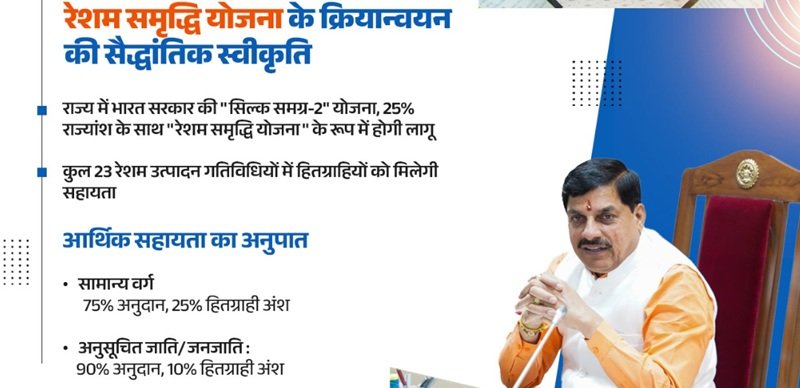
The Madhya Pradesh Cabinet approved the Resham Samriddhi Yojana on 14 October 2025 under Chief Minister Mohan Yadav. The scheme implements the Government of India’s Silk Samagra-2 programme in Madhya Pradesh with an additional 25% state contribution. This combination raises the approved unit cost from Rs. 3.65 lakh to Rs. 5 lakh per acre, making it one of the strongest sericulture support frameworks in the state. The Directorate of Sericulture under the Gram Udyog Department, Government of Madhya Pradesh, implements the scheme through the official E-Resham portal at eresham.mp.gov.in.
The scheme covers 23 sericulture-related activities across the full value chain from mulberry plantation and silkworm rearing to cocoon production, reeling units, silk yarn production, and marketing support. General category farmers receive 75% of the approved unit cost with only 25% contribution from their side, meaning Rs. 3.75 lakh from the government and Rs. 1.25 lakh from the farmer per acre. SC and ST beneficiaries receive 90% assistance with just a Rs. 50,000 contribution per acre, making entry into sericulture extremely affordable. Chhindwara and Burhanpur are the primary sericulture hubs in Madhya Pradesh, where the scheme has the maximum concentration of beneficiaries. Mulberry silk allows 3 to 5 crops per year with a maximum recorded income of Rs. 1,75,000 per acre in the state.
Madhya Pradesh farmers engaged in sericulture can also explore the PM Kisan Samman Nidhi Yojana, which provides Rs. 6,000 per year in three equal instalments of Rs. 2,000 directly into the bank accounts of eligible farmer families across India including Madhya Pradesh and Mukhyamantri Kisan Kalyan Yojana as additional income support.
Farmers, tribal communities, rural entrepreneurs, women in sericulture, and anyone looking for more agricultural support schemes, rural livelihood programmes, and artisan welfare initiatives in Madhya Pradesh can also explore other available programmes under our Madhya Pradesh Government Welfare Schemes List section.

Benefits Provided to Eligible Beneficiaries
Resham Samriddhi Yojana provides financial assistance across 23 sericulture-related activities to farmers, tribal communities, and rural entrepreneurs in Madhya Pradesh through a structured subsidy framework under the Silk Samagra-2 programme.
Financial Assistance Structure
- Unit cost revised upward from Rs. 3.65 lakh to Rs. 5 lakh per acre under Resham Samriddhi Yojana, a significant upgrade from earlier sericulture assistance programmes
- General category farmers receive 75% of the approved unit cost as government assistance, with only 25% contribution from the farmer
- SC and ST beneficiaries receive 90% of the approved unit cost as government assistance, with only 10% contribution from the beneficiary
Subsidy Calculation at a Glance
- General category: Government pays Rs. 3.75 lakh per acre, farmer pays Rs. 1.25 lakh per acre
- SC/ ST category: Government pays Rs. 4.50 lakh per acre, beneficiary pays Rs. 50,000 per acre
Activities Covered
- The scheme provides financial assistance across 23 sericulture-related activities covering the full value chain from plantation to post-cocoon processing
- Activities include mulberry plantation, silkworm rearing, seed production, cocoon production, reeling units, silk yarn production, training, equipment support, and marketing support, among others
- The maximum recorded income from Mulberry silk cultivation in Madhya Pradesh is Rs. 1,75,000 per acre per year
- Mulberry silk allows 3 to 5 crops per year, giving farmers multiple income cycles annually
Employment and Livelihood Benefits
- The scheme generates sustainable rural employment for tribal and economically weaker communities across Madhya Pradesh
- Women can participate in sericulture activities like silkworm rearing and silk thread production from home, reducing dependency on seasonal agricultural income
- SC and ST communities in Chhindwara and Burhanpur sericulture hubs get the maximum 90% assistance, making entry into sericulture highly affordable
- State contribution of 25% over and above the Central Government Silk Samagra-2 programme funds ensures higher unit costs and better equipment access for MP farmers
Four Types of Silk Under the Resham Samriddhi Yojana
Resham Samriddhi Yojana promotes three main types of silk in Madhya Pradesh. Farmers must select the silk type based on their land, location, and available host plants before applying under the scheme.
1. Mulberry Silk (शहतूत रेशम)
- Host plant: Mulberry (Morus alba)
- Silkworm rearing is done indoors in a controlled environment
- Suitable for farmers with their own agricultural land
- 3 to 5 crops can be taken per year, giving multiple income cycles
- Maximum recorded income in Madhya Pradesh: Rs. 1,75,000 per acre per year
- Most commercially viable silk variety for MP farmers with irrigated land
2. Tassar Silk (टसर/कोसा रेशम)
- Host plants: Arjun and Saja trees
- Available in semi-domesticated and wild forms
- Also known as Kosa or Vanya Silk in Madhya Pradesh
- Wild Tassar found naturally on Sal trees in forests
- Suitable for tribal communities with access to forest areas and Arjun/Saja plantations
- Commonly practised in tribal-dominated districts of MP
3. Eri Silk (इरी रेशम)
- Host plant: Castor (Arandi)
- Silkworm rearing done at home makes it suitable for women
- Cheapest silk thread among all varieties
- Low investment and home-based, making it ideal for women’s self-employment
- Silk pupa is also used as food in several communities
4. Muga Silk (मूंगा रेशम)
- Host plant: Solu (Litsea polyantha)
- The most expensive silk variety in India
- Primarily found in Northeast India
- Experimental rearing is being conducted at Pachmarhi in Madhya Pradesh
- Not yet commercially promoted under the Resham Samriddhi Yojana in MP
Farmers in Chhindwara and Burhanpur districts can consult the nearest District Sericulture Office or visit eresham.mp.gov.in to identify the most suitable silk variety for their land and location before applying under the scheme.
Eligibility Conditions Required to be Fulfilled
The following eligibility conditions apply to farmers and beneficiaries seeking assistance under Resham Samriddhi Yojana as per the scheme structure approved by the Madhya Pradesh Cabinet.
Basic Eligibility
- Applicant must be a permanent resident of Madhya Pradesh
- Applicant must be engaged in sericulture activities or willing to undertake sericulture-based livelihood
- Applicant must have land available for a mulberry plantation or access to forest-based host plants for Tassar silk
- Applicant must have a valid Aadhaar Card and an Aadhaar-linked bank account for DBT payment
Category-wise Eligibility
- General category farmers receive 75% assistance on the approved unit cost, with 25% beneficiary contribution
- Scheduled Caste (SC) beneficiaries receive 90% assistance on the approved unit cost, with only 10% beneficiary contribution
- Scheduled Tribe (ST) beneficiaries receive 90% assistance on the approved unit cost, with only 10% beneficiary contribution
- Women engaged in sericulture activities are actively encouraged to apply under the scheme
- Rural entrepreneurs and youth seeking livelihood opportunities through sericulture are eligible
Who Can Benefit the Most
- Tribal and rural communities in Chhindwara and Burhanpur districts, where sericulture activities are concentrated
- SC and ST farmers who get the highest assistance of 90% with a minimal contribution of just 10%
- Women who want to participate in sericulture-based self-employment at home
- Farmers already engaged in mulberry, Tassar, or Eri silk production, wanting to scale up activities
Detailed eligibility conditions for each of the 23 covered sericulture activities will be notified by the Directorate of Sericulture. Applicants must contact their nearest District Sericulture Office or visit eresham.mp.gov.in for complete category-wise eligibility details.
Documents Required to be Attached
Based on the scheme structure and existing sericulture assistance programmes in Madhya Pradesh, the following documents are likely to be required at the time of applying for the Resham Samriddhi Yojana.
- Aadhaar Card of the applicant
- Land ownership documents or land cultivation proof
- Caste Certificate for SC/ST category applicants
- Bank account details with IFSC code linked with Aadhaar for DBT payment
- Residence proof confirming permanent residence in Madhya Pradesh
- Passport-sized photograph
- Mobile number linked with Aadhaar
Applicants must verify the final document requirements from the nearest District Sericulture Office or through the official E-Resham portal at eresham.mp.gov.in before submitting their application.
How Beneficiaries Can Apply to Avail the Benefit of this Scheme
Resham Samriddhi Yojana is implemented by the Directorate of Sericulture, Government of Madhya Pradesh, through the official E-Resham portal at eresham.mp.gov.in which is the official Beneficiary Management and e-Payment Platform developed by NIC.
Step 1: Visit the official E-Resham portal at eresham.mp.gov.in and register as a beneficiary by entering Aadhaar details, personal information, land details, and bank account details linked with Aadhaar.
Step 2: Select the relevant sericulture activity from the available list of 23 covered activities under the scheme based on your interest and available land and resources.
Step 3: Fill in complete application details, including land area, proposed activity, category (General, SC, or ST), and upload all required documents including Aadhaar Card, land documents, caste certificate, wherever applicable, and bank passbook copy.
Step 4: Submit the completed application on the E-Resham portal. The concerned District Sericulture Officer verifies the application and conducts field verification wherever required.
Step 5: After verification and approval, the financial assistance is credited directly into the beneficiary’s Aadhaar-linked bank account through DBT as per the approved unit cost and category-wise subsidy structure.
Step 6: Farmers can also visit the nearest District Sericulture Office in their district to apply offline, get guidance on eligible activities, and receive assistance with the registration process on the E-Resham portal.
Important Links Available
- E-Resham Portal, Directorate of Sericulture Madhya Pradesh.
- Department Structure, Directorate of Sericulture Madhya Pradesh.
Contact Details in Case of Help Needed
Farmers and beneficiaries facing issues related to Resham Samriddhi Yojana registration, activity selection, subsidy payment, or scheme-related queries can contact the following official channels.
- Directorate of Sericulture, Government of Madhya Pradesh
Gram Udyog Vibhag,
Government of Madhya Pradesh,
Bhopal, Madhya Pradesh - For local queries: Contact the nearest District Sericulture Office in your district
Frequently Asked Questions (FAQs)
Q. What is the Resham Samriddhi Yojana?
Ans. Resham Samriddhi Yojana is a sericulture promotion scheme approved by the Madhya Pradesh Cabinet on 14 October 2025. The scheme implements the Government of India’s Silk Samagra-2 programme in Madhya Pradesh with a 25% state contribution. It provides financial assistance across 23 sericulture-related activities to farmers, tribal communities, and rural entrepreneurs for income enhancement and employment generation through silk production.
Q. What is the unit cost under the Resham Samriddhi Yojana?
Ans. The unit cost under the Resham Samriddhi Yojana is Rs. 5 lakh per acre. This is a significant upgrade from the earlier unit cost of Rs. 3.65 lakh per acre under the previous sericulture assistance programmes in Madhya Pradesh.
Q. What is the subsidy for general category farmers?
Ans. General category farmers receive 75% of the approved unit cost as government assistance. At the current unit cost of Rs. 5 lakh per acre, the government pays Rs. 3.75 lakh, and the farmer contributes Rs. 1.25 lakh per acre.
Q. What is the subsidy for SC and ST beneficiaries?
Ans. SC and ST beneficiaries receive 90% of the approved unit cost as government assistance. At the current unit cost of Rs. 5 lakh per acre, the government pays Rs. 4.50 lakh and the beneficiary contributes only Rs. 50,000 per acre, making entry into sericulture highly affordable for tribal and SC communities.
Q. What is the connection between the Resham Samriddhi Yojana and the Silk Samagra-2?
Ans. Resham Samriddhi Yojana is not a standalone new scheme. The Madhya Pradesh Government adopted the Government of India’s Silk Samagra-2 programme in the state under the name Resham Samriddhi Yojana with an additional 25% state contribution. This combination allows MP farmers to access higher unit costs and better subsidy support than under the central programme alone.
Q. How many activities are covered under the Resham Samriddhi Yojana?
Ans. The scheme provides financial assistance across 23 sericulture-related activities covering the full value chain from plantation to post-cocoon processing, including mulberry plantation, silkworm rearing, seed production, cocoon production, reeling units, silk yarn production, training, equipment support, and marketing support, among others.
Q. Which districts are the primary sericulture hubs under this scheme?
Ans. Chhindwara and Burhanpur are the primary sericulture hubs in Madhya Pradesh, where the scheme has maximum impact and beneficiary concentration.
Q. What types of silk are promoted under the Resham Samriddhi Yojana?
Ans. The scheme promotes Mulberry silk, where the host plant is Mulberry (Morus alba), Tassar silk (Kosa), where the host plants are Arjun and Saja trees, and Eri silk, where the host plant is Castor (Arandi). Mulberry silk allows 3 to 5 crops per year with a maximum recorded income of Rs. 1,75,000 per acre in Madhya Pradesh.
Q. Can women apply for the Resham Samriddhi Yojana?
Ans. Yes. Women engaged in sericulture activities are actively encouraged to apply. Women can participate in silk worm rearing, silk thread production, and other sericulture-related activities from home, making it a suitable self-employment opportunity.
Q. When was the Resham Samriddhi Yojana approved?
Ans. The Madhya Pradesh Cabinet approved the Resham Samriddhi Yojana on 14 October 2025 under Chief Minister Mohan Yadav.
Q. How can farmers apply for the Resham Samriddhi Yojana?
Ans. Farmers can apply through the official E-Resham portal at eresham.mp.gov.in, which is the official Beneficiary Management and e-Payment Platform developed by NIC for the Directorate of Sericulture, Government of Madhya Pradesh. Farmers can also visit the nearest District Sericulture Office for offline assistance.
Q. How is the subsidy amount paid to beneficiaries?
Ans. After verification and approval by the District Sericulture Officer, the financial assistance is credited directly into the beneficiary’s Aadhaar-linked bank account through DBT as per the approved unit cost and category-wise subsidy structure.
Q. How does the Resham Samriddhi Yojana differ from earlier sericulture assistance programmes?
Ans. Under earlier sericulture assistance programmes, the unit cost was Rs. 3.65 lakh per acre with a lower support structure. Under the Resham Samriddhi Yojana, the unit cost is Rs. 5 lakh per acre with 75% assistance for the general category and 90% for SC/ST beneficiaries. The scheme also combines Central Government Silk Samagra-2 funds with a 25% state contribution, providing a stronger and more comprehensive support structure.

Tabassum is a government schemes researcher and writer with 5 years of experience tracking Central and State welfare scheme programmes across India. She has covered 500+ schemes spanning agriculture, women welfare, education, and housing, helping lakhs of beneficiaries understand their entitlements in simple language.