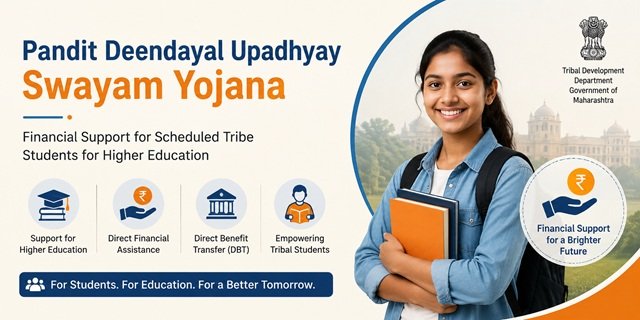
Pandit Deendayal Upadhyay Swayam Yojana is a welfare initiative of the Tribal Development Department, Government of Maharashtra that provides financial assistance to eligible Scheduled Tribe (ST) students who are unable to secure admission to a Government Tribal Hostel. The scheme is linked with the official Swayam Portal, through which students apply for hostel admission and may be considered for financial assistance if a hostel seat is not allotted.
Maharashtra Pandit Deendayal Upadhyay Swayam Yojana Highlights | |
|---|---|
| Scheme Name | Pandit Deendayal Upadhyay Swayam Yojana |
| Nodal Department | Tribal Development Department, Government of Maharashtra |
| Target Beneficiaries | Scheduled Tribe (ST) Students |
| Scheme Objective | Financial assistance to eligible students not allotted a Government Tribal Hostel |
| Application Mode | Online through the Swayam Portal |
| Application Process | Government Tribal Hostel Application with Swayam Yojana Option |
| Benefit Transfer Mode | Direct Benefit Transfer (DBT) |
| Official Portal | Swayam Portal |
| Toll-Free Helpline | 1800 267 0007 |
| Email Support | tddswayamhostelhelp@gmail.com |
Introduction of Maharashtra Pandit Deendayal Upadhyay Swayam Yojana: A Brief Insight
The Pandit Deendayal Upadhyay Swayam Yojana is a welfare initiative of the Tribal Development Department, Government of Maharashtra that provides financial assistance to eligible Scheduled Tribe (ST) students who are unable to secure admission to a Government Tribal Hostel while pursuing higher education. Instead of hostel accommodation, eligible students receive financial support to help meet their accommodation and other essential educational expenses.
The scheme has been introduced to ensure that the shortage of Government Tribal Hostel seats does not become a barrier to higher education. Students who are not allotted a hostel seat despite applying through the prescribed admission process can be considered for assistance under this scheme, subject to the eligibility conditions laid down by the Department.
One of the most important features of the scheme is that there is no separate application process. Students must first apply for admission to a Government Tribal Hostel through the official Swayam Portal. While submitting the hostel application, applicants are required to opt for consideration under the Pandit Deendayal Upadhyay Swayam Yojana. If they are not allotted a hostel seat, their application may be considered for financial assistance in accordance with the prescribed guidelines.
Eligible applicants are required to submit the prescribed documents, including their Aadhaar Card, Caste Certificate, Caste Validity Certificate, educational documents, Income Certificate, and bank account details through the online portal. Applications are verified by the concerned authorities before financial assistance is approved and released through the Direct Benefit Transfer (DBT) system.
Students looking for other education and youth empowerment initiatives in Maharashtra may also explore the Chief Minister Fellowship Program and the Mukhyamantri Yuva Karya Prashikshan Yojana, both of which provide valuable opportunities for skill development, practical training, and professional experience.
Further, our readers can check the All Welfare Schemes of Maharashtra Government to explore scholarships, hostel facilities, education assistance, skill development programmes, employment initiatives, and other welfare schemes launched by the Government of Maharashtra.
Benefits Provided to Eligible Beneficiaries
Under the Pandit Deendayal Upadhyay Swayam Yojana, eligible Scheduled Tribe (ST) students who are not allotted accommodation in a Government Tribal Hostel receive financial assistance to help meet their accommodation and living expenses while pursuing higher education. The assistance is provided in accordance with the norms prescribed by the Tribal Development Department.
- Financial Assistance: Eligible students receive financial support in place of Government Tribal Hostel accommodation.
- Direct Benefit Transfer (DBT): The approved financial assistance is credited directly to the beneficiary’s Aadhaar-linked bank account through the Direct Benefit Transfer (DBT) system.
- Support for Higher Education: The assistance helps students meet accommodation, food, and other essential living expenses while continuing their higher education away from home.
- No Separate Application: Students who opt for consideration under the Swayam Yojana during the Government Tribal Hostel admission process are considered under the scheme as per the prescribed procedure.
- Transparent Benefit Delivery: Financial assistance is released only after verification and approval by the competent authority in accordance with the applicable guidelines.
Applicable Financial Assistance under Pandit Deendayal Upadhyay Swayam Yojana
Eligible beneficiaries under the Pandit Deendayal Upadhyay Swayam Yojana receive financial assistance to help meet their food, accommodation, and other educational expenses while pursuing higher education. The amount of assistance depends on the location of the educational institution, as students studying in larger cities generally incur higher living expenses than those studying in smaller towns.
| Location of Educational Institution | Food Allowance | Accommodation Allowance | Maintenance / Educational Allowance | Total Annual Assistance |
|---|---|---|---|---|
| Mumbai City, Mumbai Suburban, Navi Mumbai, Thane, Pune, Pimpri-Chinchwad and Nagpur | ₹32,000 | ₹20,000 | ₹8,000 | ₹60,000 |
| Other Divisional Headquarters and remaining Class-C Municipal Corporation areas | ₹28,000 | ₹15,000 | ₹8,000 | ₹51,000 |
| Other District Places | ₹25,000 | ₹12,000 | ₹6,000 | ₹43,000 |
| Taluka Places | ₹23,000 | ₹10,000 | ₹5,000 | ₹38,000 |
Note: The financial assistance is released through the Direct Benefit Transfer (DBT) system into the beneficiary’s Aadhaar-linked bank account after verification and approval by the competent authority. Applicants should refer to the latest Government Resolution or departmental guidelines for any future revisions in the assistance amount.
Eligibility Conditions Required to be Fulfilled
The Pandit Deendayal Upadhyay Swayam Yojana is available only to eligible Scheduled Tribe (ST) students who are not allotted a seat in a Government Tribal Hostel through the common online admission process. Applicants must satisfy the eligibility conditions prescribed by the Tribal Development Department.
- Scheduled Tribe Category: The applicant must belong to the Scheduled Tribe (ST) category and possess a valid Caste Certificate and Caste Validity Certificate.
- Government Hostel Application: The applicant must first apply for admission to a Government Tribal Hostel through the official online portal.
- Hostel Seat Not Allotted: Only applicants who are not selected in the Government Hostel merit list and have opted for consideration under the Swayam Yojana are eligible.
- Admission Confirmation: Applicants who fail to confirm an allotted hostel seat or withdraw their hostel application become ineligible for the Swayam Yojana.
- Educational Qualification: The applicant should be pursuing higher education after Class 12 in a recognised college or educational institution.
- Residential Requirement: The applicant’s family should not ordinarily reside in the same city or town where the educational institution is located.
- Full-Time Student: The applicant should not be engaged in any full-time or part-time employment or business while pursuing the course.
- Other Hostel Benefits: The applicant should not be availing hostel accommodation under the Social Welfare Department at the same time.
- Bank Account: The applicant must have an Aadhaar-linked bank account with matching personal details for Direct Benefit Transfer (DBT), wherever applicable.
Note: Applicants must ensure that all information provided in the online application matches the supporting documents. Any discrepancy may result in the application being rejected or kept pending for verification.
Documents Required to be Attached
Applicants seeking admission under the Pandit Deendayal Upadhyay Swayam Yojana are required to upload the prescribed documents while submitting the combined online application for Government Hostel admission on the official portal. Clear scanned copies of the original documents should be uploaded in the prescribed format.
- Aadhaar Card: Scanned copy of both sides of the Aadhaar Card in the prescribed format.
- Caste Certificate and Caste Validity Certificate: Scanned copies of both certificates combined into a single file to establish Scheduled Tribe (ST) status.
- College Admission Receipt and Bonafide Certificate: Admission receipt and Bonafide Certificate combined into one file. A Gap Certificate should also be attached wherever applicable.
- Government Medical Certificate: Valid medical certificate in the prescribed format for hostel admission.
- Income Certificate: Income Certificate issued by the competent authority. Where applicable, applicants may provide the prescribed BPL Certificate details instead of an Income Certificate, subject to the conditions mentioned in the official guidelines.
- Bank Passbook: Scanned copy of the first page of the bank passbook showing the account holder’s name, account number, IFSC code, and branch details.
- Previous Examination Marksheet and Passing Certificate: Scanned copies of the latest qualifying examination marksheet(s) and passing certificate.
- School Leaving Certificate (LC) or Transfer Certificate (TC): Scanned copy of the original certificate issued by the previously attended educational institution.
- Principal-Attested Certificate: If the original School Leaving Certificate has been deposited with the current college, applicants may upload a copy duly attested by the Principal along with an affidavit for any educational gap, wherever applicable.
- Disability Certificate or Orphan Certificate: Government-issued Disability Certificate or an Orphan Certificate issued by the Women and Child Development Department, wherever applicable.
How Beneficiaries Can Apply to Avail the Benefit of this Scheme
Eligible Scheduled Tribe (ST) students can apply for the Pandit Deendayal Upadhyay Swayam Yojana through the official Swayam Portal while applying for admission to a Government Tribal Hostel. Since there is no separate application form for the scheme, applicants must complete the combined hostel admission process and opt for consideration under the Swayam Yojana.
Step 1: Visit the official Swayam Portal and register as a new applicant using your Aadhaar number. Complete the OTP verification using the mobile number linked with your Aadhaar.
Step 2: Create your User ID and Password and keep them safe, as the same login credentials will be required for future renewals and application tracking.
Step 3: Fill in the online application form with your personal, educational, communication, caste, and bank account details exactly as mentioned in the supporting documents.
Step 4: Apply for admission to a Government Tribal Hostel through the same portal. Since the Swayam Yojana is linked with the hostel admission process, submitting a hostel application is mandatory.
Step 5: While filling out the application form, select “Yes” for consideration under the Pandit Deendayal Upadhyay Swayam Yojana if a hostel seat is not allotted. Applicants selecting “No” will not be considered for the scheme.
Step 6: Upload clear scanned copies of all the prescribed documents in the required format and verify that every document is complete and legible before final submission.
Step 7: Submit the online application and note down the Application Number for future reference. Regularly check your application status through the Swayam Portal and respond promptly if any corrections are requested by the concerned authorities.
Step 8: If a Government Tribal Hostel seat is allotted, download the call letter and complete the admission process within the prescribed time limit. Failure to confirm admission may result in cancellation of both the hostel seat and eligibility for the Swayam Yojana.
Step 9: If you are not allotted a hostel seat and have opted for consideration under the Swayam Yojana, your application will be processed under the scheme as per the eligibility conditions prescribed by the Tribal Development Department.
Step 10: Submit the required student and parent self-declarations along with any additional documents, wherever applicable, and complete the verification process through your college and the concerned authorities.
Important: Ensure that all information and uploaded documents are accurate and genuine. Incomplete applications, incorrect information, or failure to follow the prescribed procedure may result in rejection of the application or cancellation of benefits.
Important Links Available
- Swayam Application Portal
- Student User Manual (PDF)
- Tribal Development Department, Government of Maharashtra
- Government Resolution
Contact Details in Case of Help Needed
Applicants facing issues related to registration, login, document upload, application status, or other portal-related services may contact the following official helpdesk.
- Toll-Free Helpline: 1800 267 0007
- Email Support: tddswayamhostelhelp@gmail.com
- Project Officer (Integrated Tribal Development Project): Contact the concerned Project Officer for issues such as unavailable colleges or courses, correction requests, or changes to the registered mobile number.
- Department Website: Tribal Development Department, Government of Maharashtra
Note: Keep your Application Number and registered mobile number ready while contacting the helpdesk for faster assistance.
Frequently Asked Questions (FAQs)
Q. What is the Pandit Deendayal Upadhyay Swayam Yojana?
Ans. The Pandit Deendayal Upadhyay Swayam Yojana is a scheme of the Tribal Development Department, Government of Maharashtra, that provides financial assistance to eligible Scheduled Tribe (ST) students who are not allotted accommodation in a Government Tribal Hostel.
Q. Can I apply for the Pandit Deendayal Upadhyay Swayam Yojana directly?
Ans. No. There is no separate application for the scheme. Students must first apply for admission to a Government Tribal Hostel through the official Swayam Portal and opt for consideration under the Swayam Yojana.
Q. Who is eligible for the Swayam Yojana?
Ans. Eligible Scheduled Tribe (ST) students who apply for Government Tribal Hostel admission but are not allotted a hostel seat, and who have opted for consideration under the Swayam Yojana, may be considered for benefits subject to the prescribed eligibility conditions.
Q. How is the financial assistance provided?
Ans. The approved financial assistance is released directly to the beneficiary’s Aadhaar-linked bank account through the Direct Benefit Transfer (DBT) system, subject to verification and approval by the competent authority.
Q. What documents are required while applying?
Ans. Applicants generally need to upload documents such as the Aadhaar Card, Caste Certificate, Caste Validity Certificate, College Admission Receipt, Bonafide Certificate, Income Certificate or BPL details (where applicable), Bank Passbook, previous examination documents, and other prescribed documents.
Q. What happens if I do not confirm the allotted hostel seat?
Ans. Applicants who fail to confirm admission to an allotted Government Tribal Hostel within the prescribed time or withdraw their application become ineligible for the Swayam Yojana.
Q. Can I work while receiving the benefit under this scheme?
Ans. No. Applicants are required to declare that they are pursuing full-time education and are not engaged in any full-time or part-time employment or business while availing the scheme benefits.
Q. Is there an online portal for this scheme?
Ans. Yes. Applications are submitted through the official Swayam Portal, which is also used for Government Tribal Hostel admissions and related services.
Q. Which Department implements the Pandit Deendayal Upadhyay Swayam Yojana?
Ans. The scheme is implemented by the Tribal Development Department, Government of Maharashtra.

Tabassum is a government schemes researcher and writer with 5 years of experience tracking Central and State welfare scheme programmes across India. She has covered 500+ schemes spanning agriculture, women welfare, education, and housing, helping lakhs of beneficiaries understand their entitlements in simple language.