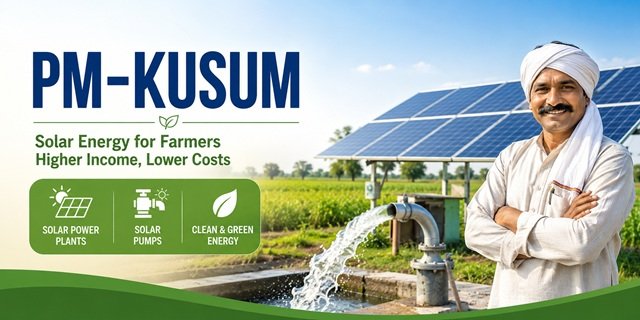
PM-KUSUM (Pradhan Mantri Kisan Urja Suraksha evam Utthaan Mahabhiyan) is a flagship solar agriculture scheme of the Ministry of New and Renewable Energy (MNRE), helping farmers reduce irrigation costs, install solar-powered pumps, and earn additional income from solar energy generation. Eligible beneficiaries can receive substantial government subsidy under Components B and C or set up grid-connected solar power plants under Component A through their respective State Nodal Agency.
PM-KUSUM Scheme Highlights | |
|---|---|
| Scheme Name | Pradhan Mantri Kisan Urja Suraksha evam Utthaan Mahabhiyan (PM-KUSUM) |
| Launch Year | 2019 |
| Current Validity | Extended up to 31 March 2026 |
| Nodal Ministry | Ministry of New and Renewable Energy (MNRE) |
| Main Objective | Promote solar energy in agriculture, reduce diesel dependence, and increase farmers’ income |
| Total Solar Capacity Target | 34,800 MW |
| Central Financial Outlay | Rs. 34,422 Crore |
| Component-A | Grid-connected Solar Power Plants (500 kW to 2 MW) |
| Component-B | Standalone Solar Agricultural Pumps in off-grid areas |
| Component-C | Solarisation of Existing Grid-Connected Agricultural Pumps (IPS/FLS) |
| General State Subsidy Pattern | 30% Central Assistance + Minimum 30% State Subsidy + Maximum 40% Farmer Contribution |
| Special Category State Subsidy Pattern | 50% Central Assistance + Minimum 30% State Subsidy + Maximum 20% Farmer Contribution |
| Special Category States | North Eastern States, Sikkim, Jammu & Kashmir, Himachal Pradesh, Uttarakhand, Lakshadweep and Andaman & Nicobar Islands |
| Bank Loan Facility | Available for eligible beneficiaries; farmer contribution can be reduced to around 10% upfront |
| Additional Income Opportunity | Sale of surplus solar power to DISCOMs under eligible components |
| Power Purchase Agreement (PPA) | Up to 25 Years under Component-A |
| Project Beneficiaries | Individual Farmers, FPOs, Cooperatives, Panchayats, Water User Associations and Other Eligible Entities |
| Farmers Benefited | 21.77 Lakh+ (as per latest available scheme progress) |
| Application Mode | Online/Offline through State Nodal Agencies and Implementing Authorities |
| Official PM-KUSUM Portal | pmkusum.mnre.gov.in |
| MNRE Website | mnre.gov.in |
| Helpline Number | 18001803333 |
Introduction of PM-KUSUM Scheme: A Brief Insight
For millions of Indian farmers, irrigation still depends on expensive diesel pumps or an unreliable electricity supply. Rising fuel costs directly increase cultivation expenses, while power shortages can delay irrigation at critical stages of crop growth. To address these challenges and make agriculture more energy-secure, the Government of India launched the Pradhan Mantri Kisan Urja Suraksha evam Utthaan Mahabhiyan (PM-KUSUM) in 2019.
The scheme is implemented by the Ministry of New and Renewable Energy (MNRE) in partnership with State Nodal Agencies and electricity distribution companies (DISCOMs) across the country. Its core objective is to reduce farmers’ dependence on diesel, promote the use of clean solar energy, and create an additional source of income through power generation.
PM-KUSUM is not just a solar pump scheme. It is a comprehensive agricultural solarisation programme designed to help farmers produce electricity, reduce irrigation costs, and strengthen long-term farm income. The scheme also supports India’s broader renewable energy goals by encouraging decentralised solar power generation in rural areas.
Under PM-KUSUM, farmers can choose from three different components based on their requirements. Component-A allows eligible beneficiaries to establish grid-connected solar power plants on suitable land and earn income by selling electricity to DISCOMs. Component-B provides standalone solar-powered irrigation pumps for farmers in off-grid areas, while Component-C helps farmers solarise their existing grid-connected agricultural pumps.
One of the biggest advantages of the scheme is the financial support available from the Central and State Governments. Depending on the component and state category, beneficiaries can receive substantial subsidy assistance, significantly reducing the overall project cost. Farmers can also avail bank financing for their contribution, reducing the need for large upfront investment.
Special provisions have been made for North Eastern States, hilly regions, and island territories, where higher levels of Central Financial Assistance are available. The scheme therefore supports not only energy security but also equitable access to solar technology in geographically challenging regions.
Since its launch, PM-KUSUM has benefited lakhs of farmers across the country through solar pumps, feeder solarisation projects, and decentralised solar power plants. The scheme plays a key role in improving irrigation reliability, lowering farming costs, reducing carbon emissions, and creating new income opportunities for rural households.
Applications are processed through authorised State Nodal Agencies and official government portals linked to the National PM-KUSUM Portal. Farmers should always use official channels while applying and avoid unofficial websites or agents claiming guaranteed approvals. For assistance, beneficiaries can contact their State Nodal Agency or call the toll-free helpline at 1800-180-3333.
Farmers looking to reduce household electricity expenses in addition to agricultural energy costs can also explore the PM Surya Ghar Muft Bijli Yojana, which supports rooftop solar installations for residential consumers. Those seeking direct income support may benefit from the PM Kisan Samman Nidhi Yojana, while farmers looking for crop-risk protection can explore the Pradhan Mantri Fasal Bima Yojana (PMFBY).
Farmers and readers interested in more agriculture, renewable energy, and farmer welfare initiatives can explore additional programmes on our List of Welfare Schemes of Central Government page.
Benefits Provided to Eligible Beneficiaries
PM-KUSUM Scheme offers different benefits under its three components, helping farmers reduce irrigation costs, generate clean energy, and create an additional source of income from solar power. The level of assistance depends on the component selected and the category of the state where the project is implemented.
Component-A – Grid-Connected Solar Power Plants
- Farmers, FPOs, cooperatives, panchayats, and other eligible entities can establish solar power plants ranging from 500 kW to 2 MW
- Electricity generated from the plant can be sold directly to the local DISCOM
- Revenue is earned through a Feed-in Tariff (FiT) approved by the respective State Electricity Regulatory Commission (SERC)
- A long-term Power Purchase Agreement (PPA) of 25 years provides predictable income from power sales
- Farmers who do not wish to invest themselves can lease their land to a developer or DISCOM and earn regular lease income
- Suitable for generating a stable, non-farm source of income from underutilised land
Component-B – Standalone Solar Agriculture Pumps
Under this component, eligible farmers receive financial assistance for installing standalone solar-powered irrigation pumps in off-grid areas.
| State Category | Central Financial Assistance (CFA) | State Subsidy | Farmer Contribution |
|---|---|---|---|
| General States | 30% | Minimum 30% | Maximum 40% |
| North Eastern, Hilly & Island States | 50% | Minimum 30% | Maximum 20% |
Special Category States include Arunachal Pradesh, Assam, Manipur, Meghalaya, Mizoram, Nagaland, Sikkim, Tripura, Jammu & Kashmir, Himachal Pradesh, Uttarakhand, Lakshadweep, and Andaman & Nicobar Islands.
Component-C – Individual Pump Solarisation (IPS)
- Existing grid-connected agricultural pumps can be solarised with a solar PV system
- Solar capacity can be installed up to twice the pump capacity (in kW terms)
- Farmers receive the same subsidy support structure available under Component-B
- Electricity generated is first used for irrigation purposes
- Any surplus electricity can be exported to the grid, creating an additional source of income
- Reduces dependence on grid power and lowers irrigation-related electricity costs
Component-C – Feeder Level Solarisation (FLS)
- Entire agricultural feeders are solarised instead of individual pumps
- Projects are implemented through CAPEX or RESCO models with a project period of up to 25 years
- Central Financial Assistance is available up to 30% (maximum Rs. 1.05 crore/MW) for General States
- Special Category States receive up to 50% CFA (maximum Rs. 1.75 crore/MW)
- Farmers benefit from reliable daytime electricity supply for irrigation
- Power is provided free of cost or at rates determined by the respective State Government
Bank Loan Facility
- Farmers are not always required to pay the entire beneficiary share from their own pocket
- Many banks provide financing under PM-KUSUM guidelines
- In several cases, farmers may contribute only 10% of the project cost upfront, while the remaining eligible share can be financed through bank loans
- SBI and various other scheduled banks offer PM-KUSUM financing options subject to eligibility and lending norms
Scheme Progress and Achievements
PM-KUSUM Scheme has emerged as one of India’s largest renewable energy programmes for the agriculture sector. As of 31 July 2026, lakhs of farmers have benefited through solar pumps, feeder solarisation projects, and decentralised solar power plants across the country.
| Component | Progress Achieved | Sanctioned/Target |
|---|---|---|
| Component-A | 1,986.30 MW Installed | 10,000 MW Target |
| Component-B | 11,68,667 Solar Pumps Installed | 13,07,190 Sanctioned |
| Component-C (IPS) | 16,259 Pumps Solarised | Ongoing Implementation |
| Component-C (FLS) | 16,54,044 Pumps Covered | 35,36,602 Sanctioned |
Eligibility Conditions Required to be Fulfilled
The Ministry of New and Renewable Energy (MNRE) has prescribed separate eligibility criteria for each component of the PM-KUSUM Scheme. Before applying, applicants should carefully identify the component that matches their land, irrigation facility, and electricity connection status.
For Component-A (Decentralised Solar Power Plants)
- Individual farmers are eligible to set up solar power plants on their land
- Groups of farmers, Farmer Producer Organisations (FPOs), cooperatives, panchayats, and Water User Associations (WUAs) can also participate as Renewable Power Generators (RPGs)
- The proposed land should preferably be barren, fallow, or uncultivable
- Agricultural land is also eligible if solar panels are installed in a manner that allows farming activities to continue beneath or between the panels
- The project site should generally be located within 5 km of a suitable electricity sub-station
For Component-B (Standalone Solar Agriculture Pumps)
- Individual farmers are eligible to apply
- Water User Associations and community-based irrigation systems can also avail benefits
- The agricultural land should be located in an off-grid area where regular grid electricity is not available for irrigation
- Farmers currently using diesel pumps may receive preference during selection
For Component-C (Solarisation of Existing Grid-Connected Pumps)
- Farmers must already have a functional grid-connected agricultural pump
- The scheme primarily covers pumps up to 7.5 HP capacity
- Water User Associations and community or cluster-based irrigation systems are also eligible
- Applicants must have a valid agricultural electricity connection linked to the existing pump
Priority Categories
- Small and marginal farmers are generally given preference under Component-B and Component-C
- States may introduce additional priority categories based on local implementation guidelines
Who Is Not Eligible?
- Applicants seeking a standalone solar pump despite having a reliable grid-connected agricultural connection may not qualify under Component-B
- Farmers applying under the wrong component based on their electricity connection status may face rejection
- Projects proposed beyond the prescribed sub-station distance under Component-A may not be considered, unless specifically permitted by the implementing agency
- For pumps with capacity higher than 7.5 HP, subsidy support is generally limited to the equivalent of a 7.5 HP pump capacity
Documents Required to be Attached
The documents required under PM-KUSUM Scheme depend on the component for which the applicant is applying. Farmers, Farmer Producer Organisations (FPOs), cooperatives, and other eligible entities should keep all relevant documents ready before starting the application process to avoid delays during verification.
For Component-B and Component-C (Individual Farmers)
- Aadhaar Card
- Land ownership or possession documents
- Bank account details and passbook copy
- Recent passport-size photographs
- Duly filled application form
- Existing pump details, including pump capacity and electricity connection details (for Component-C)
- Certificate confirming off-grid location, wherever required (for Component-B)
- Income certificate, if prescribed by the concerned State Nodal Agency
- Caste or category certificate, if claiming benefits under a reserved category
For Component-A (Solar Power Plant Developers/Farmers)
- Land ownership, lease, or consent documents
- Proof showing the proposed land is located within 5 km of a suitable electricity substation
- Registration certificate of the organisation (for FPOs, cooperatives, Water User Associations, or farmer groups)
- Bank account details
- Project proposal or Detailed Project Report (DPR)
- Technical feasibility and connectivity-related documents
- Power Purchase Agreement (PPA) or related documents, wherever applicable
How Beneficiaries Can Apply to Avail the Benefit of the Scheme
PM-KUSUM Scheme has three different components, and the application process depends on what benefit you want. Don’t worry if the technical terms sound confusing at first. Simply identify your situation and follow the matching process below.
If You Want a New Solar Pump (Component-B) or Want to Convert Your Existing Pump to Solar (Component-C)
Step 1: First, visit the official PM-KUSUM Scheme Portal and find the State Nodal Agency responsible for implementing the scheme in your state.
Think of the State Nodal Agency as the official government office that handles PM-KUSUM applications in your state. Every state has its own agency, so farmers must apply through the correct authority.
Step 2: Now decide which component applies to you.
- If your farm does not have grid electricity and you need a new solar pump, choose Component-B.
- If you already have a grid-connected agricultural pump and want to run it using solar power, choose Component-C.
This step is very important because many applications are rejected simply because farmers select the wrong component.
Step 3: Open your state’s PM-KUSUM Scheme application portal and fill in the application form carefully.
You will generally need to enter details such as:
- Name and address
- Aadhaar details
- Land details
- Bank account information
- Existing pump details (if applicable)
Step 4: Upload or submit the required documents, including land ownership proof and other documents prescribed by your State Nodal Agency.
If you are applying under Component-B, you may also need to provide proof that your area is not connected to the electricity grid.
Step 5: After receiving your application, government officials may conduct a field inspection.
During this visit, they verify your land, irrigation requirements, water source, and the technical feasibility of installing a solar system.
Step 6: Once your application is approved, the subsidy is adjusted directly in the project cost.
This means you do not receive the subsidy amount in your bank account. Instead, the government share is deducted from the total system cost, and you only pay the remaining beneficiary contribution.
Step 7: If required, you can also avail a bank loan for your contribution.
Many farmers pay only a small portion themselves, while the remaining amount is financed through approved banks under PM-KUSUM guidelines.
Step 8: An empanelled vendor approved by the government installs the solar pump system at your farm.
The equipment supplied under PM-KUSUM must comply with MNRE standards and technical specifications.
Step 9: After installation and verification, the project is officially completed, and you can start using your solar-powered irrigation system.
If You Want to Earn Income by Setting Up a Solar Power Plant (Component-A)
Step 1: Check whether your nearby electricity substation has capacity available for new solar projects.
This information is usually published by the local DISCOM or State Nodal Agency from time to time.
Step 2: Confirm that your land meets the basic requirements.
- Land should preferably be barren or uncultivable
- Agricultural land can also be used in permitted cases
- The land should generally be located within 5 km of a substation
Step 3: Submit your application through the concerned DISCOM or State Nodal Agency along with land and project details.
Step 4: If you do not want to invest your own money in building a solar plant, you can lease your land to a developer or DISCOM.
In this situation, the developer sets up the solar project and you earn lease income from your land without managing the project yourself.
Step 5: Once the project is approved, a Power Purchase Agreement (PPA) is signed.
This agreement allows the DISCOM to purchase electricity generated by your solar plant for a period of up to 25 years.
Step 6: After the plant becomes operational, you start earning income from the electricity supplied to the grid according to the approved tariff.
Important: Always apply through the official PM-KUSUM portal, State Nodal Agency, or authorised DISCOM channels. Never pay cash to middlemen or private agents claiming guaranteed approval under the scheme. Government subsidies are processed only through official systems.
Important Links Available of the Scheme
- PM-KUSUM Scheme National Portal, State Nodal Agencies, and Application Status
- PM-KUSUM Scheme Official Scheme Page, Ministry of New and Renewable Energy
- Ministry of New and Renewable Energy Official Portal
⚠️ Fraud Warning
The Ministry has officially warned farmers against fraudulent websites impersonating PM-KUSUM Scheme, including domains such as kusumyojanaonline.in.net, pmkisankusumyojana.co.in, onlinekusamyojana.org.in, and pmkisankusumyojana.com. Always verify that you are on an official .gov.in portal, and never make payments through unofficial websites or third parties.
Contact Details in Case of Help Needed
- Nodal Ministry: Ministry of New and Renewable Energy (MNRE), Government of India
- Toll-Free Helpline: 1800-180-3333
- Local Level: Contact your State Nodal Agency or nearest agricultural energy office for application status and installation queries
Frequently Asked Questions (FAQs)
Q. What is PM-KUSUM Scheme?
Ans. PM-KUSUM (Pradhan Mantri Kisan Urja Suraksha evam Utthaan Mahabhiyan) is a flagship scheme of the Ministry of New and Renewable Energy (MNRE), launched to help farmers adopt solar energy for irrigation and power generation. The scheme supports solar power plants, standalone solar pumps, and solarisation of existing agricultural pumps to reduce diesel usage and create additional income opportunities for farmers.
Q. What is the main objective of PM-KUSUM?
Ans. The primary objective of PM-KUSUM is to provide reliable energy for agriculture, reduce farmers’ dependence on diesel and conventional electricity, promote renewable energy, and help farmers earn extra income through solar power generation.
Q. Is PM-KUSUM a 90% subsidy scheme?
Ans. No. Many people believe PM-KUSUM offers a 90% subsidy, but that is incorrect. Under Components B and C, the subsidy is generally shared between the Central Government and the State Government. In most states, farmers receive up to 60% combined subsidy, while the remaining amount is paid by the beneficiary or financed through a bank loan.
Q. What are the three components of PM-KUSUM?
Ans. PM-KUSUM consists of three major components:
- Component-A: Grid-connected solar power plants (500 kW to 2 MW)
- Component-B: Standalone solar-powered agricultural pumps in off-grid areas
- Component-C: Solarisation of existing grid-connected agricultural pumps and agricultural feeders
Q. How do I know whether I should apply under Component-B or Component-C?
Ans. The easiest way to understand this is to look at your existing electricity connection:
- If you do not have a grid-connected agricultural pump, you should generally apply under Component-B.
- If you already have a grid-connected agricultural pump and want to convert it to solar energy, you should apply under Component-C.
Choosing the correct component is important because applications submitted under the wrong category may be rejected.
Q. How much subsidy is available under PM-KUSUM?
Ans. The subsidy depends on the component and state category. In General States, farmers typically receive 30% Central Financial Assistance (CFA) and a minimum 30% State subsidy. In North Eastern, hilly, and island states, the Central assistance can increase up to 50%, reducing the farmer’s contribution significantly.
Q. Can I take a bank loan for my contribution?
Ans. Yes. Farmers can avail financing from participating banks. In many cases, beneficiaries may pay only a small upfront contribution, while the remaining eligible amount is financed through a bank loan, subject to the lender’s terms and conditions.
Q. Can I earn money by selling solar power?
Ans. Yes. Under Component-A, farmers and other eligible entities can sell electricity generated from solar power plants directly to the DISCOM under a long-term Power Purchase Agreement (PPA). Under Component-C (IPS), excess electricity generated after meeting irrigation needs can also be exported to the grid, subject to applicable regulations.
Q. Can I set up a solar power plant without investing my own money?
Ans. Yes. If you have suitable land but cannot invest in the project yourself, you may lease the land to a developer or DISCOM under Component-A and earn regular lease income without developing the solar plant on your own.
Q. What is Feeder Level Solarisation (FLS)?
Ans. Feeder Level Solarisation is a part of Component-C. Instead of solarising individual pumps, the entire agricultural feeder supplying electricity to multiple farmers is powered through a solar plant. This helps provide reliable daytime electricity for irrigation and reduces the subsidy burden on DISCOMs.
Q. Can agricultural land be used for solar projects under PM-KUSUM?
Ans. Yes. Under Component-A, agricultural land can be used in accordance with applicable guidelines. In many cases, solar panels are installed in a stilt-mounted configuration, allowing farming activities to continue beneath or between the panels.
Q. How can I apply for PM-KUSUM?
Ans. Applications are submitted through the concerned State Nodal Agency or designated state portal. Farmers can visit the official PM-KUSUM Portal to identify the authorised agency responsible for implementation in their state.
Q. Are there any fake PM-KUSUM websites?
Ans. Yes. MNRE has repeatedly cautioned applicants against fraudulent websites and unauthorised agents claiming to offer guaranteed approvals. Always use official government portals and verify information through the official PM-KUSUM website or your State Nodal Agency.
Q. How long is the Power Purchase Agreement (PPA) under Component-A?
Ans. The Power Purchase Agreement signed with the DISCOM is generally valid for 25 years, allowing long-term revenue generation from solar power sales.
Q. Where can I get help regarding PM-KUSUM?
Ans. Farmers can contact their respective State Nodal Agency, visit the official PM-KUSUM Portal, or call the MNRE helpline at 1800-180-3333 for guidance regarding eligibility, applications, subsidy structure, and implementation status.

Tabassum is a government schemes researcher and writer with 5 years of experience tracking Central and State welfare scheme programmes across India. She has covered 500+ schemes spanning agriculture, women welfare, education, and housing, helping lakhs of beneficiaries understand their entitlements in simple language.