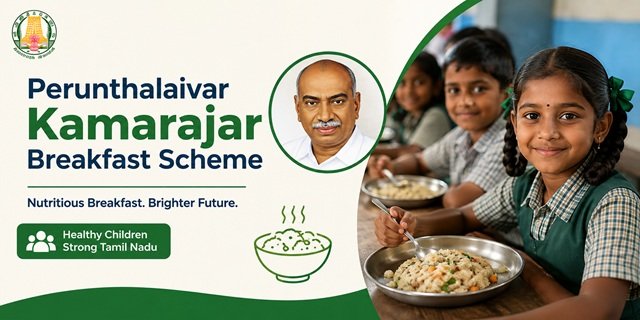
Perunthalaivar Kamarajar Breakfast Scheme is a flagship nutrition initiative of the Government of Tamil Nadu that provides free hot cooked breakfast to students studying in government and government-aided schools. Originally launched on 15 September 2022 as the Chief Minister’s Breakfast Scheme, it was renamed on 15 July 2026 in honour of former Chief Minister Perunthalaivar K. Kamaraj. The scheme currently covers students from Classes 1 to 5 and has been expanded to Classes 6 to 8 from 17 September 2026, taking total coverage to nearly 34.48 lakh students across Tamil Nadu.
Tamil Nadu Perunthalaivar Kamarajar Breakfast Scheme Highlights | |
|---|---|
| Scheme Name | Perunthalaivar Kamarajar Breakfast Scheme (Formerly Chief Minister’s Breakfast Scheme) |
| Original Launch Date | 15 September 2022 |
| Renamed On | 15 July 2026 |
| Named After | Perunthalaivar K. Kamaraj |
| Implementing Department | Social Welfare and Women Empowerment Department, Government of Tamil Nadu |
| Implementing Agency | Tamil Nadu Corporation for Development of Women (TNCDW) |
| Implementation Support | Local Self-Help Groups (SHGs) |
| Objective | Provide free nutritious breakfast to school children and improve attendance, nutrition, and learning outcomes |
| Current Coverage | Classes 1 to 5 |
| Expanded Coverage | Classes 6 to 8 from 17 September 2026 |
| Current Beneficiaries | 19,34,230 students across 37,447 schools |
| Additional Beneficiaries Under Expansion | 15,14,274 students across 15,414 schools |
| Total Beneficiaries After Expansion | Approximately 34.48 lakh students |
| Breakfast Quantity | 150–200 grams per student |
| Nutritional Value | Approximately 293 calories, 9.85 grams protein, and 5.91 grams fat |
| Menu Components | Upma, Khichdi, Pongal, Kesari and other approved breakfast items |
| Millet Inclusion | At least twice every week |
| Average Cost Per Student | Approximately Rs. 12.71 per breakfast |
| Funding Pattern | 100% funded by the Government of Tamil Nadu |
| Budget Allocation (2026-27) | Rs. 710 crore |
| Expansion Allocation | Rs. 343.55 crore |
| Current Year Sanction | Rs. 217.63 crore |
| Eligibility | Students studying in Classes 1 to 8 in government and government-aided schools |
| Income Limit | No income ceiling |
| Caste Restriction | None |
| Application Process | No application or registration required |
| Food Preparation | Prepared by trained women SHG members |
| Food Delivery Time | Before 7:30 AM on school working days |
| Serving Time | Before commencement of classes |
| Cooking Infrastructure | 116 cooking sheds constructed across 112 schools in Chennai and Chengalpattu areas |
| Official Website | tnsocialwelfare.tn.gov.in |
| Scheme Page | View Official Details |
| Helpline Number | 044-24310126 |
| Department Address | Social Welfare and Women Empowerment Department, Secretariat, Chennai – 600009 |
Introduction of Tamil Nadu Perunthalaivar Kamarajar Breakfast Scheme: A Brief Insight
Every morning, thousands of children across Tamil Nadu begin their school day before sunrise. For many families, especially those facing financial challenges, ensuring a nutritious meal before school is not always possible. Studies conducted by the state highlighted concerns regarding malnutrition among young children, while teachers observed that hunger often affected classroom concentration, attendance, and overall learning outcomes.
To address this challenge directly, the Government of Tamil Nadu launched the Chief Minister’s Breakfast Scheme on 15 September 2022 at Madurai, initially covering 1,545 government schools. Later, on 15 July 2026, the scheme was renamed the Perunthalaivar Kamarajar Breakfast Scheme in honour of former Chief Minister K. Kamaraj, whose vision transformed school education and student welfare in Tamil Nadu.
The scheme is implemented by the Social Welfare and Women Empowerment Department, Government of Tamil Nadu with support from the Tamil Nadu Corporation for Development of Women and local Self-Help Groups. Its primary objective is to ensure that children do not attend classes on an empty stomach, thereby improving attendance, reducing dropouts, encouraging enrolment, and supporting the nutritional requirements of school-going children. By serving a hot cooked breakfast before classes begin, the state aims to create a healthier and more productive learning environment for students.
Under the scheme, students receive a nutritious breakfast prepared using cereals, pulses, vegetables, and locally available ingredients, including millets. At present, children studying in Classes 1 to 5 receive breakfast every school working day. The meal provides approximately 293 calories and 9.85 grams of protein per child. The weekly menu includes different varieties of upma, khichdi, pongal, and sweet dishes to ensure dietary diversity. The scheme currently benefits around 19.34 lakh students studying in 37,447 government and government-aided schools.
The programme witnessed a major expansion from 17 September 2026, when coverage was extended to students studying in Classes 6 to 8. This expansion added approximately 15.14 lakh students from 15,414 schools, taking the total number of beneficiaries to nearly 34.48 lakh students across Tamil Nadu. To support the expanded coverage, the Government of Tamil Nadu allocated Rs. 710 crore under the Revised Budget Estimates for 2026-27.
One of the biggest advantages of this scheme is its universal nature. Every child studying in the covered classes of a government or government-aided school automatically receives breakfast. There is no income limit, no caste-based eligibility condition, and no registration process. Parents do not need to submit any application form or documents. Schools maintain attendance and student strength records, while Self-Help Group members handle the preparation and serving of meals under departmental supervision.
Parents whose children are studying in government schools can also explore the Tamil Nadu Nutritious Meal Programme, which provides cooked midday meals during school hours and complements the breakfast initiative. Likewise, the PM POSHAN Scheme supports nutritional assistance for school students across the country and works alongside state-level nutrition programmes.
Students, parents, and citizens interested in education, nutrition, and welfare initiatives can explore more programmes through our dedicated Tamil Nadu Government Welfare Schemes section.
Benefits Provided to Eligible Beneficiaries
The Social Welfare and Women Empowerment Department, Government of Tamil Nadu provides the following benefits to students under the Perunthalaivar Kamarajar Breakfast Scheme:
Free Nutritious Breakfast
- Free hot cooked breakfast on every school working day
- Breakfast served to students of Classes 1 to 8 before regular classes begin
- Portion size ranging between 150 grams and 200 grams per child
- Each meal contains cereals, dal, and vegetable sambar to ensure balanced nutrition
- Locally available millets included in the menu at least twice every week
- Government spends approximately Rs. 12.71 per child per day on breakfast
- Food supplied to schools by around 7:30 AM for timely serving
Nutritional Support Provided
- Approximately 293 calories per child per day
- Approximately 9.85 grams of protein per serving
- Approximately 5.91 grams of fat per serving
- Iron and calcium-rich ingredients included to support healthy growth
- Helps address malnutrition and anaemia among school-going children
Weekly Breakfast Menu
| Day | Breakfast Menu |
|---|---|
| Monday | Rava Upma, Vermicelli Upma, Rice Upma, or Wheat Rava Upma with Vegetable Sambar |
| Tuesday | Rava Vegetable Khichdi, Vermicelli Vegetable Khichdi, Sorghum Vegetable Khichdi, or Wheat Rava Vegetable Khichdi |
| Wednesday | Rava Pongal or Ven Pongal with Vegetable Sambar |
| Thursday | Vermicelli Upma, Rice Upma, Rava Upma, or Wheat Rava Upma with Vegetable Sambar |
| Friday | Sweet Pongal, Rava Kesari, or Semiya Kesari |
A total of 13 approved breakfast items are included in the scheme menu, allowing schools to rotate meals throughout the week.
Educational Benefits
- Encourages students to attend school regularly
- Helps children start the school day with adequate nutrition
- Improves concentration and classroom participation
- Supports better learning outcomes among young students
- Reduces the risk of students attending school on an empty stomach
Benefits for Women Self-Help Groups
- Employment opportunities created for local Self-Help Group (SHG) women
- SHG members engaged for cooking and serving breakfast in schools
- Mandatory food safety and cooking skills training provided
- Regular livelihood opportunities generated for women in rural and urban areas
Infrastructure Support
- 116 cooking sheds constructed across 112 schools in Chennai and Chengalpattu Corporation areas
- Additional cooking shed construction planned in remaining schools
- Food supply arrangements made through long-term procurement contracts
Positive Impact of the Scheme
- School attendance increased by approximately 10% to 30%
- Improvement in students’ learning and recall abilities reported
- Reduction in school dropout rates among vulnerable children
- Strengthens nutritional security for lakhs of school-going students
Scheme Coverage
- Approximately 34.48 lakh students covered after expansion to Classes 6 to 8
- Implemented in government and government-aided schools across Tamil Nadu
- Rs. 710 crore allocated under the Revised Budget Estimates 2026-27
- Scheme fully funded by the Government of Tamil Nadu
Eligibility Conditions Required to be Fulfilled
The Social Welfare and Women Empowerment Department, Government of Tamil Nadu has prescribed the following eligibility conditions for availing benefits under the Perunthalaivar Kamarajar Breakfast Scheme.
Eligibility for Students
- Must be studying in Classes 1 to 8.
- Must be enrolled in a Government School or Government-Aided School in Tamil Nadu.
- Must be present in school on the day breakfast is served.
- No income limit applies.
- No caste, religion, or community-based restriction applies.
- No separate application or registration is required.
Coverage Under the Scheme
- Classes 1 to 5 – approximately 19,34,230 students studying in 37,447 Government and Government-Aided Schools.
- Classes 6 to 8 – covered from 17 September 2026 – approximately 15,14,274 students studying in 15,414 schools.
- Total beneficiaries after expansion – approximately 34.48 lakh students.
Eligibility Conditions for SHG Members Engaged in Cooking and Serving
- Minimum 3 years of experience in a Self-Help Group (SHG).
- Must reside in the same village or town panchayat where the school is located.
- Should possess basic food preparation skills.
- Children should be studying in the same school.
- Minimum educational qualification of Class 10 (relaxation up to Class 8 in hilly, remote, and tribal areas).
- Must possess an internet-enabled Android mobile phone.
- Should have a satisfactory loan repayment record.
- Must complete prescribed cooking and food safety training.
Who Is Not Eligible
- Students studying in private unaided schools.
- Students studying in classes other than Classes 1 to 8.
- Students absent on the day breakfast is served.
Documents Required to be Attached
Under the Perunthalaivar Kamarajar Breakfast Scheme, parents are not required to submit any application form or documents. All eligible students enrolled in government and government-aided schools automatically receive breakfast under the scheme. However, schools maintain certain records for smooth implementation and monitoring.
- Student enrolment records maintained by the school
- Daily attendance register for calculating breakfast requirements
- Student strength reports submitted for allocation of food materials
Documents Required for SHG Members Engaged in Cooking and Serving
Women belonging to eligible Self-Help Groups (SHGs) who wish to participate in cooking and serving breakfast under the scheme may be required to submit the following documents:
- SHG Membership Certificate
- Residential Proof
- Educational Qualification Certificate
- School Enrolment Proof of Children Studying in the Same School
- Bank Loan Repayment Record
- Aadhaar Card
- Bank Account Details
- Proof of Internet-Enabled Android Mobile Phone
Note: Students and parents are not required to submit any documents, complete any registration, or fill out any application form to receive benefits under the scheme. Admission in an eligible government or government-aided school is sufficient for availing breakfast. The meal is served and consumed within the school premises on the same day and cannot be taken outside the school.
How Beneficiaries Can Avail the Benefit of this Scheme
The Perunthalaivar Kamarajar Breakfast Scheme does not require any application form, registration, or approval process. Every eligible student studying in a covered school automatically receives breakfast under the scheme. The benefit reaches students through the school system itself. The complete process is explained below:
Step 1: Take Admission in an Eligible School
A child must be enrolled in a government school or government-aided school in Tamil Nadu and study in Classes 1 to 8. No separate application is required for the breakfast scheme. Admission to an eligible school automatically makes the student a beneficiary.
Step 2: Student Details Are Maintained by the School
The school headmaster maintains enrolment records, attendance registers, and daily student strength reports. These records help the authorities estimate the quantity of breakfast required and ensure that every eligible student receives the meal regularly.
Step 3: Allocation of Food Materials
Based on the student strength reported by the school, food materials such as rice, rava, wheat, millets, dal, vegetables, and other ingredients are supplied. The allocation is made according to the number of students expected to attend school on a particular day.
Step 4: Preparation of Breakfast by Self-Help Groups
Women belonging to local Self-Help Groups (SHGs) prepare the breakfast under the scheme. These SHG members receive cooking skills training and food safety training before undertaking meal preparation responsibilities. The breakfast is prepared fresh every morning according to the approved weekly menu.
Step 5: Delivery and Quality Verification
The breakfast is supplied to schools by around 7:30 AM. Before distribution, designated teachers, School Management Committee representatives, and concerned officials verify the quality, hygiene, and safety of the food. Regular inspections are also conducted to maintain prescribed standards.
Step 6: Breakfast Served to Students
Eligible students receive a hot cooked breakfast of approximately 150 to 200 grams before classroom teaching begins. The meal is served within the school premises and must be consumed on the same day. Breakfast is not provided separately to students who remain absent from school.
Expansion to Classes 6 to 8
The Government of Tamil Nadu expanded the scheme to cover students studying in Classes 6 to 8 from 17 September 2026. Students in these classes also receive the benefit automatically through their schools without completing any separate registration process.
What Parents Should Do If Breakfast Is Not Being Provided
If an eligible student is not receiving breakfast under the scheme, parents may take the following steps:
- Contact the School Headmaster and report the issue
- Raise the matter before the School Management Committee (SMC)
- Approach the concerned Elementary Education Officer
- Contact the District Collector’s Office for district-level intervention
- In Chennai, approach the Greater Chennai Corporation authorities responsible for implementation
- Seek assistance from the Social Welfare and Women Empowerment Department through the official helpline
How Women Can Participate as Cooks and Helpers
Women interested in working under the scheme should contact their local Self-Help Group or the Tamil Nadu Corporation for Development of Women. Eligible SHG members are selected as per government norms and receive necessary training before deployment in schools.
Parents can obtain the latest information regarding the Perunthalaivar Kamarajar Breakfast Scheme through their child’s school or by visiting the official website of the Social Welfare and Women Empowerment Department at tnsocialwelfare.tn.gov.in.
Important Links Available
- Social Welfare and Women Empowerment Department
- Perunthalaivar Kamarajar Breakfast Scheme
- Perunthalaivar Kamarajar Breakfast Scheme (Tamil)
- Government of Tamil Nadu
Contact Details in Case of Help Needed
- Department: Social Welfare and Women Empowerment Department, Government of Tamil Nadu
- Address: Secretariat, Chennai, Tamil Nadu – 600009
- Helpline: 044-24310126
- Implementing Agency: Tamil Nadu Corporation for Development of Women (TNCDW)
- Official Website: tnsocialwelfare.tn.gov.in
- School Level Assistance: School Headmaster / Headmistress
- Committee Level Assistance: School Management Committee (SMC)
- Block Level Assistance: Elementary Education Officer (EEO)
- Chennai Region: Greater Chennai Corporation
- District Level Assistance: District Collector Office
Frequently Asked Questions (FAQs)
Q. What is the Perunthalaivar Kamarajar Breakfast Scheme?
Ans. The Perunthalaivar Kamarajar Breakfast Scheme is a flagship nutrition programme of the Government of Tamil Nadu that provides free hot cooked breakfast to students studying in government and government-aided schools. The scheme was renamed on 15 July 2026 in honour of former Chief Minister Perunthalaivar K. Kamaraj.
Q. When was the scheme launched?
Ans. The scheme was originally launched as the Chief Minister’s Breakfast Scheme on 15 September 2022 in Madurai. It was subsequently expanded in phases and now covers students from Classes 1 to 8.
Q. Who can get the benefit of this scheme?
Ans. Students studying in Classes 1 to 8 in government schools and government-aided schools of Tamil Nadu are eligible to receive breakfast under the scheme.
Q. Is any application form required for this scheme?
Ans. No. Students do not need to submit any application form, registration form, income certificate, caste certificate, or any other document. Admission in an eligible school is sufficient.
Q. Is there any income limit for receiving breakfast?
Ans. No. The scheme is implemented on a universal basis in covered schools. Students receive the benefit irrespective of family income, caste, religion, or social category.
Q. How many students are covered under the scheme?
Ans. After the expansion to Classes 6 to 8, approximately 34.48 lakh students studying in government and government-aided schools across Tamil Nadu are expected to benefit from the scheme.
Q. When did students of Classes 6 to 8 become eligible?
Ans. The Government of Tamil Nadu expanded the scheme to students of Classes 6 to 8 from 17 September 2026.
Q. What type of breakfast is served under the scheme?
Ans. Students receive freshly prepared hot breakfast items such as Upma, Khichdi, Pongal, Kesari, and other approved menu items along with vegetable-based preparations as per the weekly menu prescribed by the government.
Q. Are millets included in the breakfast menu?
Ans. Yes. Locally available millets are included in the breakfast menu at least twice every week to improve nutritional value and encourage healthy eating habits.
Q. What is the nutritional value of the breakfast?
Ans. Each breakfast serving provides approximately 293 calories, 9.85 grams of protein, and 5.91 grams of fat, along with essential nutrients such as iron and calcium.
Q. How much breakfast is provided to each student?
Ans. Each eligible student receives approximately 150 to 200 grams of hot cooked breakfast on every school working day.
Q. Who prepares and serves the breakfast?
Ans. Women belonging to local Self-Help Groups (SHGs) prepare and serve the breakfast after receiving necessary cooking and food safety training.
Q. Can students take the breakfast home?
Ans. No. The breakfast must be consumed within the school premises on the day it is served. It cannot be taken home or claimed later.
Q. What happens if a student is absent from school?
Ans. Students who remain absent on a particular day do not receive breakfast for that day. The benefit is available only on days when the student attends school.
Q. Are private school students covered under the scheme?
Ans. No. The scheme covers only students studying in government schools and government-aided schools. Students enrolled in private unaided schools are not eligible.
Q. How much budget has been allocated for the scheme?
Ans. The Government of Tamil Nadu has allocated approximately Rs. 710 crore under the Revised Budget Estimates for 2026-27 for implementation and expansion of the scheme.
Q. Has the scheme improved school attendance?
Ans. Yes. Government assessments have reported a noticeable increase in school attendance and improvements in classroom participation and learning outcomes after the implementation of the breakfast programme.
Q. What should parents do if breakfast is not being provided in a covered school?
Ans. Parents should first contact the school headmaster. If the issue remains unresolved, they may approach the School Management Committee (SMC), Elementary Education Officer, District Collector’s Office, or the concerned department helpline.
Q. How can women join as cooks or helpers under this scheme?
Ans. Eligible women can apply through their local Self-Help Group and the Tamil Nadu Corporation for Development of Women. Selection is carried out as per the eligibility conditions prescribed by the government.
Q. Where can I get official information about the scheme?
Ans. Beneficiaries can visit tnsocialwelfare.tn.gov.in or contact the department helpline at 044-24310126 for the latest updates and official information.

Tabassum is a government schemes researcher and writer with 5 years of experience tracking Central and State welfare scheme programmes across India. She has covered 500+ schemes spanning agriculture, women welfare, education, and housing, helping lakhs of beneficiaries understand their entitlements in simple language.