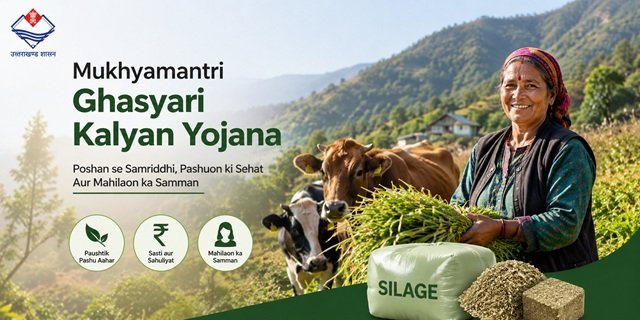
Mukhyamantri Ghasyari Kalyan Yojana is a scheme launched by the Government of Uttarakhand on 1 November 2021 that provides subsidised nutritious fodder, including silage and Total Mixed Ration (TMR) at approximately Rs. 2.75 per kg to livestock owners in hilly rural areas, along with a free Ghasyari Kit to eligible women from animal husbandry families. Visit cooperative.uk.gov.in for more details.
Uttarakhand Mukhyamantri Ghasyari Kalyan Yojana Highlights | |
|---|---|
| Scheme Name | Mukhyamantri Ghasyari Kalyan Yojana (MGKY) |
| Cabinet Approval | 25 February 2021 |
| Official Launch Date | 1 November 2021 |
| Launched By | Union Home Minister Amit Shah and CM Pushkar Singh Dhami |
| Nodal Department | Cooperative Department, Government of Uttarakhand |
| Target Beneficiaries | Livestock owners, dairy farmers, and women from animal husbandry families in hilly rural areas |
| Benefit 1 | Free Ghasyari Kit worth approximately Rs. 1,500 per eligible woman |
| Kit Contents | 2 Hoe, 2 Sickles, 1 Water Bottle, 1 Food Tiffin |
| Benefit 2 | Subsidised silage, TMR, and fodder blocks at approximately Rs. 2.75 per kg |
| Government Subsidy | 75% subsidy on silage sale price |
| Distribution Centres | 7,771 cooperative centres across hilly rural villages |
| Budget Approved | Rs. 16.78 crore |
| MPACS Computerised | 670 Multi-Purpose Primary Agricultural Credit Cooperative Societies |
| Official Portal | cooperative.uk.gov.in |
Introduction of Uttarakhand Mukhyamantri Ghasyari Kalyan Yojana: A Brief Insight
In the hilly regions of Uttarakhand, women called “Ghasyaari” spend several hours every day walking through steep forests and dangerous terrain to collect grass for their cattle. This exhausting daily task leaves them with little time for anything else, exposes them to wildlife risks, and still does not guarantee nutritious fodder for their animals. Due to the lack of quality feed, milk production stays low and farmers lose interest in animal husbandry. To solve both these problems at once, the Government of Uttarakhand launched the Mukhyamantri Ghasyari Kalyan Yojana.
The Cabinet Committee, headed by then Chief Minister Trivendra Singh Rawat, approved the scheme on 25 February 2021. Union Home Minister Amit Shah and Chief Minister Pushkar Singh Dhami officially launched it on 1 November 2021, Uttarakhand Foundation Day in Dehradun. The Cooperative Department, Government of Uttarakhand, implements the scheme through a network of cooperative societies across the hilly districts of the state.
The scheme provides two benefits. First, every eligible woman from an animal husbandry family receives a free Ghasyari Kit worth approximately Rs. 1,500 containing hoes, sickles, a water bottle, and a tiffin. Second, the government supplies subsidised packed silage, Total Mixed Ration (TMR), and fodder blocks through 7,771 cooperative centres near beneficiaries’ villages at approximately Rs. 2.75 per kg, made possible by a 75% government subsidy on the actual fodder cost.
With nutritious silage and TMR delivered at their doorstep, cattle owners no longer need to walk through forests for hours. Their animals receive better feed, producing more milk, and their daily income from dairy farming improves significantly. The state government allocated Rs. 16.78 crore for the scheme and also computerised all 670 Multi-Purpose Primary Agricultural Credit Cooperative Societies (MPACS) to strengthen implementation.
Women in Uttarakhand who want to know about other state government support available to them can also explore the Mukhyamantri Mahalaxmi Kit Yojana, which provides a free kit of essential items to mothers at the time of institutional delivery in government hospitals across the state. Women who engage in self-employment and want financial support can check the Mukhyamantri Swarozgar Yojana, which provides subsidised loans to youth and entrepreneurs to set up their own business in Uttarakhand.
Livestock owners, dairy farmers, and anyone looking for more welfare and livelihood schemes available under the Uttarakhand Government can explore all available programmes on our Uttarakhand Government Welfare Schemes page.
Benefits Provided to Eligible Beneficiaries
The Cooperative Department, Government of Uttarakhand, provides the following two distinct benefits to eligible livestock owners and dairy farming women under the Mukhyamantri Ghasyari Kalyan Yojana:
Benefit 1 – Free Ghasyari Kit
Every eligible woman from an animal husbandry family receives a free Ghasyari Kit worth approximately Rs. 1,500 containing the following items:
- 2 Hoe (Kudal) for cutting grass and fodder
- 2 Sickles (Daranti) for harvesting fodder
- 1 Water bottle for daily forest and field work
- 1 Food tiffin (lunch box) for carrying meals during fieldwork
Benefit 2 – Subsidised Nutritious Fodder
- Packed Silage prepared from green maize and nutritious ingredients provided at subsidised rates
- Total Mixed Ration (TMR) and fodder blocks are provided to livestock farmers
- The government provides 75% subsidy on the silage sale price
- Beneficiaries receive subsidised fodder at approximately Rs. 2.75 per kg at their doorstep
- Fodder is supplied through 7,771 cooperative centres across hilly villages, no need to travel far
- State government facilitates cooperative cultivation of maize for the production of silage and TMR
- Annual budget of Rs. 16.78 crore approved for implementation of the scheme
Eligibility Conditions Required to be Fulfilled
The Cooperative Department, Government of Uttarakhand, has designed the Mukhyamantri Ghasyari Kalyan Yojana primarily for livestock owners and dairy farmers living in the hilly rural areas of the state. The following conditions must be fulfilled to avail the benefits of the scheme:
- The applicant must be a permanent resident of Uttarakhand
- The applicant must be a livestock owner or dairy farmer maintaining cattle in rural areas
- The applicant must reside in a mountainous or hilly rural area of Uttarakhand
- Women belonging to animal husbandry families in hilly areas are the primary target beneficiaries
Who Is Not Eligible
- Residents of urban areas not engaged in livestock rearing
- Applicants who do not own or maintain cattle or milk animals
- Non-residents of Uttarakhand
Documents Required to be Attached
No officially notified document list has been published for the Mukhyamantri Ghasyari Kalyan Yojana. Beneficiaries should contact their nearest cooperative society or District Cooperative Department office to confirm the exact documents required at the time of enrolment. The following documents may generally be required during verification:
- Aadhaar Card of the applicant
- Residence proof confirming Uttarakhand residency
- Ration Card
- Passport-sized photograph
- Bank account details with account number and IFSC code
- Mobile number
- Livestock-related details as may be required by the local cooperative office
How Beneficiaries Can Apply to Avail the Benefit of this Scheme
No dedicated online application portal has been officially confirmed for the Mukhyamantri Ghasyari Kalyan Yojana. The scheme operates through the Cooperative Department’s network of cooperative societies and distribution centres across the hilly areas of Uttarakhand. Eligible beneficiaries must contact their nearest cooperative society or District Cooperative Department office to enrol and avail the benefits of the scheme.
Step 1: Identify your nearest cooperative society or Multi-Purpose Primary Agricultural Credit Cooperative Society (MPACS) in your village or block. The scheme distributes subsidised fodder through 7,771 cooperative centres spread across hilly rural areas of Uttarakhand.
Step 2: Visit the cooperative society and inform the officials that you want to register under the Mukhyamantri Ghasyari Kalyan Yojana. Carry your Aadhaar Card, residence proof, Ration Card, bank passbook, and passport-size photograph for verification.
Step 3: The cooperative society staff will verify your eligibility as a livestock owner or dairy farmer residing in a hilly rural area of Uttarakhand. Provide livestock-related details as may be required by the local cooperative office.
Step 4: After verification, the cooperative society will register your name as a beneficiary under the scheme. Eligible women from animal husbandry families will receive the free Ghasyari Kit after registration.
Step 5: After registration, collect subsidised silage, Total Mixed Ration (TMR), and fodder blocks from your nearest cooperative centre at the subsidised rate of approximately Rs. 2.75 per kg at your doorstep. No need to travel to distant forests for fodder collection once you are registered under the scheme.
Important: Enrolment procedures and distribution schedules may vary from district to district depending on local cooperative society guidelines. For the most current information on registration and fodder availability in your area, visit the Cooperative Department, Uttarakhand official portal or contact your District Cooperative Department office directly.
Important Links Available
- Cooperative Department, Government of Uttarakhand Official Portal
- State Government Schemes – Cooperative Department, Uttarakhand
- Government of Uttarakhand Official Portal
Contact Details in Case of Help Needed
- Office: Office of the Registrar, Cooperative Societies, Cooperative Department, Government of Uttarakhand, Dehradun, Uttarakhand
Important: For scheme-related queries, enrolment information, and fodder distribution details, contact your nearest District Cooperative Department office or local cooperative society directly. Visit cooperative.uk.gov.in for district-wise contact details.
Frequently Asked Questions (FAQs)
Q. What is Mukhyamantri Ghasyari Kalyan Yojana?
Ans. Mukhyamantri Ghasyari Kalyan Yojana is a scheme launched by the Government of Uttarakhand on 1 November 2021 under the Cooperative Department. It provides subsidised nutritious fodder, including silage, Total Mixed Ration (TMR), and fodder blocks to livestock owners and dairy farmers in hilly rural areas of the state. The scheme also provides a free Ghasyari Kit to eligible women from animal husbandry families to reduce their daily burden of collecting fodder from forests.
Q. What does “Ghasyari” mean?
Ans. In Uttarakhand’s regional language, a “Ghasyari” refers to a woman who collects grass and fodder for livestock from forests and hillsides. These women travel long distances through difficult and often dangerous terrain daily to collect fodder for their cattle. The scheme is named after them to honour their hard work and provide them with direct relief.
Q. Who can get subsidised fodder under the scheme?
Ans. Permanent residents of Uttarakhand who own livestock or maintain cattle in rural hilly areas of the state are eligible. Women belonging to animal husbandry families in mountainous regions are the primary target beneficiaries of the scheme.
Q. What is the subsidy available under the scheme?
Ans. The Government of Uttarakhand provides a 75% subsidy on the silage sale price under the scheme. As a result, eligible beneficiaries receive subsidised fodder at approximately Rs. 2.75 per kg delivered at their doorstep through cooperative centres.
Q. What is silage?
Ans. Silage is a nutritious animal feed prepared by fermenting green maize and other nutritious ingredients. It is a high-quality fodder that significantly improves cattle health, milk production, and overall livestock productivity compared to dry or unprocessed grass.
Q. What is Total Mixed Ration (TMR)?
Ans. Total Mixed Ration (TMR) is a scientifically balanced cattle feed that combines all the nutrients a milk animal needs in a single mixture. It includes energy sources, proteins, minerals, and vitamins in the right proportions to improve cattle health and maximise milk yield.
Q. What items does the free Ghasyari Kit contain?
Ans. The free Ghasyari Kit provided to eligible women under the scheme contains 2 hoes (kudal), 2 sickles (daranti), 1 water bottle, and 1 food tiffin. The kit is worth approximately Rs. 1,500 and helps women manage their daily fodder collection and field work more efficiently.
Q. How does the scheme help women in hill areas?
Ans. Before this scheme, women in hilly areas had to travel long distances through forests and dangerous terrain daily to collect grass for their cattle. The scheme delivers ready-to-use nutritious fodder directly through cooperative centres near their villages, saving several hours of daily labour, reducing physical hardship, and eliminating the risk of injury or wildlife encounters during forest visits.
Q. How does the scheme increase farmers’ income?
Ans. Nutritious silage and TMR significantly improve cattle health and milk production. Higher milk yield means more income for dairy farming families. Additionally, the 75% subsidy reduces fodder expenses considerably, directly improving the net income of livestock owners in hilly areas.
Q. Through how many centres is fodder distributed under the scheme?
Ans. Subsidised fodder is distributed through 7,771 cooperative centres spread across hilly rural villages of Uttarakhand. These centres ensure that beneficiaries can access nutritious fodder near their homes without travelling to distant locations.
Q. Which department implements the Mukhyamantri Ghasyari Kalyan Yojana?
Ans. The Cooperative Department, Government of Uttarakhand, implements the Mukhyamantri Ghasyari Kalyan Yojana. The scheme runs through the network of Multi-Purpose Primary Agricultural Credit Cooperative Societies (MPACS) and cooperative centres across hilly districts of the state.
Q. Is online registration available for the scheme?
Ans. No dedicated online application portal has been officially confirmed for this scheme. Eligible beneficiaries must contact their nearest cooperative society or District Cooperative Department office to enrol and avail the benefits. Visit cooperative.uk.gov.in for further information.
Q. Can dairy farmers also apply under the scheme?
Ans. Yes. The scheme covers all livestock owners and dairy farmers residing in hilly rural areas of Uttarakhand. Any permanent resident of Uttarakhand who owns cattle and lives in a mountainous rural area can contact the nearest cooperative society to enrol under the scheme.

Tabassum is a government schemes researcher and writer with 5 years of experience tracking Central and State welfare scheme programmes across India. She has covered 500+ schemes spanning agriculture, women welfare, education, and housing, helping lakhs of beneficiaries understand their entitlements in simple language.