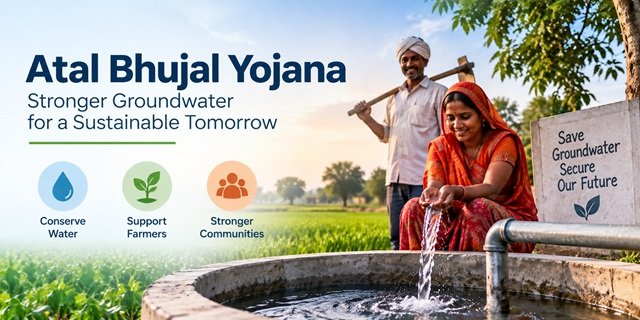
Atal Bhujal Yojana (Atal Jal) is a community-driven groundwater management programme implemented by the Ministry of Jal Shakti. The scheme covers 8,203 water-stressed Gram Panchayats across 7 states and promotes sustainable groundwater use through Water Security Plans, community participation, and water conservation measures. There is no individual application process, as implementation takes place through Gram Panchayats and local water management committees.
Atal Bhujal Yojana Highlights | |
|---|---|
| Scheme Name | Atal Bhujal Yojana (Atal Jal) |
| Launch Date | 25 December 2019 |
| Implementation Period | 2020-21 to 2024-25 (field activities continued up to October 2025) |
| Nodal Ministry | Ministry of Jal Shakti |
| Implementing Department | Department of Water Resources, River Development & Ganga Rejuvenation |
| Objective | Community-led and sustainable groundwater management |
| Total Project Cost | Rs. 6,000 crore |
| Funding Pattern | 50% World Bank assistance and 50% Government of India contribution |
| Covered States | Gujarat, Haryana, Karnataka, Madhya Pradesh, Maharashtra, Rajasthan, and Uttar Pradesh |
| Coverage Area | 8,203 Gram Panchayats across 229 blocks and 80 districts |
| Key Intervention | Preparation of Water Security Plans and promotion of efficient water use |
| Beneficiaries | Rural communities, farmers, women, and local institutions in covered Gram Panchayats |
| Application Process | No individual application required; participation through Gram Panchayats |
| Women’s Participation | Minimum 33% representation in local water management committees |
| Major Achievement | Groundwater improvement recorded in 180 of 229 covered blocks |
| Official Website | jalshakti-dowr.gov.in |
Introduction of Atal Bhujal Yojana: A Brief Insight
Across many parts of rural India, groundwater levels have been declining year after year, creating serious challenges for both farming and drinking water availability. Instead of focusing only on building new water infrastructure, the Government of India introduced Atal Bhujal Yojana on 25 December 2019, the 95th birth anniversary of former Prime Minister Atal Bihari Vajpayee.
The scheme is implemented by the Ministry of Jal Shakti, Department of Water Resources, River Development & Ganga Rejuvenation. Its core objective is to promote sustainable groundwater management through active community participation, local planning, and scientific water-use practices.
Unlike most government schemes that target individual beneficiaries, Atal Bhujal Yojana focuses on entire villages and communities. The programme covers 8,203 water-stressed Gram Panchayats spread across Gujarat, Haryana, Karnataka, Madhya Pradesh, Maharashtra, Rajasthan, and Uttar Pradesh.
Under the scheme, participating Gram Panchayats prepare Water Security Plans, monitor groundwater levels, strengthen local water governance, and encourage farmers to adopt water-efficient agricultural practices. These efforts are supported through a total project outlay of Rs. 6,000 crore.
The scheme also promotes better groundwater monitoring through modern equipment, recharge structures, community awareness programmes, and convergence with initiatives such as MGNREGA and PMKSY. The overall goal is to reduce groundwater stress while ensuring long-term water security for rural communities.
There is no individual application process under Atal Bhujal Yojana. Participation takes place through the Gram Panchayat, Water User Association, Village Water and Sanitation Committee, or other local community institutions working under the programme. Residents can contact their Gram Panchayat office or district-level implementation team for guidance.
Rural households benefiting from improved water management can also explore the Har Ghar Nal Yojana under Jal Jeevan Mission, which aims to provide tap water connections to rural homes. Families may also check the benefits available under PM Awas Yojana Gramin and PM Awas Yojana Urban, which support affordable housing across India.
Farmers, rural communities, and readers looking for more water conservation, agriculture, and welfare programmes can explore all available initiatives on our List of Central Government Schemes page.
Benefits Provided to Eligible Beneficiaries
Unlike traditional welfare schemes that provide direct financial assistance to individuals, Atal Bhujal Yojana focuses on strengthening groundwater management at the community level. The scheme supports villages, farmers, and local institutions through funding, infrastructure, technology, and capacity-building measures aimed at improving long-term water security.
Major Financial Support Under the Scheme
- Total project outlay of Rs. 6,000 crore
- Rs. 3,000 crore financed through World Bank assistance
- Rs. 3,000 crore contributed by the Government of India
- Rs. 1,400 crore allocated for institutional strengthening, training, monitoring systems, and capacity building
- Rs. 4,600 crore earmarked as performance-based incentives for participating states
Support for Better Groundwater Management
- Preparation of community-led Water Security Plans at the Gram Panchayat level
- Public access to groundwater monitoring and water resource data
- Promotion of scientific water budgeting and local water planning
- Strengthening of village-level water governance institutions
- Convergence with schemes such as MGNREGA and PMKSY for water conservation works
Benefits for Farmers and Rural Communities
- Encouragement of water-efficient irrigation systems such as drip and sprinkler irrigation
- Promotion of crop diversification and sustainable farming practices
- Improved groundwater recharge through water conservation structures
- Better availability of groundwater for irrigation and drinking water needs
- Access to training, awareness programmes, and water management initiatives
Infrastructure and Monitoring Support
- Installation and strengthening of groundwater monitoring systems
- Creation and renovation of recharge structures, including check dams, farm ponds, and recharge shafts
- Deployment of Digital Water Level Recorders, piezometers, and rain gauges
- Improved collection and analysis of groundwater-related data
Women’s Participation and Community Leadership
- Active involvement of women in local water governance committees
- Training programmes for women on water conservation and groundwater management
- Enhanced participation of Self-Help Groups (SHGs) in village-level planning and decision-making
Eligibility Conditions Required to be Fulfilled
Atal Bhujal Yojana does not follow the traditional beneficiary-based eligibility model seen in most government schemes. Instead, eligibility is determined at the Gram Panchayat level, and participation depends on whether a village falls within the notified project area.
- Your Gram Panchayat must be located in one of the seven participating states like Gujarat, Haryana, Karnataka, Madhya Pradesh, Maharashtra, Rajasthan, or Uttar Pradesh
- The Gram Panchayat must be among the 8,203 water-stressed Gram Panchayats identified under the scheme
- Residents, farmers, women, Self-Help Groups (SHGs), and local community organisations within covered villages can participate in scheme activities
- Participation takes place through local institutions such as Water User Associations, Village Water and Sanitation Committees, and Participatory Groundwater Management Committees
Coverage Under Atal Bhujal Yojana
- 7 States Covered: Gujarat, Haryana, Karnataka, Madhya Pradesh, Maharashtra, Rajasthan, and Uttar Pradesh
- 80 Districts Covered
- 229 Blocks/Talukas Covered
- 8,203 Water-Stressed Gram Panchayats Covered
Who Can Benefit
- Farmers dependent on groundwater for irrigation
- Rural households relying on groundwater for drinking water
- Women’s groups and Self-Help Groups involved in water conservation activities
- Local communities participating in village-level water management and planning
No Individual Eligibility Restrictions
- No income limit has been prescribed
- No caste-based eligibility condition applies
- No minimum or maximum age requirement exists
- No individual application or registration is required
Note: Atal Bhujal Yojana is a community-led groundwater management programme. Eligibility is linked to the inclusion of your Gram Panchayat under the scheme, rather than any individual beneficiary criteria.
Documents Required to be Attached
Atal Bhujal Yojana is a community-based groundwater management programme and does not require individual citizens or farmers to submit any application form. Since the scheme is implemented at the Gram Panchayat level, there is generally no separate document requirement for individual participation.
- No individual application form is required
- No Aadhaar Card submission is required for participation under the scheme
- No income certificate is required
- No caste certificate is required
- No land ownership documents are required for general community participation
- No bank account details need to be submitted by individual beneficiaries
Documents Maintained at the Gram Panchayat Level
Although residents do not submit documents individually, Gram Panchayats and local water management committees may maintain records related to scheme implementation and water planning activities.
- Water Security Plans (WSPs)
- Village water budget and groundwater assessment records
- Gram Sabha resolutions related to water conservation activities
- Committee membership and meeting records
- Progress reports of water conservation and recharge works
How Beneficiaries Can Apply to Avail the Benefit of the Scheme
Unlike most government schemes, Atal Bhujal Yojana does not require individuals to submit an application form. The scheme works at the Gram Panchayat level, and people participate through community-led water management activities. Here’s how you can get involved.
Step 1: First, find out whether your village is covered under Atal Bhujal Yojana. The scheme operates in selected Gram Panchayats across Gujarat, Haryana, Karnataka, Madhya Pradesh, Maharashtra, Rajasthan, and Uttar Pradesh. You can confirm this through your Gram Panchayat office.
Step 2: If your village is covered, participation takes place through local bodies such as the Water User Association, Village Water and Sanitation Committee (VWSC), or Participatory Groundwater Management Committee. These groups work on behalf of the entire community.
Step 3: Attend Gram Sabha meetings whenever they are organised. During these meetings, villagers discuss groundwater availability, water usage, and approve the village’s annual Water Security Plan.
Step 4: If you want to contribute more actively, you can volunteer as a Community Resource Person or become part of the local water management committee. The scheme encourages women’s participation, and at least 33% of committee members are required to be women.
Step 5: Farmers can participate by adopting water-saving farming practices promoted under the scheme, such as drip irrigation, sprinkler irrigation, mulching, rainwater conservation, and cultivation of less water-intensive crops.
Step 6: Take part in awareness programmes, training sessions, and village-level activities organised under the scheme. These programmes help residents understand groundwater conservation and sustainable water use.
Important: There is no individual registration, income limit, or personal application process under Atal Bhujal Yojana. Benefits are delivered through the Gram Panchayat and community institutions. If you wish to participate, simply contact your Gram Panchayat office, Village Water Committee, or the local implementation team working in your area.
Important Links Available of the Scheme
- Atal Bhujal Yojana Official Scheme Page, Ministry of Jal Shakti
- Department of Water Resources, River Development & Ganga Rejuvenation
- Central Ground Water Board (CGWB)
Contact Details in Case of Help Needed
- Nodal Ministry: Ministry of Jal Shakti, Department of Water Resources, River Development & Ganga Rejuvenation
- Local Level: Contact your Gram Panchayat office, or the District Implementation Partner (typically an NGO) working in your district
Frequently Asked Questions (FAQs)
Q. What is Atal Bhujal Yojana?
Ans. Atal Bhujal Yojana (Atal Jal) is a Central Sector Scheme launched by the Ministry of Jal Shakti on 25 December 2019. The scheme focuses on improving groundwater management through community participation in water-stressed rural areas.
Q. Which states are covered under Atal Bhujal Yojana?
Ans. The scheme covers selected Gram Panchayats in Gujarat, Haryana, Karnataka, Madhya Pradesh, Maharashtra, Rajasthan, and Uttar Pradesh. Chhattisgarh is not included under the scheme.
Q. Can an individual apply online for Atal Bhujal Yojana?
Ans. No. There is no individual application process. The scheme is implemented at the Gram Panchayat level, and participation takes place through local water committees and community institutions.
Q. What is the total budget of Atal Bhujal Yojana?
Ans. The scheme has a total outlay of Rs. 6,000 crore, comprising Rs. 3,000 crore from the World Bank and Rs. 3,000 crore from the Government of India.
Q. What is a Water Security Plan?
Ans. A Water Security Plan is a village-level plan prepared by the Gram Panchayat after assessing groundwater availability, water usage, and recharge potential. It helps communities manage water resources in a sustainable manner.
Q. How are states rewarded under this scheme?
Ans. Incentive funds are released based on measurable performance indicators such as groundwater data disclosure, preparation of Water Security Plans, adoption of water-saving practices, convergence with other schemes, and improvement in groundwater conditions.
Q. What benefits have been achieved under Atal Bhujal Yojana?
Ans. The scheme has supported the creation and renovation of thousands of groundwater recharge structures, expanded efficient irrigation coverage, strengthened groundwater monitoring, and helped many water-stressed blocks improve groundwater levels.
Q. Is women’s participation important under this scheme?
Ans. Yes. At least 33% of members in local water management committees must be women. The scheme actively promotes women’s involvement in groundwater planning and decision-making.
Q. Is Atal Bhujal Yojana a farmer welfare scheme?
Ans. The scheme is primarily a groundwater management programme. However, farmers benefit through improved water availability, efficient irrigation methods, crop diversification, and better long-term water security.
Q. How can farmers participate in the scheme?
Ans. Farmers can participate by attending Gram Sabha meetings, contributing to Water Security Plans, joining local water committees, and adopting water-efficient agricultural practices promoted under the programme.
Q. Where can I get help regarding Atal Bhujal Yojana?
Ans. You can contact your local Gram Panchayat, Village Water and Sanitation Committee, District Water Resources Office, or the implementation agency working in your district for guidance and information.

Tabassum is a government schemes researcher and writer with 5 years of experience tracking Central and State welfare scheme programmes across India. She has covered 500+ schemes spanning agriculture, women welfare, education, and housing, helping lakhs of beneficiaries understand their entitlements in simple language.