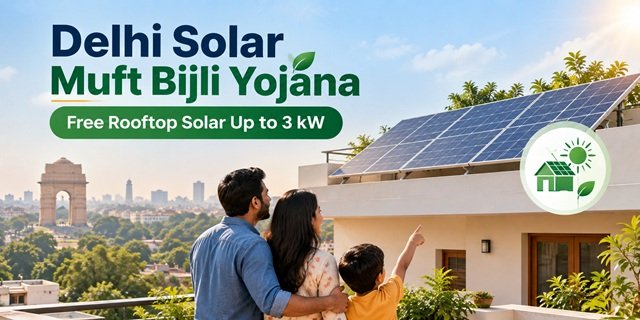
Delhi Solar Muft Bijli Yojana is implemented by the Energy Efficiency and Renewable Energy Management Centre (EEREMC), Department of Power, Government of NCT of Delhi. The scheme helps Delhi households switch to rooftop solar by offering free solar installations for eligible consumers, substantial subsidies, and generation-based incentives. Applications can be submitted online through the Delhi Solar Portal.
Delhi Solar Muft Bijli Yojana Highlights | |
|---|---|
| Scheme Name | Delhi Solar Muft Bijli Yojana |
| Implementing Department | Department of Power, Government of NCT of Delhi |
| Implementing Agency | Energy Efficiency and Renewable Energy Management Centre (EEREMC) |
| Policy Framework | Delhi Solar Energy Policy (Amended) |
| Objective | Promote rooftop solar adoption and expand Delhi’s solar capacity to 750 MW |
| Free Solar Installation | Up to 3 kW for eligible households consuming up to 400 units/month |
| Central Government Subsidy | Up to Rs. 78,000 under PM Surya Ghar Muft Bijli Yojana |
| Delhi Government Support | Additional subsidy and incentives as per applicable category |
| Generation-Based Incentive (GBI) | Up to Rs. 3 per unit generated |
| Eligible Beneficiaries | Residential consumers, Group Housing Societies (GHS), and RWAs |
| DISCOMs Covered | BRPL, BYPL, TPDDL, NDMC, and MES |
| Application Mode | Online through Consumer Consent Form |
| Implementation Basis | First-Come, First-Served |
| Target Coverage | 2.20 lakh rooftop solar installations |
| Scheme Availability | Up to 28 February 2027 (as notified) |
| Official Portal | solar.delhi.gov.in |
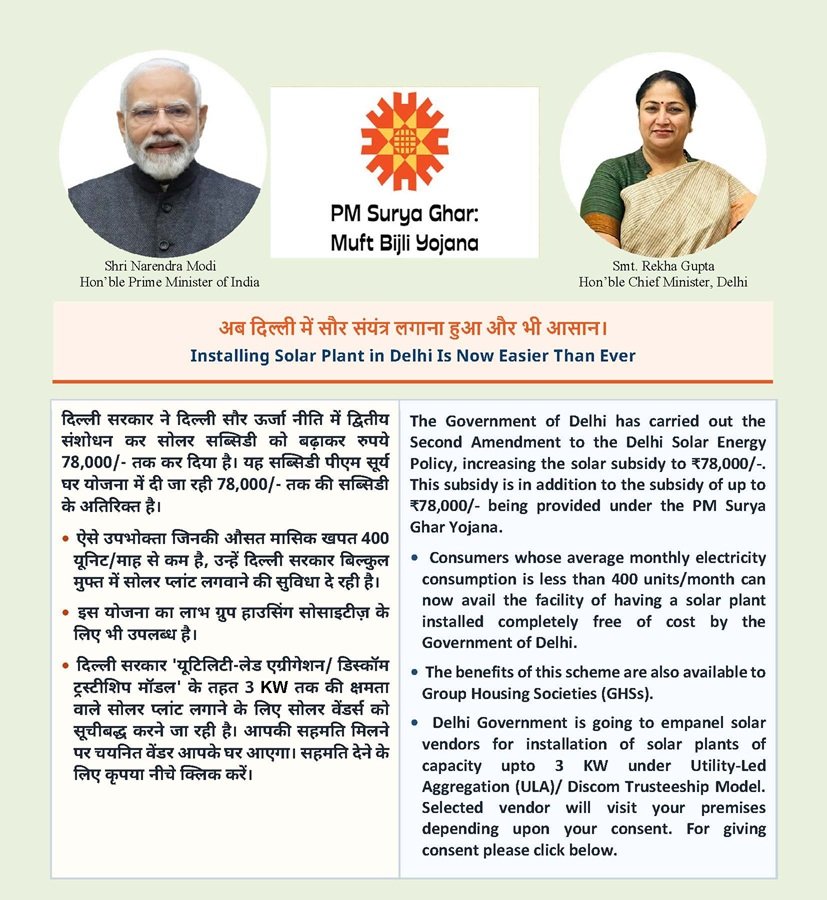
Introduction of Delhi Solar Muft Bijli Yojana: A Brief Insight
For many Delhi families, rooftop solar has always been a smart way to reduce electricity bills. However, the high upfront installation cost often prevented households from taking advantage of solar energy. To remove this barrier and accelerate clean energy adoption, the Government of NCT of Delhi introduced Delhi Solar Muft Bijli Yojana through amendments to the Delhi Solar Energy Policy.
The scheme is implemented by the Energy Efficiency and Renewable Energy Management Centre (EEREMC), Department of Power, Government of NCT of Delhi. Its goal is not only to expand rooftop solar adoption across the city but also to make solar power affordable for ordinary households.
Under this initiative, eligible families consuming less than 400 units of electricity per month can receive a free rooftop solar installation of up to 3 kW capacity. This allows households to generate their own electricity and significantly reduce their monthly power expenses.
Consumers with higher electricity usage can also benefit from the scheme. They can avail substantial financial support through a combination of Central and Delhi Government subsidies. In addition, eligible consumers may receive a Generation-Based Incentive (GBI) of up to Rs. 3 per unit of electricity generated from their rooftop solar system.
The scheme also supports Group Housing Societies and Resident Welfare Associations, helping them install solar systems for common-area electricity consumption and reduce recurring energy costs.
The application process has been kept simple. Interested consumers only need their Consumer Account (CA) Number, DISCOM details, and contact information to submit consent through the official Delhi Solar Portal. After registration, the technical assessment, installation, and subsidy process are handled through the approved implementation framework.
For any assistance related to the scheme, applicants can contact the authorities through the official portal or email delhisolarpolicy@gmail.com.
This Delhi-specific initiative works alongside the Central Government’s PM Surya Ghar Muft Bijli Yojana, which provides nationwide support for residential rooftop solar adoption. Farmers interested in solar-powered irrigation systems can also explore the PM KUSUM Yojana, which promotes solar pumps and renewable energy use in agriculture.
Delhi households, Group Housing Societies, and residents looking for more welfare, energy, and subsidy programmes can explore all available initiatives on our Delhi Government Welfare Schemes List page.
Benefits Provided to Eligible Beneficiaries
Delhi Solar Muft Bijli Yojana offers different benefits based on your household’s average monthly electricity consumption. The lower your electricity usage, the higher the support available under the scheme.
Households Consuming 0-200 Units Per Month
- Free rooftop solar system installation up to 3 kW
- Continued benefit of the existing electricity subsidy available to eligible consumers
- Additional 50% energy-saving incentive under the scheme
- Payment for surplus electricity exported to the grid through net metering, as per applicable APPC rates
- Potential to bring monthly electricity expenses close to zero, depending on actual consumption and solar generation
Households Consuming 201-400 Units Per Month
- Free rooftop solar installation up to 3 kW
- Existing electricity subsidy benefits continue as per applicable government rules
- Significant reduction in monthly electricity bills through solar power generation
- Additional savings through net-metering benefits
Households Consuming More Than 400 Units Per Month
- Enhanced capital subsidy up to Rs. 78,000 from the Delhi Government
- Additional subsidy available under the PM Surya Ghar Muft Bijli Yojana, substantially reducing installation costs
- Long-term savings on electricity bills through rooftop solar generation
- Net-metering facility for adjustment of surplus electricity exported to the grid
Benefits for Group Housing Societies (GHS) and RWAs
- Central subsidy of Rs. 18,000 per kW for common-area solar installations
- Delhi Government subsidy up to Rs. 11,000 per kW
- Financial support available for projects up to 500 kW capacity, subject to prescribed limits
- Facility of Group Net Metering and Virtual Net Metering, wherever permitted
- Reduced common-area electricity expenses for residents
Generation-Based Incentive (GBI)
In addition to installation subsidies, eligible consumers can also receive a Generation-Based Incentive based on the electricity generated by their solar system.
| Consumer Category | GBI Rate |
|---|---|
| Residential Consumers (up to 3 kW) | Rs. 3 per kWh generated |
| Residential Consumers (above 3 kW and up to 10 kW) | Rs. 2 per kWh generated |
| Group Housing Societies / RWAs (up to 500 kW) | Rs. 2 per kWh generated |
| Commercial & Industrial Consumers (first 200 MW deployment) | Rs. 1 per kWh generated |
How the Scheme Can Reduce Your Electricity Bill
A family consuming around 400 units of electricity per month can install a 3 kW rooftop solar system and receive substantial financial support through Central and Delhi Government subsidies. Combined with solar power generation and net metering, the monthly electricity bill can reduce significantly, and in many cases may become negligible.
Important: Actual subsidy amount, electricity savings, incentive payments, and bill reduction depend on your sanctioned system capacity, rooftop suitability, electricity consumption pattern, applicable tariff, and the final project cost approved under the scheme.
Eligibility Conditions Required to be Fulfilled
The Government of NCT of Delhi has designed Delhi Solar Muft Bijli Yojana primarily for residential electricity consumers. Your eligibility and the level of support you receive largely depend on your monthly electricity consumption and the availability of a suitable rooftop for solar installation.
- Must be a residential electricity consumer in Delhi served by BRPL, BYPL, TPDDL, NDMC, or MES
- Must have a valid electricity connection with an active Consumer Account (CA) Number
- Must have adequate and technically feasible rooftop space for solar panel installation
- Group Housing Societies (GHS) and Resident Welfare Associations (RWAs) can also participate for common-area solar projects
Free Rooftop Solar Installation for Eligible Households
Households with an average monthly electricity consumption of up to 400 units are eligible for a free rooftop solar system of up to 3 kW capacity under the Utility Led Aggregation (ULA) model. The installation cost is covered through the scheme’s support framework, helping families reduce their electricity expenses without making an upfront investment.
Benefits Available for Households Consuming More Than 400 Units
Consumers using more than 400 units of electricity per month can also participate in the scheme. While they are not eligible for the completely free installation category, they can avail enhanced financial assistance through a combination of Central and Delhi Government subsidies and pay only the remaining project cost.
Who Is Not Eligible for the Free Installation Category
- Commercial, industrial, or other non-residential electricity consumers
- Households with consumption above 400 units per month seeking the fully free installation benefit
- Applicants whose rooftops do not meet technical feasibility requirements
- Properties where solar installation cannot be approved by the concerned DISCOM or vendor after inspection
Documents Required to be Attached
One of the biggest advantages of Delhi Solar Muft Bijli Yojana is that residents do not need to arrange a large number of documents at the beginning. To register your interest, only a few basic details are required. Additional documents are usually collected later by the empanelled vendor and DISCOM during verification and installation.
Documents and Details Required for Initial Registration
- Consumer Account (CA) Number mentioned on your electricity bill
- Name of your electricity distribution company (DISCOM) – BRPL, BYPL, TPDDL, NDMC, or MES
- Active mobile number for communication and verification
Documents Commonly Required During Verification and Installation
- Latest electricity bill
- Proof of ownership or authorised use of the rooftop
- Aadhaar Card or any valid identity proof
- Bank account details for Direct Benefit Transfer (DBT) of subsidy
- Recent passport-size photograph, if requested by the vendor or DISCOM
How Beneficiaries Can Apply to Avail the Benefit of the Scheme
Applying for Delhi Solar Muft Bijli Yojana is quite simple. Once you submit your consent, the government, DISCOM, and empanelled vendor handle most of the technical process. Follow the steps below carefully.
Step 1: Visit the official Delhi Solar Consumer Consent Portal.
Step 2: Enter your Consumer Account (CA) Number exactly as mentioned on your electricity bill. Also select your electricity provider (BRPL, BYPL, TPDDL, NDMC, or MES) and provide an active mobile number.
Step 3: In the next section, fill in the details of the rooftop solar system you wish to install. Residential consumers can generally register for a system of up to 3 kW capacity under the scheme.
Step 4: Review all details carefully and submit the consent form. This informs your DISCOM that you want to participate in Delhi Solar Muft Bijli Yojana.
Step 5: After submitting your consent, apply for a Net Meter through your DISCOM’s official portal. Net metering is essential because it allows you to send surplus solar electricity back to the grid and receive corresponding benefits.
What Happens After You Submit the Consent Form
Step 1: An empanelled solar vendor, approved by the Government of Delhi and your DISCOM, will contact you and schedule a site visit.
Step 2: During the visit, the vendor will inspect your rooftop, check structural suitability, available space, sunlight exposure, and overall technical feasibility for solar installation.
Step 3: If your rooftop is found suitable, the vendor will install the approved rooftop solar plant and complete all required electrical connections.
Step 4: After installation, your DISCOM will install and activate the Net Meter, enabling your solar system to exchange electricity with the grid.
Step 5: Eligible subsidies and financial benefits are processed according to the applicable implementation model. Depending on your category, the subsidy may be adjusted directly in the project cost or released through the designated payment mechanism.
Important: Delhi Solar Muft Bijli Yojana is being implemented on a first-come, first-served basis. The scheme aims to cover approximately 2.20 lakh rooftop solar installations and is currently scheduled to remain available until 28 February 2027. Applying early improves your chances of securing benefits under the programme. Before registering, you may also review the list of government-approved empanelled vendors to understand who will be responsible for your installation.
ULA Model vs DISCOM Trusteeship Model – What’s the Difference?
While applying for Delhi Solar Muft Bijli Yojana, you may hear about two implementation methods, the Utility Led Aggregation (ULA) Model and the DISCOM Trusteeship Model. Both help consumers install rooftop solar systems, but the way subsidies are handled is different.
Utility Led Aggregation (ULA) Model
- The rooftop solar system is installed through an empanelled vendor selected under the scheme
- Eligible government subsidies are adjusted as part of the project cost itself
- You are generally required to pay only the remaining amount after applicable subsidies are considered
- The process is designed to minimise the upfront financial burden on consumers
- This model is particularly beneficial for households eligible for free or highly subsidised installations
DISCOM Trusteeship Model
- The rooftop solar installation is carried out through an empanelled vendor approved under the scheme
- The Central Government subsidy under PM Surya Ghar Muft Bijli Yojana is processed as per the prescribed mechanism
- The Delhi Government’s financial support is routed through the approved implementation framework and credited towards the project cost
- Consumers are required to pay only the balance amount remaining after the applicable benefits are accounted for
- This model ensures transparent handling of subsidies while simplifying the installation process for consumers
Note: Both models operate through government-approved empanelled vendors and authorised DISCOMs. Consumers do not need to choose a model on their own. Based on your electricity consumption, eligibility category, and implementation framework applicable in your area, the concerned DISCOM or empanelled vendor will guide you through the correct process.
Important Links Available of the Scheme
- Delhi Solar Portal Official Website
- Consumer Consent Form Apply for Delhi Solar Muft Bijli Yojana
- Detailed Scheme Guidelines Official PDF
- List of Empanelled Vendors
- Frequently Asked Questions Official FAQ Page
- PM Surya Ghar Muft Bijli Yojana National Portal
Contact Details in Case of Help Needed
- Nodal Body: Energy Efficiency and Renewable Energy Management Centre, Department of Power, Government of NCT of Delhi
- Address: Vikash Bhawan-II, 2nd Floor, E-Wing, Civil Lines, New Delhi-110054
- Email: delhisolarpolicy@gmail.com
Frequently Asked Questions (FAQs)
Q. What is Delhi Solar Muft Bijli Yojana?
Ans. Delhi Solar Muft Bijli Yojana is a rooftop solar initiative launched by the Government of NCT of Delhi to promote clean energy adoption among residential consumers. The scheme provides free solar installation for eligible households and enhanced subsidies for other consumers, helping reduce electricity bills through solar power generation.
Q. Who can get a free rooftop solar installation under this scheme?
Ans. Residential consumers whose average monthly electricity consumption is up to 400 units can avail a free rooftop solar installation of up to 3 kW capacity, subject to eligibility and technical feasibility.
Q. Can consumers using more than 400 units per month apply?
Ans. Yes. Consumers with monthly electricity usage above 400 units can also participate in the scheme. While they are not eligible for the completely free installation category, they can receive substantial financial assistance through combined Central and Delhi Government subsidies.
Q. How much subsidy is available under Delhi Solar Muft Bijli Yojana?
Ans. Eligible residential consumers can receive support through a combination of Central Government and Delhi Government incentives. Depending on the category and system size, subsidies can significantly reduce the overall installation cost. Additional Generation-Based Incentives (GBI) are also available for eligible systems.
Q. Are Group Housing Societies (GHS) and RWAs eligible?
Ans. Yes. Group Housing Societies and Resident Welfare Associations can install rooftop solar systems for common areas and receive financial assistance as per the scheme guidelines, subject to the prescribed capacity limits.
Q. How can I apply for Delhi Solar Muft Bijli Yojana?
Ans. You can apply online through the Delhi Solar Consumer Consent Portal by submitting your Consumer Account (CA) Number, DISCOM details, and contact information.
Q. What documents are required for registration?
Ans. During the initial registration stage, you only need your CA Number, DISCOM name, and a valid mobile number. Additional documents may be requested later during site verification and installation.
Q. Is net metering mandatory under the scheme?
Ans. Yes. Eligible consumers are required to obtain a net meter through their respective DISCOM. Net metering allows surplus solar electricity to be exported to the grid and helps maximise savings.
Q. Who will install the rooftop solar system?
Ans. Installation is carried out by government-empanelled vendors approved under the scheme. These vendors also conduct the technical feasibility assessment before installation.
Q. What happens if my rooftop is not suitable for solar installation?
Ans. Every application undergoes a technical feasibility check. If the rooftop does not meet the required safety, structural, or sunlight conditions, the installation may not be approved.
Q. Is there any last date to apply?
Ans. The scheme is being implemented on a first-come, first-served basis and is currently planned to remain open until 28 February 2027, subject to achievement of installation targets and future government decisions.
Q. Where can I get help regarding Delhi Solar Muft Bijli Yojana?
Ans. For assistance, you can email delhisolarpolicy@gmail.com or contact the concerned authorities through the official Delhi Solar Portal. You may also visit the Energy Efficiency and Renewable Energy Management Centre (EEREMC), Vikash Bhawan-II, Civil Lines, New Delhi.

Tabassum is a government schemes researcher and writer with 5 years of experience tracking Central and State welfare scheme programmes across India. She has covered 500+ schemes spanning agriculture, women welfare, education, and housing, helping lakhs of beneficiaries understand their entitlements in simple language.