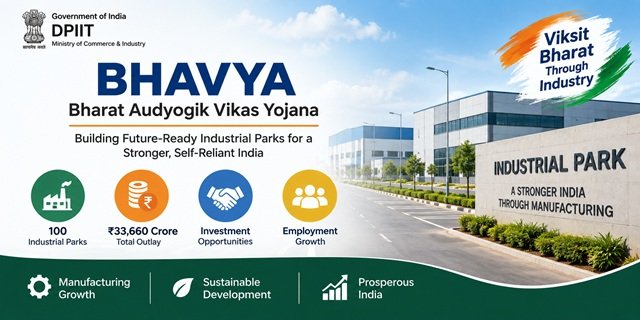
BHAVYA (Bharat Audyogik Vikas Yojana) is a flagship industrial infrastructure scheme of the Department for Promotion of Industry and Internal Trade (DPIIT), Ministry of Commerce & Industry. The scheme aims to develop 100 world-class, plug-and-play industrial parks across India with a total outlay of Rs. 33,660 crore, helping states create investment-ready manufacturing ecosystems and attract large-scale industrial investments.
BHAVYA Scheme Highlights | |
|---|---|
| Scheme Name | Bharat Audyogik Vikas Yojana (BHAVYA) |
| Cabinet Approval Date | 18 March 2026 |
| Notification Date | 10 April 2026 |
| Nodal Ministry | Ministry of Commerce & Industry |
| Nodal Department | Department for Promotion of Industry and Internal Trade (DPIIT) |
| Project Management Agency | National Industrial Corridor Development Corporation (NICDC) |
| Objective | Development of investment-ready, plug-and-play industrial parks across India |
| Total Scheme Outlay | Rs. 33,660 crore |
| Implementation Period | FY 2026-27 to FY 2031-32 (6 Years) |
| Total Target | 100 Industrial Parks |
| Phase-I Target | Up to 50 Industrial Parks |
| Selection Process | Challenge-based competitive evaluation |
| Eligible Applicants | State Governments, UT Administrations, CPSEs, and eligible private developers |
| Minimum Land Requirement | 100 acres (25 acres for eligible hilly, North-Eastern, and smaller States/UTs) |
| Land Readiness Condition | Minimum 90% encumbrance-free land possession at proposal stage |
| Implementation Model | Special Purpose Vehicle (SPV) under the Companies Act, 2013 |
| Central Assistance (Standard Projects) | Up to Rs. 1 crore per acre |
| Central Assistance (Private Developer Projects) | Up to Rs. 50 lakh per acre or 50% of eligible infrastructure cost, whichever is lower |
| Fund Release Pattern | Three milestone-based tranches (40% : 40% : 20%) |
| Key Infrastructure Supported | Roads, utilities, power, water, drainage, CETP, warehousing, worker facilities, R&D and common infrastructure |
| Anchor Investor Provision | Eligible anchor investors may self-allot up to 25% of developed land, subject to scheme conditions |
| Related Initiative | BHAVYA-Rasayan for development of Chemical Parks |
| Official Website | dpiit.gov.in |
Introduction of BHAVYA Scheme: A Brief Insight
Setting up a manufacturing unit in India often involves more than just investing in machinery. Businesses usually spend months dealing with land availability, utility connections, approvals, and basic infrastructure before production can even begin. To address these challenges and create ready-to-use industrial ecosystems, the Union Cabinet approved the Bharat Audyogik Vikas Yojana (BHAVYA) on 18 March 2026, with the scheme officially notified on 10 April 2026.
The scheme is being implemented by the Department for Promotion of Industry and Internal Trade (DPIIT), Ministry of Commerce & Industry. The National Industrial Corridor Development Corporation (NICDC) serves as the Project Management Agency responsible for appraisal, monitoring, and implementation support.
The primary objective of BHAVYA is to develop 100 investment-ready, plug-and-play industrial parks across the country. Instead of industries spending years creating roads, utility networks, and common infrastructure, the scheme focuses on building these facilities in advance so that manufacturers can start operations much faster after receiving land allotment.
Under the scheme, State Governments, Union Territories, and Central Public Sector Enterprises (CPSEs) can propose industrial parks on eligible land parcels. In most states, a minimum of 100 acres of land is required, while eligible hilly states, North-Eastern states, and certain smaller states or Union Territories can propose parks with a minimum of 25 acres.
Approved projects can receive Central Government support of up to Rs. 1 crore per acre through a Special Purpose Vehicle (SPV) structure. The scheme has a total outlay of Rs. 33,660 crore and will be implemented over a period of six years. During the first phase, up to 50 industrial parks are proposed to be selected through a competitive challenge-based process.
BHAVYA also allows participation from private developers. Eligible developers can join projects as co-developers, partners, or anchor investors and may self-allot a portion of the developed land, subject to the conditions laid down in the scheme guidelines and investment commitments.
Unlike most government schemes that are designed for individual beneficiaries, BHAVYA is a project-based initiative. Applications are submitted by State Governments, CPSEs, or eligible project developers through the official BHAVYA Portal whenever proposal windows are announced by the Government of India.
For detailed guidelines, notifications, and implementation updates, applicants can visit dpiit.gov.in or contact their respective State Industries & Commerce Department.
Manufacturers and businesses looking for financing support to set up their own unit can explore the Prime Minister’s Employment Generation Programme (PMEGP), a credit-linked subsidy scheme for new micro-enterprises, and the Pradhan Mantri Mudra Yojana (PMMY), offering collateral-free loans for small businesses, both useful once a plot is secured in a BHAVYA-developed park.
State Governments, manufacturers, and anyone looking for more industrial, infrastructure, and business schemes available under the Central Government can explore all available programmes on our Central Government Welfare Schemes page.
Benefits Provided to Eligible Beneficiaries
The BHAVYA Scheme has been designed to support the development of world-class industrial parks across India. Through financial assistance, infrastructure support, and institutional facilitation, the scheme aims to create investment-ready manufacturing ecosystems that can attract industries, generate employment, and strengthen industrial growth.
Financial Support for Approved Projects
- Financial assistance of up to Rs. 1 crore per acre for eligible projects sponsored by State Governments, UT Administrations, or CPSEs
- For projects involving private developers, support of up to Rs. 50 lakh per acre or 50% of eligible infrastructure cost, whichever is lower
- Government support is provided as equity participation through the designated project structure
- A portion of the approved assistance may also be used for last-mile and external connectivity infrastructure
Release of Government Funding
Approved assistance is released in phases based on project progress and achievement of prescribed milestones.
| Funding Tranche | Share of Approved Assistance | Indicative Milestone |
|---|---|---|
| First Tranche | 40% | Project approval, land availability, utility allocation, and key statutory clearances |
| Second Tranche | 40% | Substantial utilisation of the first tranche and commencement of industrial allotments |
| Final Tranche | 20% | Completion of major infrastructure works and fulfilment of final project conditions |
Infrastructure That Can Be Developed
- Internal roads and transport infrastructure
- Power distribution networks and utility corridors
- Water supply systems and drainage networks
- Common Effluent Treatment Plants (CETP)
- Water Treatment Plants (WTP) and Sewage Treatment Plants (STP)
- Solid waste management facilities
- Street lighting and security infrastructure
- Warehousing and logistics facilities
- Research, testing, and innovation centres
- Renewable energy and sustainable infrastructure
- Worker housing and social infrastructure
- Skill development and common facility centres
- External connectivity such as access roads, power lines, gas pipelines, and water supply networks
Key Advantages for Industry and Investors
- Creation of ready-to-use industrial parks with modern infrastructure
- Faster establishment of manufacturing and industrial units
- Improved ease of doing business through streamlined approval mechanisms
- Enhanced opportunities for domestic and foreign investment
- Generation of large-scale direct and indirect employment
- Development of integrated industrial ecosystems with supplier and vendor networks
- Better connectivity with national and global supply chains
Expenditure Not Covered Under the Scheme
- Land acquisition costs
- Land purchase expenses
- Pre-operative and preliminary project expenses
- Royalty and commissioning charges
- Capitalised interest expenses
- Purchase of vehicles and transportation equipment
- Working capital requirements
Eligibility Conditions Required to be Fulfilled
The Department for Promotion of Industry and Internal Trade (DPIIT), Ministry of Commerce and Industry, has laid down specific eligibility criteria for projects seeking support under the BHAVYA Scheme. Since the scheme focuses on the development of world-class industrial parks, applicants must satisfy both land-related and institutional requirements before submitting a proposal.
Eligible Sponsoring Agencies
- State Governments and Union Territory Administrations
- Central Public Sector Enterprises (CPSEs)
- Special Purpose Vehicles (SPVs) formed for project implementation, including eligible private sector participation as per scheme guidelines
Minimum Land Requirement
- For most states, the proposed industrial park must have at least 100 acres of land
- Up to two non-contiguous land parcels may be considered, provided the distance between them does not exceed 2 kilometres
- For hilly states, North-Eastern states, Goa, and certain smaller Union Territories and states with a population below 1 crore, the minimum requirement is 25 acres
- The scheme also allows a limited number of large industrial parks ranging from 500 to 1,000 acres
- At least 90% of the proposed land must be encumbrance-free and available with the sponsoring agency at the time of application
Land Ownership Conditions
- The identified land must be transferred to the project SPV after approval of the proposal
- Such land contribution is treated as the sponsoring agency’s equity contribution in the SPV
- The transfer process must generally be completed within the timeline prescribed under the scheme guidelines
Additional Eligibility for Private Sector Participation
- The entity must be registered in India under the Companies Act, 2013
- A positive net worth of at least 15% of the total project cost is required
- The applicant should have prior experience in developing large industrial, logistics, infrastructure, SEZ, or similar projects
- The entity must not have been blacklisted or debarred by any Central or State Government authority during the prescribed period
Projects That May Not Qualify
- Proposals that do not meet the minimum land requirement
- Projects where the sponsoring agency cannot demonstrate possession of the required encumbrance-free land
- Applicants lacking the prescribed financial strength or technical experience
- Entities facing blacklisting, debarment, or other disqualifying restrictions under government norms
- Projects with unresolved compliance or implementation issues under similar Government-supported industrial park programmes
Documents Required for Project Proposal Submission
BHAVYA is designed for institutional applicants such as State Governments, Union Territory Administrations, Central Public Sector Enterprises (CPSEs), and eligible private developers. Therefore, individual citizens cannot apply under this scheme. Applicants must submit a comprehensive project proposal along with the prescribed supporting documents through the official BHAVYA Portal.
For State Governments, UT Administrations, and CPSEs
- Detailed Project Report (DPR) prepared in the prescribed format
- Land ownership and possession documents showing at least 90% contiguous encumbrance-free land availability
- Recommendation of the State Level Committee (SLC), wherever applicable
- Board approval or competent authority approval in the case of CPSE-sponsored projects
- Status of environmental clearances, or an implementation plan for obtaining the required approvals
- Details regarding availability of essential infrastructure such as power supply and water supply
- Site planning, connectivity assessment, financial projections, and demand analysis included in the DPR
Additional Documents for Private Developer Proposals
- Certificate of Incorporation under the Companies Act, 2013
- Consortium agreement and Lead Member details, where applicable
- Chartered Accountant-certified net worth certificate demonstrating positive net worth of at least 15% of the total project cost
- Documents proving technical experience in developing a minimum of 50 acres under an industrial, logistics, or real estate project completed during the last 10 years
- Self-declaration confirming that the applicant has not been blacklisted or debarred by any Central or State Government authority during the preceding three years
- Power of Attorney authorising the designated representative to act on behalf of the company or consortium
How Beneficiaries Can Apply to Avail the Benefit of the Scheme
BHAVYA is not a scheme for individual citizens. It is meant for State Governments, Union Territories, CPSEs, and eligible private developers who want to develop large industrial parks. The application process is detailed, but if you understand it step by step, it becomes much easier.
Step 1: First, identify suitable land for the proposed industrial park. In most states, the project should have at least 100 acres of land, while eligible hilly states, North-Eastern states, and certain smaller states or UTs can apply with a minimum of 25 acres. At least 90% of the land must be free from legal disputes and encumbrances.
Step 2: The sponsoring agency must obtain the required approvals before applying. State Governments need approval from the State Level Committee (SLC), while CPSEs must secure approval from their respective Board.
Step 3: Prepare a detailed project proposal, commonly known as a Detailed Project Report (DPR). This document should clearly explain the project location, connectivity, infrastructure plan, estimated cost, funding requirements, investment potential, and expected employment generation.
Step 4: If a private developer is involved in the project, ensure that the developer satisfies all eligibility conditions, including minimum net worth requirements and prior experience in developing large industrial or infrastructure projects.
Step 5: Submit the complete proposal along with all supporting documents through the official BHAVYA Portal whenever the application window is opened by the Government of India.
Step 6: After submission, the proposal is examined by the concerned authorities. Various factors such as land readiness, infrastructure planning, connectivity, ease of doing business measures, and overall project viability are assessed under a competitive evaluation process.
Step 7: The proposal is then reviewed by the National Industrial Corridor Development Corporation (NICDC), which acts as the Project Management Agency. Based on its assessment, the proposal is placed before the National Level Steering Committee (NLSC) for final approval.
Step 8: Once approval is granted, a Special Purpose Vehicle (SPV) must be established or designated to implement and manage the project.
Step 9: The approved land must be transferred to the SPV within the prescribed timeline. This step is important because government funding cannot be released until the land transfer requirements are fulfilled.
Step 10: After meeting all approval conditions, financial assistance is released in phases. Funds are provided in three instalments linked to project milestones such as land transfer, infrastructure development, environmental clearances, and allotment of plots to manufacturing units.
Step 11: The SPV develops the industrial park by creating roads, utility networks, water supply systems, power infrastructure, common facilities, and other approved components. Once development is completed, plots can be allotted to industries and investors.
Step 12: Manufacturing companies and investors can then establish their units within the developed industrial park and benefit from ready-to-use infrastructure and improved connectivity.
Important: Individual entrepreneurs, shop owners, or small businesses cannot directly apply under BHAVYA. Their opportunity comes after an approved industrial park becomes operational, when plots, sheds, or industrial spaces are offered by the SPV for industrial investment and manufacturing activities.
Important Links Available of the Scheme
- BHAVYA Scheme Official Operational Guidelines (PDF)
- BHAVYA Scheme Official DPIIT Page
- Cabinet Approval Official PIB Release
- BHAVYA Operational Guidelines Release PIB
- Department for Promotion of Industry and Internal Trade (DPIIT) Official Portal
Contact Details in Case of Help Needed
- Nodal Department: Department for Promotion of Industry and Internal Trade (DPIIT), Ministry of Commerce & Industry
- Project Management Agency: National Industrial Corridor Development Corporation (NICDC)
- State-Level Contact: Your State Level Committee (SLC), chaired by the Chief Secretary, for state-sponsored proposals
Frequently Asked Questions (FAQs)
Q. What is the BHAVYA Scheme?
Ans. BHAVYA (Bharat Audyogik Vikas Yojana) is a Central Sector Scheme launched by the Department for Promotion of Industry and Internal Trade (DPIIT) to support the development of investment-ready industrial parks across India. The scheme aims to create 100 plug-and-play industrial parks and strengthen manufacturing infrastructure throughout the country.
Q. Who can apply under the BHAVYA Scheme?
Ans. Applications can be submitted by State Governments, Union Territory Administrations, Central Public Sector Enterprises (CPSEs), and eligible private developers participating in accordance with the scheme guidelines.
Q. Can individual citizens apply for benefits under BHAVYA?
Ans. No. BHAVYA is not an individual beneficiary scheme. It is meant for the development of large industrial parks and infrastructure projects. Individual citizens cannot apply directly.
Q. Can small businesses or manufacturers apply directly on the BHAVYA Portal?
Ans. No. Manufacturers, MSMEs, and private businesses cannot apply for plots through the central BHAVYA Portal. They can apply for land or industrial space only after an approved industrial park becomes operational and starts allotting plots.
Q. What is the minimum land requirement for a BHAVYA project?
Ans. In most states, the project should have at least 100 acres of contiguous land. For eligible hilly states, North-Eastern states, and certain smaller states or Union Territories, the minimum requirement is 25 acres.
Q. How much government support is available under the scheme?
Ans. Approved projects can receive financial assistance of up to Rs. 1 crore per acre for eligible projects. For private developer-led projects, assistance may be available up to Rs. 50 lakh per acre or 50% of eligible infrastructure cost, whichever is lower, subject to scheme conditions.
Q. What is a plug-and-play industrial park?
Ans. A plug-and-play industrial park is a fully developed industrial area where essential infrastructure such as roads, power supply, water supply, drainage systems, and common facilities are already available, allowing industries to start operations more quickly.
Q. What is an SPV under BHAVYA?
Ans. SPV stands for Special Purpose Vehicle. It is the entity responsible for implementing, managing, and operating the approved industrial park. The SPV also handles infrastructure development and plot allotment activities.
Q. How is funding released under BHAVYA?
Ans. Government assistance is generally released in three stages following a 40:40:20 structure. Each tranche is linked to specific project milestones such as land transfer, infrastructure progress, and completion requirements.
Q. Can private developers participate in the scheme?
Ans. Yes. Eligible private developers can participate subject to meeting the prescribed financial, technical, and experience requirements mentioned in the scheme guidelines.
Q. Is BHAVYA the same as PM MITRA or the National Industrial Corridor Development Programme (NICDP)?
Ans. No. BHAVYA is a separate scheme. However, it draws upon the experience gained from industrial infrastructure initiatives such as NICDP. Each scheme has its own objectives, eligibility conditions, and implementation framework.
Q. What types of infrastructure can be developed under BHAVYA?
Ans. The scheme supports infrastructure such as internal roads, water supply systems, power infrastructure, drainage networks, common facilities, warehousing, testing centres, worker amenities, skill development centres, and other approved industrial infrastructure components.
Q. How can industries get plots in a BHAVYA-funded industrial park?
Ans. Once an approved industrial park is developed and becomes operational, industries and investors can apply for plot allotment through the SPV or park management authority responsible for that specific industrial park.
Q. Where can I find official information about BHAVYA?
Ans. The latest guidelines, notifications, and implementation details can be accessed through the official DPIIT portal. Interested agencies may also contact their respective State Industries Department for proposal-related assistance and guidance.

Tabassum is a government schemes researcher and writer with 5 years of experience tracking Central and State welfare scheme programmes across India. She has covered 500+ schemes spanning agriculture, women welfare, education, and housing, helping lakhs of beneficiaries understand their entitlements in simple language.