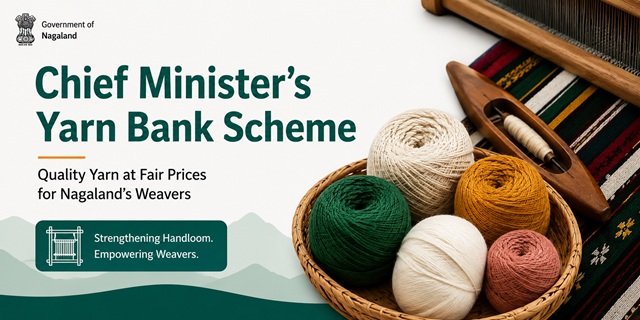
The Chief Minister’s Yarn Bank Scheme is a Nagaland Government initiative launched to make quality yarn available to handloom weavers at affordable rates. Under the scheme, eligible weavers can procure cotton, eri silk, muga silk, bamboo fibre, and other natural fibre blends directly from the Yarn Bank at mill-gate prices along with an additional 15 per cent State Government subsidy. The scheme was launched by Chief Minister Dr Neiphiu Rio on 7 August 2026 during the 12th National Handloom Day celebration and is implemented by the Department of Industries and Commerce, Government of Nagaland.
Nagaland Chief Minister’s Yarn Bank Scheme Highlights | |
|---|---|
| Scheme Name | Chief Minister’s Yarn Bank Scheme |
| Launched By | Chief Minister Dr Neiphiu Rio |
| Launch Date | 7 August 2026 |
| Implementing Department | Department of Industries and Commerce, Government of Nagaland |
| Objective | Provide affordable natural yarn to handloom weavers and strengthen the handloom sector |
| Yarn Bank Location | District Industries Centre, State Industrial Park, Toluvi, Dimapur |
| Yarn Available | Cotton, Eri Silk, Muga Silk, Bamboo Fibre, and other natural fibre blends |
| State Subsidy | 15% subsidy over and above the mill-gate price |
| Expected Beneficiaries | 5,000 to 10,000 weavers annually |
| Eligible Beneficiaries | Individual handloom weavers, cooperative societies, and weaver groups |
| Minimum Age | 18 Years |
| Mandatory Document | Valid Yarn Pass Book |
| Cooperative Society Requirement | Minimum 10 active weaver members |
| Mode of Application | Through Yarn Pass Book (detailed guidelines awaited) |
Introduction of Nagaland Chief Minister’s Yarn Bank Scheme: A Brief Insight
The Chief Minister’s Yarn Bank Scheme is a new Nagaland Government initiative that gives handloom weavers direct access to quality natural yarn at affordable prices. Chief Minister Dr Neiphiu Rio virtually inaugurated the scheme on 7 August 2026 from Kohima during the celebration of the 12th National Handloom Day, with Deputy Chief Minister T.R. Zeliang and Advisor for Industries and Commerce Hekani Jakhalu also participating in the launch programme.
The scheme addresses a long-standing challenge faced by weavers across Nagaland. For years, many handloom artisans have had to travel considerable distances to procure yarn, bear high transportation costs, and depend on middlemen who often sold raw materials at inflated prices. These factors increased production costs and reduced the income earned by weavers. The Chief Minister’s Yarn Bank Scheme seeks to solve this problem by creating a reliable supply system that provides yarn at fair prices while helping preserve Nagaland’s rich handloom traditions.
The Department of Industries and Commerce, Government of Nagaland is implementing the scheme through the District Industries Centre network. The main Yarn Bank facility has been established at the State Industrial Park, Toluvi, Dimapur, making it easier for weavers across the state to access raw materials through a dedicated distribution centre.
Under the scheme, eligible beneficiaries can procure cotton yarn, eri silk yarn, muga silk yarn, bamboo fibre, and other natural fibre blends at mill-gate prices. To make the yarn even more affordable, the Nagaland Government provides an additional 15 per cent subsidy over the mill-gate price. The initiative is expected to benefit between 5,000 and 10,000 weavers every year. To ensure transparency and accountability, the department has also introduced a real-time digital dashboard for inventory and subsidy monitoring, supported by a toll-free helpline, district-level monitoring committees, and periodic third-party audits.
To avail the benefits, an individual applicant must be a resident of Nagaland, be at least 18 years of age, and possess a valid Yarn Pass Book. Registered handloom cooperative societies and weaver groups can also participate, provided they have at least 10 active weaver members.
Since the scheme was launched only on 7 August 2026, the Department of Industries and Commerce has not yet released detailed guidelines regarding the issuance of new Yarn Pass Books. Therefore, first-time applicants should keep track of future announcements issued by the department. Weavers who already possess a valid Yarn Pass Book can procure yarn directly from the Yarn Bank at Toluvi, Dimapur. For assistance, beneficiaries may contact their nearest District Industries Centre or the Department of Industries and Commerce.
Weavers looking for additional support may also explore the National Handloom Development Programme, which supports various handloom sector initiatives across the country, and the PM Vishwakarma Yojana, which provides skill training, toolkit incentives, and financial assistance to traditional artisans, including weavers.
Weavers benefiting from the Chief Minister’s Yarn Bank Scheme may also explore other welfare initiatives launched by the Nagaland Government for artisans, entrepreneurs, farmers, women, and youth. Readers looking for similar programmes can browse our List of All Nagaland Government Welfare Schemes, where we regularly cover the latest state government schemes, subsidies, financial assistance programmes, and livelihood support initiatives available to Nagaland residents.
Benefits Provided to Eligible Beneficiaries
The CM Yarn Bank Scheme helps handloom weavers in Nagaland access quality yarn at affordable rates. Through subsidised procurement and a structured distribution system, the scheme aims to reduce production costs and strengthen the handloom sector across the state.
Financial Benefits
- Natural yarn available at mill-gate prices
- Additional 15% subsidy provided by the Nagaland Government
- Reduced transportation and procurement costs for weavers
- Expected to benefit 5,000 to 10,000 weavers annually
Yarn Varieties Available
- Cotton Yarn
- Eri Silk Yarn
- Muga Silk Yarn
- Bamboo Fibre and Other Natural Fibre Blends
Other Benefits
- Fair and transparent yarn distribution system
- Real-time monitoring of inventory and subsidy distribution
- Toll-free helpline and district-level monitoring support
- Supports women weavers and promotes traditional Naga textiles
- Helps preserve and strengthen Nagaland’s handloom heritage
Eligibility Conditions Required to be Fulfilled
The CM Yarn Bank Scheme is intended to support handloom weavers across Nagaland by providing yarn at subsidised rates. Individual weavers as well as registered cooperative societies and weaver groups must satisfy the following eligibility conditions to avail benefits under the scheme.
Who Can Apply as an Individual Weaver
- Must be a resident of Nagaland
- Must be an active handloom weaver
- Must be 18 years of age or above
- Must possess a valid Yarn Pass Book
Who Can Apply as a Cooperative Society or Weaver Group
- Must be a registered handloom cooperative society or weaver group
- Must have at least 10 active weaver members
Documents Required to be Attached
Applicants applying under the CM Yarn Bank Scheme must keep the required documents ready before visiting the Yarn Bank or submitting their details to the concerned authority. Individual weavers, cooperative societies, and weaver groups may be asked to produce the following documents for verification and availing subsidised yarn benefits under the scheme.
- Valid Yarn Pass Book
- Aadhaar Card, Voter ID Card, or any other valid identity proof
- Residence Proof of Nagaland
- Bank Account Details
- Registration Certificate of the Cooperative Society or Weaver Group (if applicable)
- List of Active Weaver Members (for Cooperative Societies and Weaver Groups)
- Bank Account Details of the Registered Society or Weaver Group (if applicable)
How Beneficiaries Can Apply to Avail the Benefit of this Scheme
Eligible handloom weavers can avail subsidised yarn under the CM Yarn Bank Scheme through the Yarn Bank established by the Government of Nagaland. Individual weavers must possess a valid Yarn Pass Book, while eligible cooperative societies and weaver groups can procure yarn on behalf of their members.
Since the scheme was launched on 7 August 2026, detailed guidelines regarding the issuance of new Yarn Pass Books may be released separately by the Department of Industries and Commerce.
- Obtain a valid Yarn Pass Book, which is required to procure yarn under the CM Yarn Bank Scheme.
- Visit the CM Yarn Bank located at the District Industries Centre, State Industrial Park, Toluvi, Dimapur.
- Choose the required yarn variety, such as cotton yarn, eri silk yarn, muga silk yarn, bamboo fibre, or other natural fibre blends available at the Yarn Bank.
- Present the Yarn Pass Book and complete the procurement formalities prescribed by the concerned authority.
- Pay the subsidised price after adjustment of the 15% state government subsidy.
- Collect the required quantity of yarn, subject to stock availability and scheme guidelines.
- Registered cooperative societies and weaver groups with at least 10 active members may also procure yarn for distribution among their eligible members.
- For assistance regarding eligibility, Yarn Pass Books, yarn availability, or procurement procedures, contact the nearest District Industries Centre or the Department of Industries and Commerce, Government of Nagaland.
Important Links Available for CM Yarn Bank Scheme
- Akashvani News Report on CM Yarn Bank Scheme Launch
- Directorate of Information and Public Relations, Government of Nagaland
- Department of Industries and Commerce, Nagaland – Textile Sector Information
Contact Details in Case of Help Needed
Handloom weavers, cooperative societies, and weaver groups seeking assistance regarding the CM Yarn Bank Scheme may contact the concerned authorities through the following channels.
- District Industries Centre, State Industrial Park, Toluvi, Dimapur
- Department of Industries and Commerce, Government of Nagaland
- Nearest District Industries Centre for local assistance and guidance
Frequently Asked Questions (FAQs)
Q. What is the CM Yarn Bank Scheme?
Ans. It is a Nagaland Government initiative that supplies handloom weavers with natural yarn at mill-gate prices along with an additional 15 per cent state subsidy through a centralised Yarn Bank facility at Toluvi, Dimapur.
Q. When was the CM Yarn Bank Scheme launched?
Ans. Chief Minister Dr Neiphiu Rio virtually inaugurated the scheme on 7 August 2026 during the celebration of the 12th National Handloom Day.
Q. Where is the Yarn Bank located?
Ans. The Yarn Bank operates from the District Industries Centre at the State Industrial Park, Toluvi, Dimapur.
Q. How much subsidy does the government provide under the CM Yarn Bank Scheme?
Ans. The Nagaland Government provides an additional 15 per cent subsidy over and above the mill-gate price of the yarn.
Q. Which types of yarn are available through the Yarn Bank?
Ans. Cotton yarn, eri silk yarn, muga silk yarn, bamboo fibre, and other natural fibre blends are available under the scheme.
Q. Who can avail the benefits of the CM Yarn Bank Scheme?
Ans. Individual handloom weavers aged 18 years or above holding a valid Yarn Pass Book, as well as registered cooperative societies and weaver groups with at least 10 active members, can avail the benefits.
Q. How many weavers are expected to benefit from the scheme?
Ans. The scheme is expected to benefit between 5,000 and 10,000 handloom weavers every year.
Q. Is the Yarn Pass Book application process available now?
Ans. No. The Department of Industries and Commerce has not yet released detailed guidelines for obtaining a new Yarn Pass Book.
Q. Which department implements the CM Yarn Bank Scheme?
Ans. The Department of Industries and Commerce, Government of Nagaland, implements the scheme through the District Industries Centre network.
Q. How does the scheme ensure transparent yarn distribution?
Ans. The Government has announced a real-time digital dashboard for inventory and subsidy tracking, district-level monitoring mechanisms, and periodic reviews to ensure transparent distribution of yarn.

Tabassum is a government schemes researcher and writer with 5 years of experience tracking Central and State welfare scheme programmes across India. She has covered 500+ schemes spanning agriculture, women welfare, education, and housing, helping lakhs of beneficiaries understand their entitlements in simple language.